2.4.1 Market equilibrium and disequilibrium
Definition: Market equilibrium occurs where quantity demanded equals quantity supplied at the equilibrium price; there is no tendency for price to change.
- Disequilibrium: price is above or below equilibrium.
- Price above equilibrium: quantity supplied exceeds quantity demanded, giving excess supply (surplus). Producers cut price, quantity demanded extends and quantity supplied contracts until equilibrium is restored.
- Price below equilibrium: quantity demanded exceeds quantity supplied, giving excess demand (shortage). Price rises, quantity supplied extends and quantity demanded contracts until equilibrium.
Example: Potato market: at 20p/kg demand is 700 (000 tonnes) but supply is 100, a shortage of 600; at 100p/kg supply is 700 but demand only 100, a surplus of 600. The equilibrium lies between.
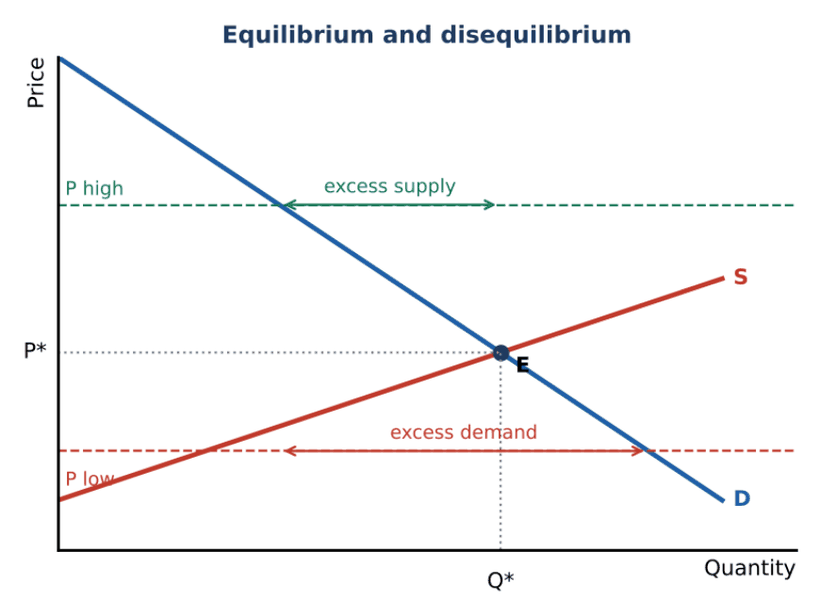
Figure: Market disequilibrium: excess supply and excess demand
Example: When onion prices rose sharply, the government released stocks and banned exports to remove the excess demand in domestic markets.
Analysis chain (AO2): Price above equilibrium → excess supply → unsold stock → firms cut prices → quantity demanded extends and quantity supplied contracts until the market clears; price below equilibrium → excess demand → shortages → prices are bid up.
🔒 Also in the full notes
- 2.4.2 Effects of shifts in demand and supply on equilibrium price and quantity
- 2.4.3 Relationships between different markets
- 2.4.4 Functions of price in resource allocation
- Exam practice: 6 practice questions
- 2 exemplar answers with full model answers and mark breakdowns