Impact versus incidence. The impact of a tax is on the person who pays it to the government in the first instance (usually the producer). The incidence is on the person who finally bears the burden. For example, an excise duty on sugar is paid first by sugar manufacturers (impact) but may be passed on to consumers (incidence).
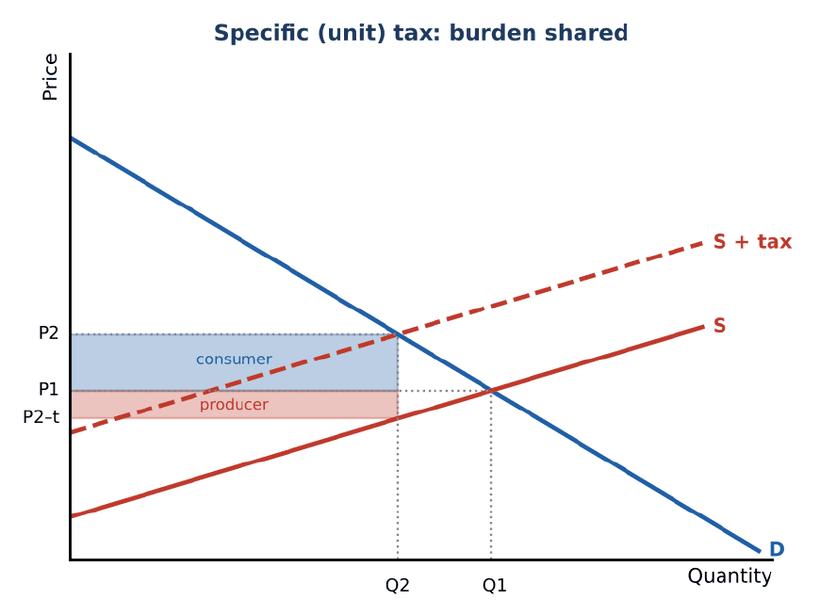
- Consumer burden = (P2 – P1) × Q2. Producer burden = (P1 – (P2 – tax)) × Q2. Tax revenue = tax per unit × Q2 = consumer burden + producer burden.
- A deadweight loss arises because the tax reduces quantity below the efficient level: consumer and producer surplus fall by more than the government gains.
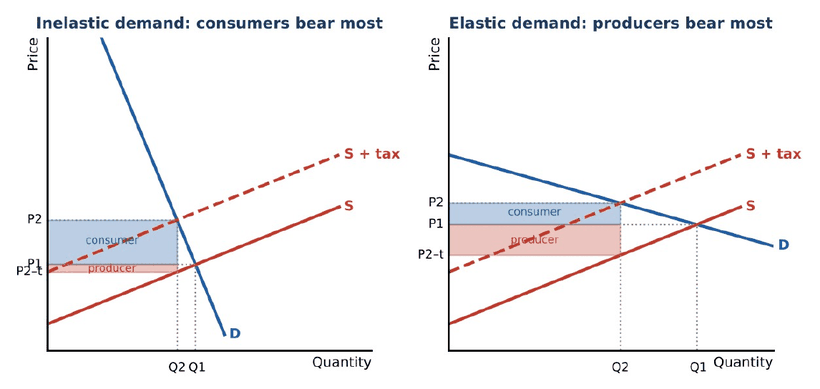
| Situation | Who bears more of the tax? | Effect on quantity |
|---|---|---|
| Inelastic demand (cigarettes, alcohol, petrol) | Consumers (price rises by nearly the full tax) | Small fall in quantity; large tax revenue |
| Elastic demand | Producers (they cannot raise price without losing sales) | Large fall in quantity; smaller revenue |
| Inelastic supply | Producers | Small fall in quantity |
| Elastic supply | Consumers | Large fall in quantity |
Evaluation. Specific taxes raise revenue and can reduce demerit goods and negative externalities. Weaknesses: regressive (low-income households pay a larger share of income), little effect on consumption if demand is inelastic, may lead to smuggling and black markets, and effects depend on elasticity. A specific tax does not change with inflation, so its real value falls over time (an ad valorem tax, a percentage of price, is covered at A Level).
Reasons for taxation include: raising revenue; discouraging demerit goods; reducing income inequality (progressive taxes); funding public and merit goods and transfer payments; managing aggregate demand
and controlling inflation; correcting market failure and negative externalities; protecting domestic firms through tariffs; and correcting a current account deficit.
- Exam tip (official mark scheme): answers that discuss only advantages or only disadvantages of an indirect tax are capped — always cover both sides.
- 3.2.2 Impact and incidence of subsidies
- 3.2.3 Direct provision of goods and services
- 3.2.4 Maximum and minimum prices
- 3.2.5 Buffer stock schemes
- 3.2.6 Provision of information
- Exam practice: 8 practice questions
- 3 exemplar answers with full model answers and mark breakdowns