Using less energy, using it more efficiently and developing new sources all help to conserve finite resources and cut emissions. This topic covers eight management strategies, four new energy technologies, and how to weigh up their benefits and limitations.
The simplest way to conserve energy is to use less: switching off lights and devices, setting air conditioners a few degrees higher, walking or cycling short distances, and drying clothes outside instead of in a tumble dryer.
Insulation reduces heat transfer through walls, roofs, floors and windows, so buildings stay warm in winter and cool in summer with less heating or air conditioning. Examples include loft insulation, cavity wall insulation, double glazing, draught excluders, and in hot climates reflective white roofs and shading.
Examples include LED bulbs, which use far less electricity than old filament bulbs; appliances with high energy-efficiency ratings; and vehicles with efficient engines or hybrid systems.
Electrically propelled vehicles (electric cars, buses, scooters and trains) produce no exhaust emissions where they are used. Their overall environmental benefit depends on how the electricity that charges them is generated.
Getting more from resources already in use, for example by upgrading old power stations to be more efficient, reducing losses in transmission lines, using waste heat from power stations to heat nearby buildings (combined heat and power), and recovering more oil from existing wells.
Campaigns, labels and school programmes explain how to save energy and why it matters. Education is most effective when it shows people that saving energy also saves money.
Governments can reduce energy use for transport by investing in public transport (metro, buses, railways), building cycle lanes, offering subsidies for electric vehicles, charging tolls for driving into city centres (congestion charging), and setting fuel-efficiency standards for new vehicles.
Solar and wind power vary with the weather and time of day. Large batteries store surplus electricity when generation is high and release it when demand is high or generation falls, for example in the evening. This lets more renewable energy be used and makes supply more reliable.
Research and investment in new technologies, such as hydrogen fuel and heat pumps, gives more options for low-carbon energy. These are covered in 1.5.2.
Hydrogen can be burned or used in a fuel cell to produce energy, and the only waste product is water. However, hydrogen is not found on its own in nature, so it must be produced, and how it is made decides how clean it is.
| Type | How it is produced | Key point |
|---|---|---|
| Blue hydrogen | From natural gas (methane); the carbon dioxide released is captured and stored underground | Uses a fossil fuel; emissions are reduced but not removed, and some carbon dioxide escapes capture |
| Green hydrogen | By electrolysis of water (splitting water into hydrogen and oxygen) using electricity from renewable resources such as solar or wind | Almost no emissions; currently more expensive; needs large amounts of renewable electricity and water |
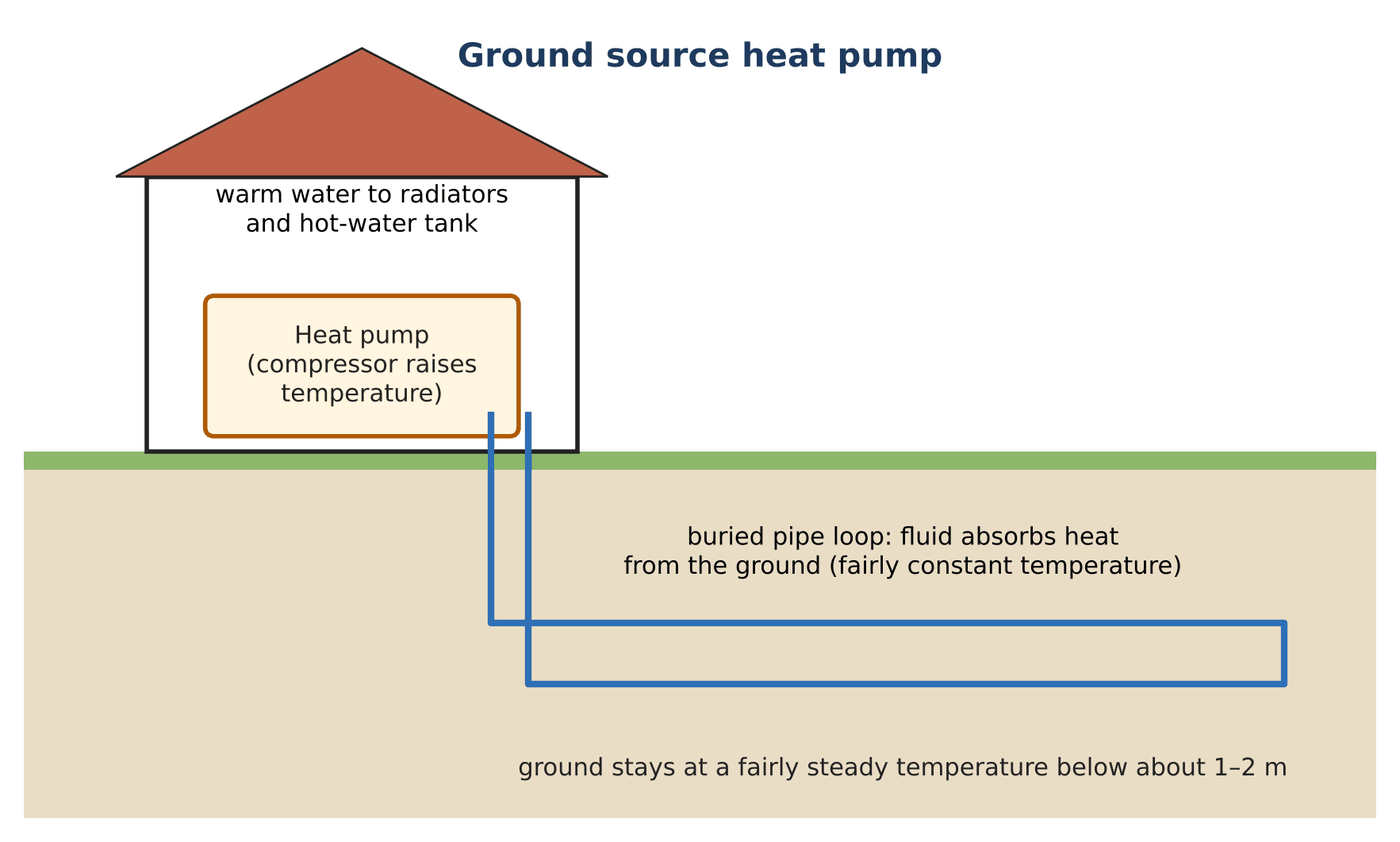
A heat pump moves heat from a cold place to a warmer place, like a refrigerator working in reverse. It uses electricity to run a compressor, but delivers several times more heat energy than the electrical energy it uses.
| Type | How it works | Comparison |
|---|---|---|
| Ground source heat pump | Pipes buried in the ground carry a fluid that absorbs heat from the soil, which stays at a fairly constant temperature all year. The heat pump raises the temperature and transfers it to the building. | More efficient in cold weather; expensive to install because it needs digging or drilling and outdoor space |
| Air source heat pump | A unit outside the building absorbs heat from the outside air, even when the air is cold, and transfers it inside. | Cheaper and easier to install; less efficient in very cold weather; the outdoor fan can be noisy |
| Strategy | Benefits | Limitations |
|---|---|---|
| Reducing consumption | No cost; saves money immediately | Depends on people changing their habits; easy to forget |
| Insulation | Lower bills; more comfortable homes; long-lasting | High initial cost; difficult to fit in some older buildings |
| Energy-efficient devices and electric vehicles | Use less energy; lower running costs; no exhaust emissions from electric vehicles | Higher purchase price; electric vehicles need charging points and clean electricity |
| Exploiting existing resources | Uses existing infrastructure; quicker than building new | Still often relies on fossil fuels; upgrades can be expensive |
| Education | Cheap; can reach many people | Behaviour change is slow and not guaranteed |
| Transport policies | Reduce congestion, air pollution and fuel use | Expensive to build public transport; congestion charges can be unpopular |
| Battery storage | Makes renewables more reliable; reduces wasted electricity | Expensive; batteries need finite metals such as lithium; limited storage time |
| Blue hydrogen | Lower emissions than burning natural gas directly; uses existing gas supplies | Still uses a finite fossil fuel; carbon capture is costly and not complete |
| Green hydrogen | Near-zero emissions; can store surplus renewable electricity | Expensive; energy lost in electrolysis; hydrogen is hard to store and transport |
| Heat pumps | Very efficient; low emissions if electricity is renewable | High installation cost; need well-insulated homes to work well |
Government subsidises insulation → homes lose less heat → less gas burned for heating → lower household bills and lower carbon dioxide emissions → gas supplies last longer
- It depends on cost: strategies with high upfront costs (heat pumps, insulation, electric vehicles) need subsidies to reach low-income households.
- It depends on the electricity source: electric vehicles and heat pumps only cut emissions significantly when the electricity is generated from low-carbon resources.
- It depends on time scale: reducing consumption works immediately, while hydrogen and battery storage are long-term investments.
- No single strategy is enough. A combination of reducing demand, improving efficiency and developing new resources is most effective.
Question: State the difference between blue hydrogen and green hydrogen. [2]
Question: Describe how a ground source heat pump provides heating for a building. [3]
Question: Suggest two ways in which a government could use transport policies to reduce energy consumption. [2]
Question: Explain why battery storage is needed when a country generates a large share of its electricity from solar power. [3]
Question: Suggest why electric vehicles may not reduce carbon dioxide emissions in a country that generates most of its electricity from coal. [2]
Question: Discuss the benefits and limitations of strategies to reduce energy consumption in homes. [6]
Question: Discuss the benefits and limitations of strategies to reduce energy consumption in homes. [6]
Insulating walls and roofs reduces the heat lost from a home in winter, or the heat gained in summer, so less energy is needed for heating or air conditioning. This lowers bills and lasts many years. However, insulation has a high initial cost and can be difficult to fit in older homes.
Replacing old appliances and bulbs with energy-efficient ones, such as LED bulbs and star-rated air conditioners, uses less electricity for the same output. The limitation is that efficient appliances usually cost more to buy, so low-income households may not be able to afford them without subsidies.
Education campaigns can encourage people to switch off devices and set air conditioners at higher temperatures. This is cheap and can reach many people, but behaviour change is slow and people may forget or not care if energy is cheap.
Overall, insulation and efficient appliances give the largest long-term savings, but they need government support such as subsidies, combined with education to change everyday habits.
- Three relevant strategies, each with a benefit and a limitation (AO1).
- Explains how each strategy saves energy (AO1, AO2).
- Considers who can afford each strategy (AO2: applying knowledge to a context).
- Ends with a reasoned judgement (AO3).
- Saying hydrogen is a renewable energy resource. Fix: hydrogen is a fuel that must be produced; green hydrogen uses renewable electricity, blue hydrogen uses natural gas.
- Saying heat pumps "create" heat. Fix: they transfer heat from the ground or air into the building.
- Claiming electric vehicles have "zero emissions" without qualification. Fix: there are no exhaust emissions, but emissions depend on how the electricity is generated.
- Giving the same benefit for every strategy ("saves energy"). Fix: give specific benefits, such as lower bills or more reliable supply.