New in the 2027 syllabus. Fracking has made it possible to extract natural gas and oil trapped in shale, but it is controversial. You need to define it and discuss its benefits and limitations.
Shale is impermeable (see 1.1.4), so gas and oil trapped in its tiny pores cannot flow out by themselves into an ordinary well. Fracking creates new cracks in the shale so the gas or oil can escape and be collected.
The syllabus asks only for the definition, but knowing the process helps you explain its benefits and limitations.
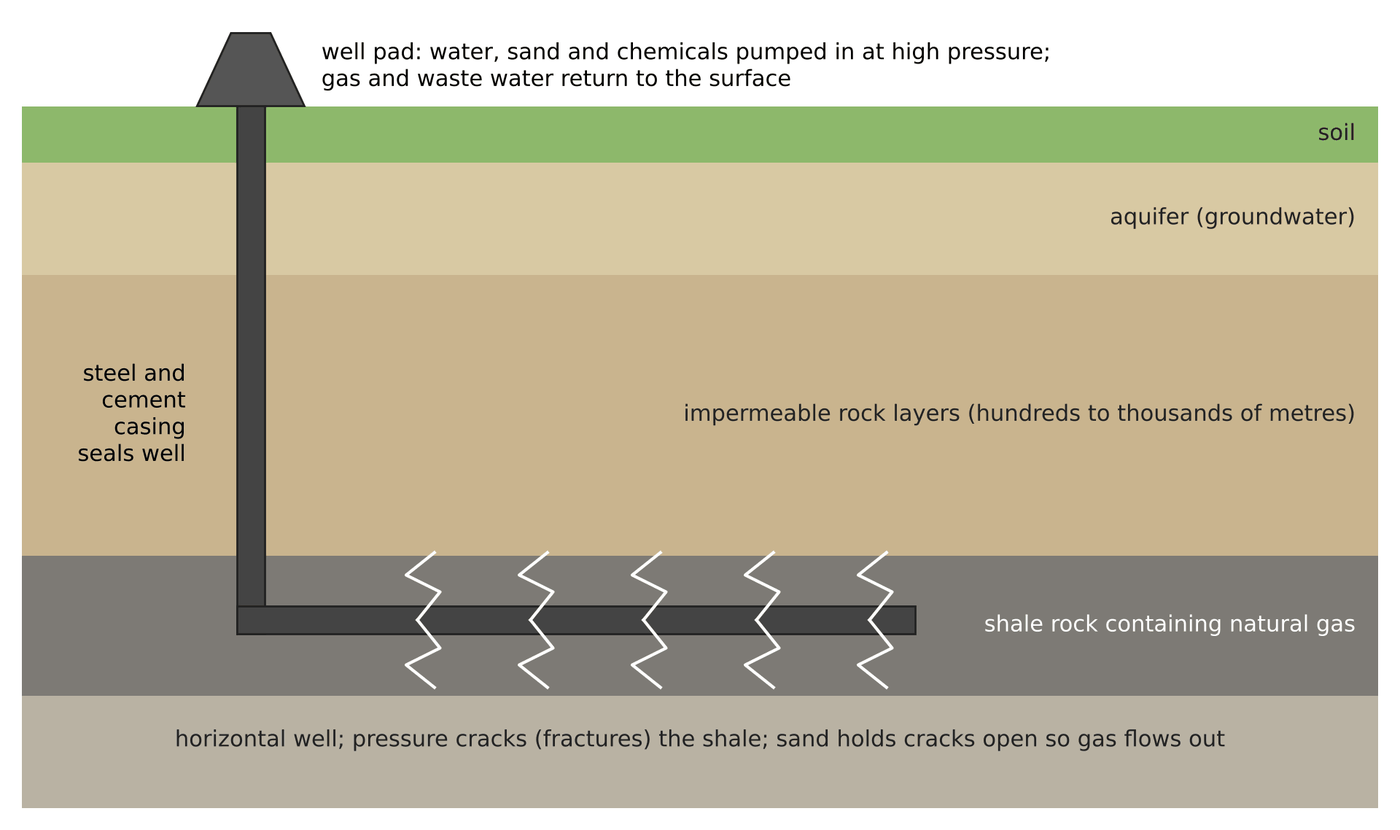
- A well is drilled vertically down, often more than a kilometre, to the shale layer. The well is lined with steel and cement casing to seal it off from rock layers and groundwater above.
- The well turns and is drilled horizontally through the shale, giving a long section of the well in contact with gas-bearing rock.
- A mixture of water, sand and chemicals is pumped into the well at very high pressure. The pressure cracks (fractures) the shale.
- The sand holds the cracks open when the pressure is released. The chemicals help the fluid flow and prevent bacteria growing.
- Gas flows out of the fractures into the well and up to the surface, along with returning waste water (flowback), which must be treated or disposed of safely.
- Energy security: a country can produce its own gas instead of importing it, so it is less affected by supply disruptions and price rises abroad.
- Economic benefits: jobs in drilling, transport and services; tax income for governments; cheaper gas for homes and industry.
- Lower emissions than coal: if natural gas replaces coal in power stations, carbon dioxide emissions per unit of electricity fall, and sulfur dioxide emissions fall sharply.
- Access to large reserves that could not be extracted before, extending the life of gas supplies.
- Water usage: each well needs very large volumes of water, which can compete with farms and towns in dry areas.
- Risk of water contamination: chemicals, waste water or methane could leak into groundwater through faulty well casing or spills at the surface.
- Induced earthquakes: injecting fluid at high pressure, and disposing of waste water underground, can trigger small earthquakes (induced seismicity).
- Greenhouse gases: natural gas is still a fossil fuel. Burning it releases carbon dioxide, and methane, a powerful greenhouse gas, can leak from wells and pipelines.
- Local disturbance: noise, heavy lorry traffic, light pollution and land taken up by well pads.
- It may delay investment in renewable energy by keeping gas cheap.
| Benefits | Limitations |
|---|---|
| Energy security: less reliance on imports | Large water use in each well |
| Jobs, tax income and cheaper gas | Risk of groundwater contamination |
| Lower carbon dioxide emissions than coal | Can trigger small earthquakes |
| Access to reserves that could not be reached before | Still a fossil fuel; methane leaks add to climate change |
| Noise, traffic and land use; may slow the switch to renewables |
In the UK, fracking at Preston New Road in Lancashire triggered a series of small earthquakes, including one of magnitude 2.9 in August 2019. The government then halted fracking in England (a moratorium). Apart from a brief period in 2022, fracking has not restarted.
In India, shale gas exploration has been carried out in areas such as the Cambay basin in Gujarat, but commercial production has not developed, partly because of high water needs and densely populated land.
High-pressure fluid injected into shale → fractures form → gas released → extra domestic supply → less imported gas and greater energy security
Faulty well casing → fracking fluid and methane escape into aquifer → groundwater contaminated → drinking water unsafe for local people and livestock
- It depends on regulation: strict rules on well casing, water treatment and monitoring of seismic activity reduce the risks.
- It depends on what gas replaces: replacing coal reduces emissions; replacing renewables increases them.
- It depends on local conditions: fracking is harder to justify in dry or densely populated areas, or where earthquakes would damage homes.
- It depends on time scale: fracking can give short-term energy security, but in the long term it continues dependence on fossil fuels.
Question: Define the term fracking. [2]
Question: Suggest why natural gas trapped in shale cannot be extracted with a conventional well. [2]
Question: State two economic benefits of fracking for a country. [2]
Question: Explain how fracking could lead to contamination of groundwater. [3]
Question: Suggest why some people believe fracking helps reduce carbon dioxide emissions while others believe it does not. [4]
Question: Discuss the benefits and limitations of fracking. [6]
Question: A country imports most of its natural gas. Its government is considering allowing fracking. Discuss the benefits and limitations of fracking for this country. [6]
Fracking would let the country produce its own natural gas from shale, so it would rely less on imports. This improves energy security, because supply would be less affected by conflicts or price rises in other countries. Fracking would also create jobs and earn tax income, and cheaper gas could lower bills for homes and industry. If the gas replaced coal in power stations, carbon dioxide and sulfur dioxide emissions would fall.
However, fracking uses large volumes of water, which could reduce supplies for farming and drinking. Chemicals or methane could leak into groundwater if a well casing fails, and high-pressure injection can trigger small earthquakes, which could damage buildings. Natural gas is still a fossil fuel, so burning it releases carbon dioxide, and methane leaks add to climate change.
Overall, fracking could help this country in the short term by reducing imports, but only if it is strictly regulated and monitored, and if gas replaces coal rather than delaying investment in renewable energy.
- Uses the context given (a country that imports gas) to explain energy security (AO2).
- Gives economic and environmental benefits with reasons (AO1).
- Covers water use, contamination, earthquakes and emissions as limitations (AO1).
- Reaches a conditional, justified judgement (AO3).
- Defining fracking as "drilling for gas". Fix: include shale and hydraulic fracturing.
- Saying fracking produces renewable energy. Fix: natural gas is a fossil fuel and non-renewable.
- Saying fracking "causes major earthquakes". Fix: it can trigger small, induced earthquakes.
- Writing about the process in detail for a "Discuss" question but giving no benefits or limitations. Fix: the syllabus asks for benefits and limitations; use the process only to explain them.
- Giving a one-sided answer. Fix: always end with a judgement that says what the outcome depends on.