Every country needs energy for homes, transport and industry. This topic explains how fossil fuels formed, how each energy resource generates electricity, the benefits and limitations of each, and why demand for energy changes.
Fossil fuels (coal, petroleum and natural gas) formed from the remains of organisms that lived millions of years ago. They store energy that those organisms originally captured from the Sun by photosynthesis.
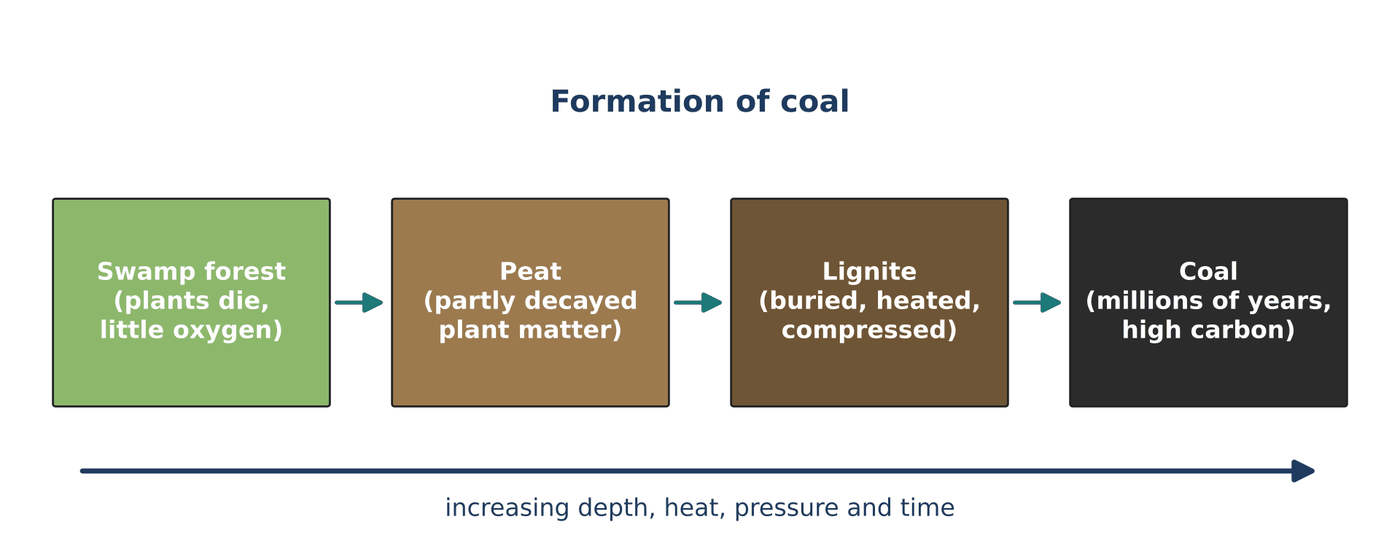
- Large swamp forests grew in warm, wet conditions millions of years ago.
- When plants died they fell into waterlogged ground with little oxygen, so they did not fully decay. The partly decayed material formed peat.
- Layers of sediment buried the peat. Heat and pressure from burial squeezed out water and gases, forming lignite and then coal.
- Over millions of years, the deeper and hotter the burial, the higher the carbon content of the coal.
- Tiny marine organisms (plankton) died and sank to the sea floor, where they were buried by mud in conditions with little oxygen.
- Burial under more layers increased the heat and pressure, slowly changing the remains into petroleum and natural gas.
- Oil and gas are less dense than water, so they moved upwards through permeable rock (such as sandstone).
- They were trapped where an impermeable cap rock (such as shale) stopped them escaping, forming a reservoir that can be drilled.
Plankton die → buried by mud with little oxygen → heat and pressure over millions of years → oil and gas form → rise through permeable rock → trapped beneath impermeable cap rock
A non-renewable (finite) energy resource is used up faster than it is replaced.
| Renewable (non-finite) | Non-renewable (finite) |
|---|---|
| Biofuels: bioethanol, biomass, biogas, wood | Fossil fuels: coal, petroleum (oil), natural gas |
| Geothermal power | Nuclear power using uranium |
| Hydro-electric power (HEP) | |
| Tidal power and wave power | |
| Solar power and wind power |
Wood and biomass are renewable only if they are replaced by new growth at the same rate as they are used. Uranium is non-renewable because it is a metal ore that is mined.
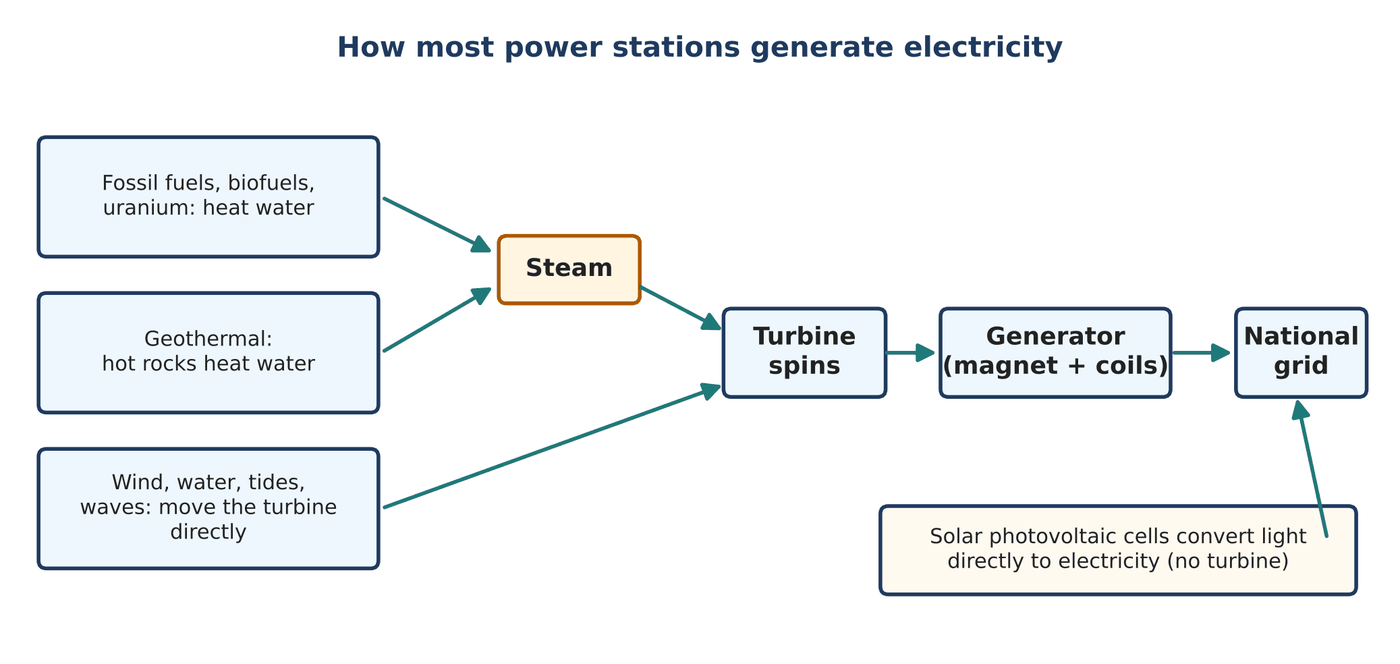
Most power stations work on the same principle: something spins a turbine, and the turbine turns a generator, which produces electricity. The resource determines how the turbine is turned. Solar photovoltaic cells are the main exception.
| Resource | How it generates electricity |
|---|---|
| Fossil fuels (coal, oil, gas) | Fuel is burned to heat water in a boiler; the steam drives a turbine connected to a generator. Gas can also be burned directly in a gas turbine. |
| Nuclear (uranium) | Uranium atoms split in a reactor (nuclear fission), releasing heat; the heat turns water into steam, which drives a turbine and generator. |
| Biomass and wood | Dried plant material, wood chips or pellets are burned in a boiler to heat water; the steam drives a turbine connected to a generator. |
| Biogas | Animal manure, sewage and food waste are broken down by bacteria without oxygen in a digester, producing methane. The methane is burned in an engine or boiler that drives a generator. |
| Bioethanol | Sugar or starch crops (sugar cane, maize) are fermented by yeast to make ethanol. The ethanol is burned, either in a gas turbine or engine that turns a generator directly, or in a boiler to make steam that drives a turbine and generator. It is more often used as a vehicle fuel. |
| Geothermal | Water is pumped down to hot rocks deep underground; the steam that returns drives a turbine and generator. |
| Hydro-electric | Water stored behind a dam flows downhill through pipes, turning turbines at the base of the dam. |
| Tidal | A barrage across an estuary traps water at high tide; when the tide falls, water flows back out through turbines. |
| Wave | The up-and-down movement of waves pushes air or water through a turbine. |
| Wind | Wind turns the blades of a turbine, which drives a generator in the nacelle. |
| Solar | Photovoltaic (PV) cells convert sunlight directly into electricity, with no turbine. |
| Resource | Benefits | Limitations |
|---|---|---|
| Coal | Plentiful in many countries; reliable, constant supply; cheap where mined locally | Highest carbon dioxide emissions per unit of energy; sulfur dioxide causes acid rain; mining damages land |
| Oil | Easily transported; high energy content; used for transport fuel | Releases carbon dioxide; risk of oil spills; supply affected by conflicts and prices |
| Natural gas | Cleaner than coal (less carbon dioxide, almost no sulfur dioxide); power stations start quickly | Still releases carbon dioxide; methane leaks are a powerful greenhouse gas; finite |
| Nuclear | Very low carbon emissions; large, reliable output from little fuel | Radioactive waste lasts thousands of years; risk of accidents; very high building costs |
| Bioethanol | Renewable; can be close to carbon neutral, as crops absorb carbon dioxide while growing; can be blended with petrol | Fuel crops take land that could grow food, raising food prices; growing them uses fertilisers, pesticides and much water; may drive deforestation; produces less energy per litre than petrol |
| Biomass and wood | Renewable if replanted; uses waste wood and crop residues; reliable supply | Burning causes air pollution (smoke, particulates); deforestation if trees are not replaced; large areas needed |
| Biogas | Uses waste that would otherwise rot and release methane; leaves a fertiliser (digestate); suits villages | Small output; digesters need regular feeding and maintenance; methane leaks are a greenhouse gas |
| Geothermal | Reliable 24 hours a day; very low emissions | Only possible near volcanic or tectonically active areas; high drilling costs |
| Hydro-electric | Reliable; output can be increased quickly; dam can also store water and control floods | Floods valleys, displacing people and habitats; expensive to build; affected by droughts |
| Tidal | Predictable, as tides are regular | Few suitable sites; barrages affect estuary habitats and shipping |
| Wave | Renewable; no fuel | Technology is still developing; damaged by storms; output varies |
| Solar | No emissions in use; ideal for remote areas; costs have fallen sharply | No output at night; less output when cloudy; needs large areas of land |
| Wind | No emissions in use; cheap to run; offshore sites have stronger winds | Output varies with wind; visual and noise impacts; can harm birds |
Iceland sits on a plate boundary and generates a large share of its electricity from geothermal power, with most of the rest from hydro-electric power. Nearly all homes are heated with geothermal hot water.
Brazil produces bioethanol from sugar cane and uses it widely as vehicle fuel.
- The best resource depends on location: geothermal suits Iceland, solar suits Rajasthan, and tidal suits only coasts with a large tidal range.
- Intermittent resources (solar, wind) need back-up or storage; this is why many countries still keep some gas or hydro-electric capacity.
- Judging a resource on emissions alone can be misleading: nuclear has very low emissions but creates long-lasting waste.
| Factor | How it affects demand |
|---|---|
| Transport | More vehicles, flights and freight increase demand for oil and, increasingly, for electricity for electric vehicles. |
| Personal and national wealth | Richer people own more appliances, air conditioners and cars; wealthy countries use far more energy per person. |
| Climate | Very hot or very cold places use more energy for cooling or heating. Demand rises in heatwaves and cold spells. |
| Human population size | More people need more energy for homes, food and services. |
| Industry | Heavy industries such as steel, cement and chemicals use large amounts of energy; industrialising countries see demand rise quickly. |
| Disruption to supply | Wars, strikes, natural disasters or accidents can cut supply, forcing countries to cut demand or switch resources. |
| Unreliable supply | Frequent power cuts lead people and businesses to buy diesel generators or batteries, changing which resources they demand. |
| Scarcity of resources | When a resource becomes scarce its price rises, which reduces demand or encourages switching to alternatives. |
After the conflict between Russia and Ukraine disrupted gas supplies in 2022, many European countries reduced gas use and increased investment in renewables.
Question: State which of the following energy resources are non-renewable: coal, wind, uranium, biogas. [2]
Question: Describe how coal was formed. [4]
Question: Explain why oil and gas collect beneath a layer of shale. [2]
Question: Describe how a geothermal power station generates electricity. [3]
Question: Suggest why solar power is a good choice for electricity generation in Rajasthan. [2]
Question: Describe three limitations of wind power. [3]
Question: Describe how bioethanol is used to generate electricity. [3]
Question: Describe three limitations of using bioethanol as an energy resource. [3]
Question: Explain how increasing national wealth affects demand for energy. [3]
Question: Discuss the benefits and limitations of using nuclear power to generate electricity. [6]
Question: Explain how two factors could increase a country's demand for energy. [4]
As a country's population increases, more homes, schools and hospitals need electricity for lighting, cooking and cooling, so total demand for energy rises.
As national wealth increases, more people can afford cars, air conditioners and electrical appliances. Industry also expands, and factories use large amounts of energy, so demand rises further.
- Two separate, named factors from the syllabus list (AO1).
- Each factor is explained with a reason that links to energy use (AO1, AO2).
- Gives specific uses of energy rather than vague statements (AO2).
Question: Discuss the benefits and limitations of using nuclear power to generate electricity. [6]
Nuclear power has very low carbon dioxide emissions during operation, so it helps a country reduce its contribution to climate change. A small amount of uranium releases a very large amount of energy, and a nuclear power station produces a constant, reliable supply day and night, unlike solar or wind power.
However, nuclear power produces radioactive waste that stays dangerous for thousands of years and must be stored safely, which is costly and difficult. Although accidents are rare, they can be very serious, as at Fukushima in Japan in 2011, where radioactive material was released and people were evacuated. Power stations are also very expensive and slow to build, and uranium is a finite resource that must be mined.
Overall, nuclear power is useful for countries that need reliable, low-carbon electricity, but its success depends on having strict safety rules and a long-term plan for storing waste.
- Benefits are explained, not just listed: low carbon, high energy density and reliability (AO1).
- Limitations include waste, accident risk, cost and finite fuel (AO1).
- Uses a real example to support a point (AO2).
- Makes a balanced judgement that names the conditions for success (AO3).
- Writing "fossil fuels are made of fossils". Fix: describe burial, lack of oxygen, heat and pressure over millions of years.
- Saying that solar panels "turn a turbine". Fix: photovoltaic cells convert light directly into electricity.
- Listing wood as always renewable. Fix: wood is renewable only if trees are replanted at the rate they are cut.
- Describing demand factors without saying why demand changes. Fix: link each factor to a specific use of energy.
- Calling nuclear power renewable because it emits little carbon dioxide. Fix: uranium is mined, so nuclear is non-renewable.