Level: SL and HL
One wedding dress, a thousand loaves of bread, a million soft-drink cans, or a trainer designed by the customer — each needs a different way of producing.
Guiding question
Is there a best way to produce — or does it depend on what, and how many, you make?
- I can explain job, batch and mass/flow production and mass customisation
- I can evaluate the most appropriate operations method for a given product or business (AO3)
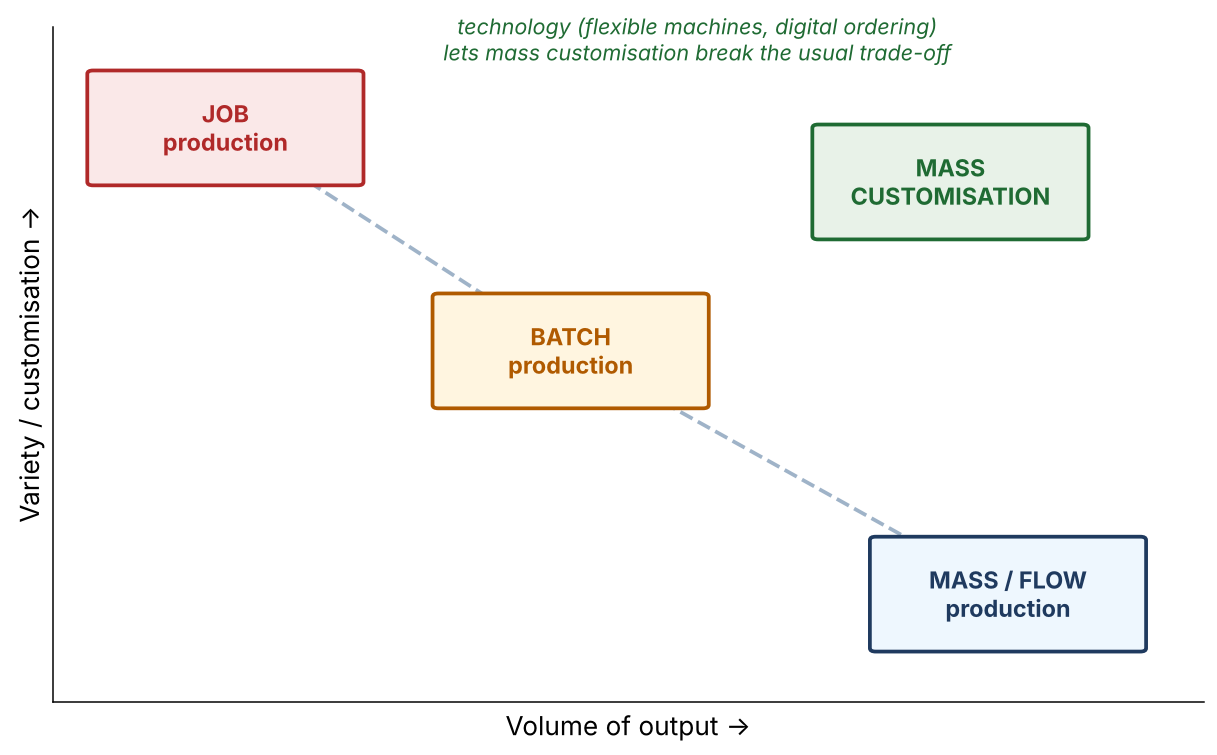
Batch production makes a quantity of identical products together; the whole batch moves through each stage before the next batch, and equipment is reset between batches — bakeries, pharmaceuticals, clothing runs.
Mass/flow production makes large volumes of standardised products continuously on production lines, each unit moving straight from one stage to the next — soft drinks, cars, cement.
Mass customisation combines the efficiency of mass production with individual tailoring, usually through flexible technology and modular designs — customised trainers, configurable laptops, personalised meal kits.
| Method | Advantages | Disadvantages | Suits |
|---|---|---|---|
| Job | Meets exact customer needs; high prices; motivating, skilled work | High unit costs; slow; needs skilled labour; hard to scale | Unique, high-value products; craft and professional services |
| Batch | Some economies of scale; flexibility to vary products between batches | Idle time when resetting; stock of work-in-progress; less variety than job | Products with moderate, predictable demand and several variants |
| Mass / flow | Lowest unit costs; consistent quality; high output | Huge set-up costs; inflexible; repetitive, demotivating work; breakdown halts the line | High, stable demand for standard products |
| Mass customisation | Personalisation at near- mass cost; premium prices; customer data | Complex systems; costly technology; longer delivery than off-the-shelf | Markets where customers value personal choice and buy online |
Demand for a product grows and becomes predictable → the business moves from job or batch to flow production → unit costs fall through economies of scale (1.5) → prices can fall and market share rise → but the business loses flexibility and must keep demand high to use the expensive capacity
Businesses often combine methods: a car maker mass-produces engines but offers customised colour and trim packages; a restaurant batch-prepares sauces but cooks each order individually. The choice can also change over a product's life cycle: job production for prototypes, batch for early sales, flow for mature high-volume products.
The most appropriate method depends on the volume of demand, how standardised customers want the product, the capital available, the skills of the workforce, and the business's competitive strategy. A low-cost strategy pushes towards flow; a differentiation strategy pushes towards job or mass customisation. Technology is changing the trade-off itself: 3D printing, flexible robotics and online configuration tools make customisation cheaper, eroding the old rule that variety must mean high cost.
The guide's conceptual understanding that creative production processes can disrupt the market is visible in mass customisation, which used technology to break the volume–variety trade-off, and historically in flow production itself, which transformed car ownership from a luxury into a mass-market product.
Toolkit: Decision trees
When choosing between methods with uncertain demand — for example, investing in a flow line or staying with batch production — a decision tree lets managers weigh the cost of each option against the probability of high or low demand and the payoff in each case, producing an expected value for each choice.
- Exam practice: 5 questions with mark allocations
- 2 exemplar answers with model answers and examiner-style commentary
- Where students commonly lose marks