HL only This topic is for Higher Level students.
Do more with less — and get it right first time: two ideas that reshaped manufacturing worldwide and now shape services too.
Guiding question
Can a business cut waste and raise quality at the same time — or does one always cost the other?
- I can state the features of lean production: less waste and greater efficiency
- I can explain kaizen, just-in-time and cradle to cradle design
- I can distinguish quality control from quality assurance and explain quality circles, benchmarking and TQM
- I can evaluate the impact of lean production and TQM on an organisation, and explain the importance of quality standards
HL only
This entire topic is HL only. Lean production and quality management link closely to motivation (2.4), stock control (5.6) and sustainability.
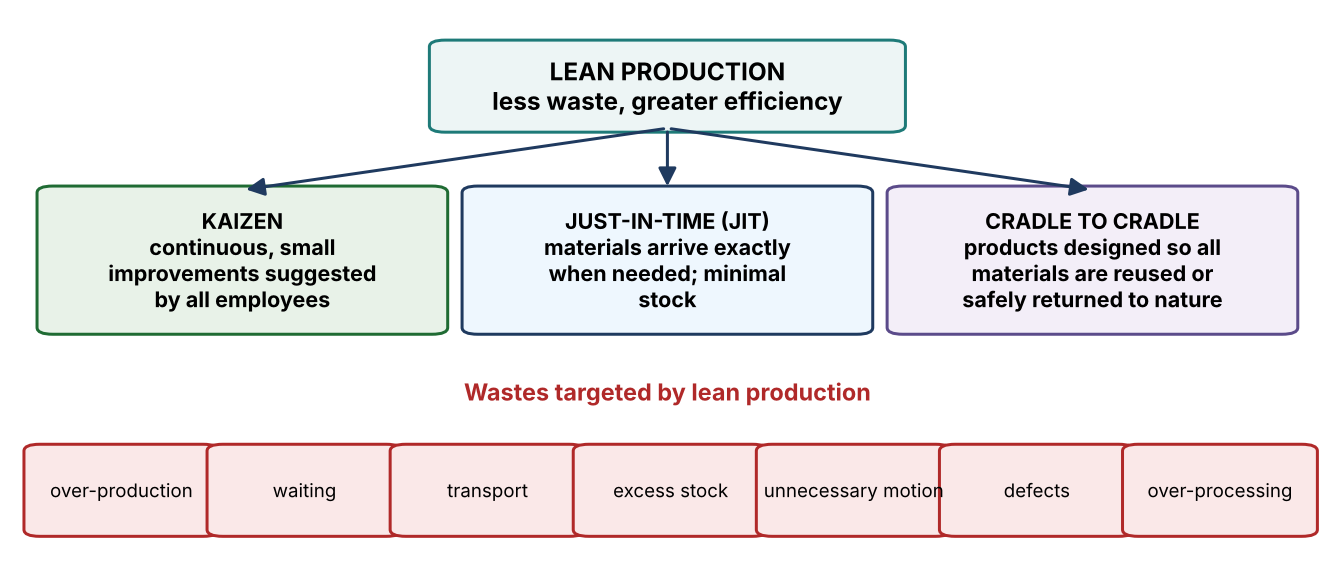
Lean thinking, developed largely from the Toyota Production System in Japan, treats anything that adds cost without adding value for the customer as waste: over-production, waiting, unnecessary transport, excess stock, unnecessary motion, defects and over-processing. Removing these cuts costs, frees space and capital, shortens lead times and usually improves quality.
- 5.3.2 Methods of lean production: kaizen and just-in-time (HL only)
- 5.3.3 Cradle to cradle design and manufacturing (HL only)
- 5.3.4 Quality control and quality assurance (HL only)
- 5.3.5 Methods of managing quality (HL only)
- 5.3.6 The impact of lean production and TQM on an organisation (HL only)
- 5.3.7 National and international quality standards (HL only)
- Exam practice: 5 questions with mark allocations
- 2 exemplar answers with model answers and examiner-style commentary
- Where students commonly lose marks