Level: SL and HL
Operations is where the business actually makes what it promises — and where most of its costs, quality and environmental impact are decided.
Guiding question
Why does a decision on the factory floor change the work of marketing, finance and HR?
- I can explain the role of operations management
- I can analyse how operations decisions connect with the other business functions
- I can explain how operations management contributes to sustainability
Production is the process of converting inputs (resources) into outputs that customers want. It applies to services as much as to goods.
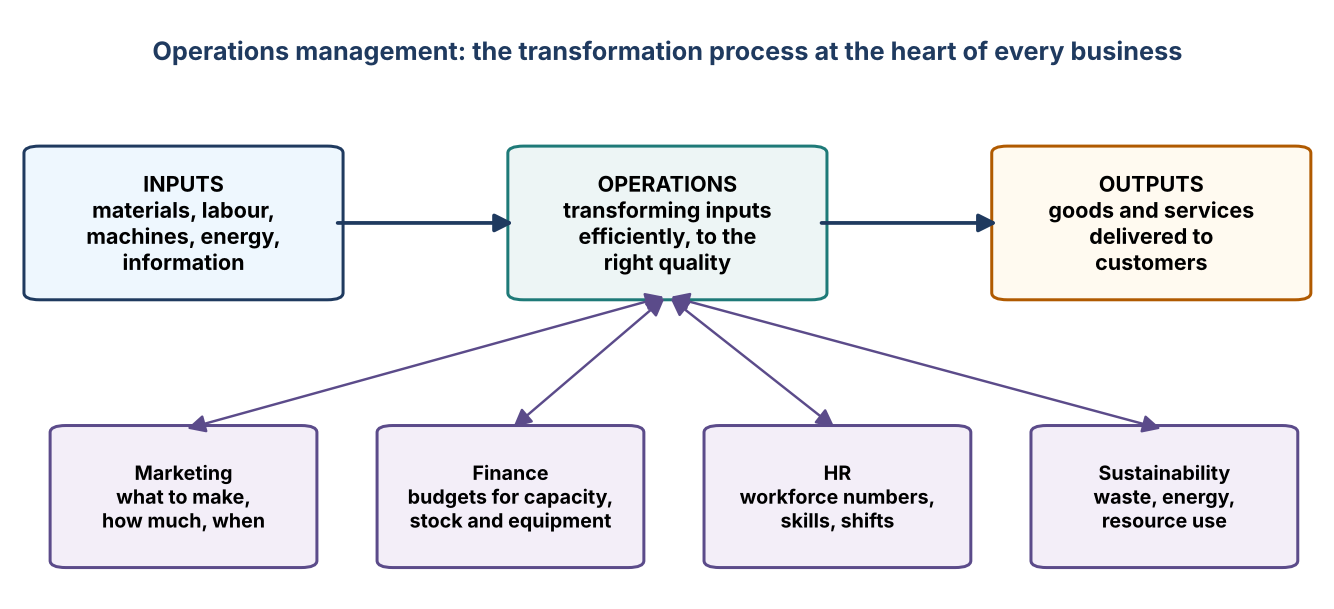
Operations managers answer practical questions: What production method should we use? Where should we produce? How much capacity and stock do we need? How do we guarantee quality? How do we keep costs down without cutting corners? The answers decide unit costs (and therefore prices and profit), product quality (and therefore reputation), speed and reliability of delivery (and therefore customer satisfaction), and the resources and energy consumed (and therefore environmental impact).
- Marketing decides what customers want and how many will sell; operations must make it, at the cost the price allows and the quality the brand promises
- Finance funds the machinery, premises and stock, and judges investments with appraisal methods (3.8); operations efficiency drives the profitability ratios (3.5)
- Human resources recruits, trains and motivates the workforce operations depends on; changes in methods (automation, lean production) change jobs
- Strategy — a business competing on low cost needs ultra-efficient operations; one competing on quality or customisation needs flexible, skilled operations
Operations introduces a faster, automated packaging line → unit costs fall, so marketing can cut prices or finance can report higher margins → HR must retrain or redeploy packers whose jobs change → finance must fund the investment and track its payback → a single operations decision ripples through every function
Operations is where most of a business's environmental footprint is created: energy use, emissions, water, raw materials, packaging and waste. Sustainable operations — efficient energy use, renewable power, less waste, recycled inputs, longer-lasting products — often cut costs as well as harm, which is why the guide links sustainability directly to efficiency. Sustainability also has economic and social dimensions: fair treatment of workers and suppliers and long-term viability, not just short-term savings.
Operations is easy to undervalue because, when it works, customers do not notice it. But no amount of clever marketing survives late deliveries, defects or costs that make the price uncompetitive. The relative importance of operations depends on the business's strategy: in commodity markets competing on price, operations efficiency is decisive; in luxury or creative markets, design and brand may matter more — yet even there, poor quality destroys the premium.
The guide's conceptual understanding — sustainability ensures efficiency in business operations — reframes environmental goals as operational goals: using less energy, wasting fewer materials and designing for reuse lowers costs while reducing harm. Circular business models make this explicit by designing waste out of the system.
Toolkit: Circular business models
A circular business model keeps products and materials in use for as long as possible — through repair, refurbishment, remanufacturing, sharing and recycling — instead of the linear 'take, make, dispose' pattern. For operations managers it means designing products for disassembly, setting up take-back and reverse logistics, and treating waste as an input.
- Exam practice: 5 questions with mark allocations
- 2 exemplar answers with model answers and examiner-style commentary
- Where students commonly lose marks