Level: SL and HL
Who owns a business, who bears its risks, and why the legal form an entrepreneur chooses shapes everything that follows.
Guiding question
How does the legal form of a business change who controls it, who finances it and who carries its risks?
- I can distinguish between the private and the public sectors
- I can analyse the main features of sole traders, partnerships, privately held companies and publicly held companies
- I can analyse the main features of for-profit social enterprises (private sector companies, public sector companies, cooperatives) and of non-governmental organisations (NGOs)
- I can recommend a suitable business entity for a given situation
The public sector consists of organisations owned and controlled by the government, which typically provide essential goods and services such as education, healthcare, defence and public transport.
The two sectors coexist in every economy, but their balance differs. The public sector provides services that are socially necessary yet might be unprofitable or under-provided if left to private firms. Governments may also privatise state-owned organisations (selling them to the private sector) or occasionally nationalise private ones. The public sector does not always mean 'free': organisations such as Indian Railways or Singapore's public transport operators charge customers, but ownership and ultimate control rest with the state.
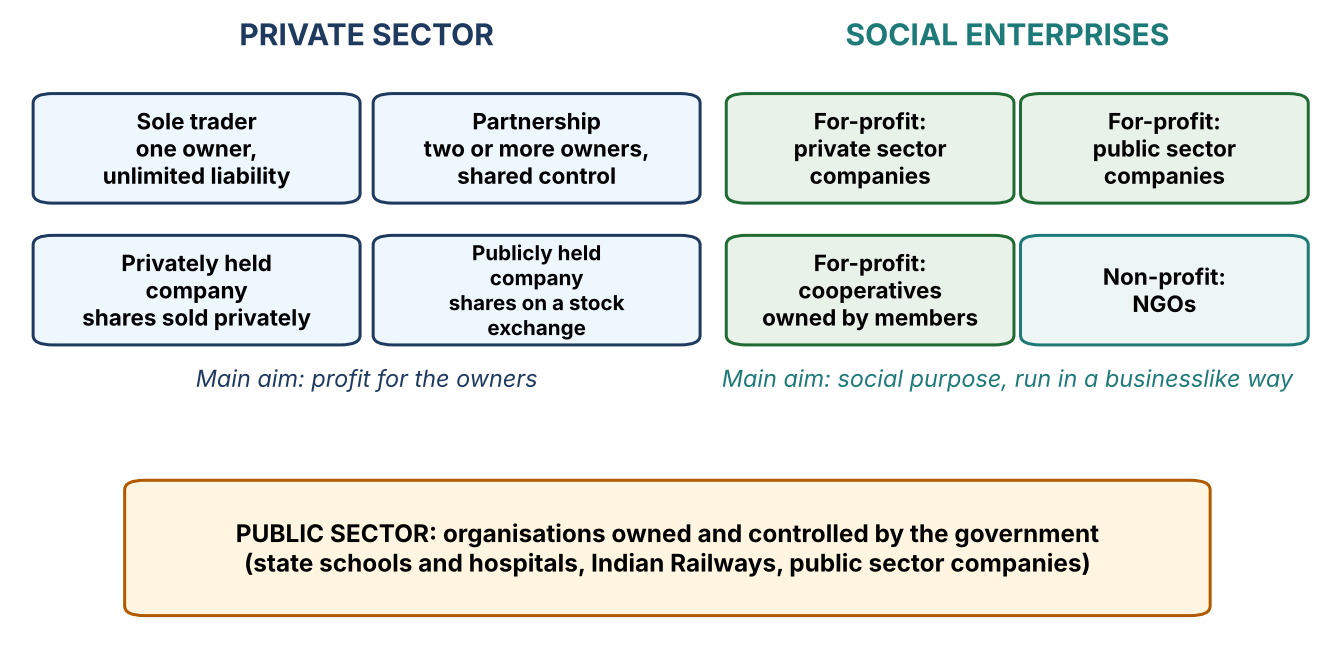
The crucial legal dividing line is incorporation. An unincorporated business (sole trader or partnership) has no legal identity separate from its owners, so the owners have unlimited liability: they are personally responsible for all business debts, down to their homes and savings. An incorporated business (a company) is a separate legal entity, so its owners — shareholders — enjoy limited liability: they can lose only the amount they invested.
A sole trader is a business owned and controlled by one person, who bears full responsibility for its debts and keeps all of its profits.
A partnership is a for-profit business owned by two or more people who share its capital, responsibilities, risks and profits.
| Feature | Sole trader | Partnership | Privately held company | Publicly held company |
|---|---|---|---|---|
| Owners | One person | Two or more partners | Shareholders (often family/founders) | Shareholders — the general public |
| Liability | Unlimited | Usually unlimited | Limited | Limited |
| Sale of shares | No shares | No shares | Private, with owners' agreement | Freely traded on a stock exchange |
| Finance available | Smallest — savings, loans | Partners' capital | Share capital from invited investors | Largest — public share issues |
| Accounts and set-up | Private; simplest to form | Private; partnership agreement advisable | Some disclosure; more formalities | Full public disclosure; costly to list |
A business incorporates → its owners' liability becomes limited to their investment → the risk of investing falls → more investors are willing to buy shares → the business can raise far more capital and grow faster
More capital comes at the price of control and privacy. Each legal step up — from sole trader to partnership to privately held to publicly held company — brings more finance but also more owners to satisfy, more disclosure, and a greater risk that the founders lose control. A publicly held company can even face a hostile takeover if its share price falls. The 'best' entity therefore depends on how much capital the business needs and how much control the founders are willing to give up.
For-profit social enterprises earn revenue and can make profit, but profit is a means rather than the end. The IB course identifies three types:
- Private sector companies — commercially run businesses with a social mission at their core. They compete in normal markets but direct profits towards the mission.
- Public sector companies — state-owned enterprises run in a businesslike, revenue-earning way to meet a social need, such as a state-owned railway, postal service or water utility.
- Cooperatives — for-profit organisations owned and democratically controlled by their members (employees, customers or producers), who share the profits. Each member typically has one vote regardless of capital contributed.
A cooperative is owned by its members → profits and votes are shared among them → members are motivated to support and use the business → loyalty and trust become a competitive advantage that investor-owned rivals find hard to copy
NGOs reinvest any surplus entirely in their mission — there are no owners to receive profit. They range from small local charities to global organisations, and they still need business management: they market themselves to donors, manage budgets, recruit staff and volunteers, and measure performance against their mission rather than profit.
The line between entity types is blurring: many NGOs now earn trading income, while many for-profit firms adopt social missions. For students, the key is to judge an organisation by its primary objective (profit for owners vs social purpose) and its legal form (who owns it, who is liable), not by its marketing language.
The choice of entity has an ethical dimension. Unlimited liability concentrates risk on a founder's family; cooperatives distribute power and profit widely; a publicly held company's duty to shareholders can collide with other stakeholders' interests. Social enterprises exist precisely because their founders judged that conventional ownership forms served society poorly.
Toolkit: SWOT analysis
When advising an entrepreneur on which entity to adopt, build a SWOT analysis for each option: for example, a privately held company's strengths (limited liability, access to share capital) and threats (disclosure requirements, possible disputes among shareholders) can be weighed directly against a partnership's simplicity and its unlimited liability.
Question: Define the term limited liability. [2]
Question: Distinguish between the private sector and the public sector. [4]
Question: Explain one advantage and one disadvantage for a sole trader of forming a partnership. [4]
Question: Explain two features of a cooperative that distinguish it from a publicly held company. [6]
Question: Discuss whether a successful family-run privately held company should become a publicly held company in order to finance expansion. [10]
Question: Explain one advantage and one disadvantage for a sole trader of forming a partnership. [4]
One advantage is access to more capital and skills. A sole trader is limited to their own savings and abilities; taking a partner brings new investment and expertise — for example, an electrician who partners with an accountant gains both funds to buy equipment and someone to manage pricing and tax — allowing the business to take on bigger jobs than either could alone. One disadvantage is the loss of sole control and the sharing of profits. Decisions that the sole trader once made instantly must now be agreed with the partner, which slows the business down and can cause disputes; and the profit that previously belonged entirely to the sole trader must now be shared, so the owner may work just as hard for a smaller personal return.
- Clearly signals one advantage and one disadvantage, matching the command term and tariff
- Each point is explained with a consequence ('allowing…', 'so…'), not merely identified
- Uses a concrete context (electrician and accountant) to demonstrate application
- Keeps to the point — a 4-mark answer does not need an introduction or a conclusion
Question: Discuss whether a successful family-run privately held company should become a publicly held company in order to finance expansion. [10]
Becoming a publicly held company would transform the firm's access to finance. Selling shares on a stock exchange raises large amounts of permanent capital without creating debt or interest payments, which suits major expansion such as new factories or entering foreign markets. A stock-market listing also raises the firm's profile and credibility with banks, suppliers and large customers, and listed shares can be used to pay for acquisitions — so expansion can continue beyond the initial share issue.
However, the family would pay a heavy price in control and privacy. Once shares trade freely, anyone — including rivals — can buy them, and if the family's stake falls below half, they can be outvoted or even face a takeover. A listed company must publish detailed accounts, hold shareholder meetings and manage pressure from institutional investors for short-term dividends, which may conflict with the patient, long-term approach that made the family firm successful. Listing itself is also expensive, with heavy legal, accounting and regulatory costs.
The decision therefore depends on the scale of finance truly needed and the family's priorities. If the expansion is moderate, alternatives — bank loans, retained profits, or selling a minority stake to a private investor — could fund it while the family keeps control, making a listing unnecessary. Going public is justified only if the expansion requires capital on a scale those alternatives cannot provide and the family accepts that they will now run the company for outside shareholders as well as themselves. On balance, the firm should first exhaust less drastic sources of finance, because the loss of control from listing is effectively irreversible, while a loan can be repaid.
- Balances a developed case for listing against a developed case against it
- Applies theory precisely (permanent capital, takeover risk, disclosure, institutional investors)
- Considers alternative sources of finance, showing synthesis rather than a rehearsed list
- Concludes with a justified recommendation and an explicit 'it depends on' condition
- Confusing the public sector (government-owned) with a publicly held company (private sector firm whose shares the public can buy) — the single most common error in this topic
- Writing 'limited liability means the business is not responsible for its debts' — the company remains fully liable; it is the shareholders whose losses are limited
- Calling any socially minded business a social enterprise — the social purpose must be the primary objective, not a marketing theme
- Forgetting that cooperatives are for-profit entities — they distribute profits to members; NGOs are the non-profit type
- Recommending an entity in a 10-mark answer without weighing finance against control and liability
- Amul ownership by 3.6 million farmers: Amul (GCMMF) website — https://amul.com/