Level: SL and HL
From a one-line vision to today's to-do list: how businesses decide what they are trying to achieve, and what happens when ethics joins the list.
Guiding question
Why might a business's objectives change over time — and who decides what they should be?
- I can distinguish between a vision statement and a mission statement
- I can explain common business objectives: growth, profit, protecting shareholder value and ethical objectives
- I can distinguish strategic objectives from tactical objectives and show how they connect
- I can evaluate the case for corporate social responsibility (CSR)
A mission statement sets out the organisation's core purpose today — what it does, for whom, and why it exists.
| Vision statement | Mission statement | |
|---|---|---|
| Question answered | Where are we going? | Why do we exist now? |
| Time focus | The long-term future | The present |
| Tone | Aspirational, inspiring | Operational, descriptive |
| Changes | Rarely | Occasionally, as activities evolve |
Good statements guide decision-making, unite employees behind a shared direction and communicate identity to customers and investors. Critics note, however, that many are interchangeable slogans written for public relations: a statement only matters if objectives, budgets and behaviour actually follow it.
The value of vision and mission statements is difficult to measure. They cost little to write but much to live up to; the test of their worth is whether managers ever reject a profitable action because it conflicts with the mission. Where statements and decisions diverge, employees and customers quickly become cynical.
- Growth — increasing sales revenue, market share, outlets or workforce. Growth brings economies of scale and market power, and protects against takeover; managers may also pursue it for status and salary.
- Profit — the surplus of revenue over total costs. New firms may target survival or break-even first; established firms may aim for satisfactory rather than maximum profit to avoid attracting rivals or regulators.
- Protecting shareholder value — delivering returns to shareholders through dividends and a rising share price. Listed companies are under constant pressure from institutional investors to protect and grow this value.
- Ethical objectives — targets based on moral principles rather than law alone, such as paying suppliers fairly, cutting emissions, or refusing corrupt payments.
A business lists on a stock exchange → ownership shifts towards institutional investors → pressure for dividends and share-price growth rises → objectives tilt from growth-at-any-cost towards profit and shareholder value → strategy, budgets and managers' targets are rewritten to match
Objectives change over time because circumstances change: a start-up aims to survive, a growing firm to expand, a mature firm to defend profit and reputation. External shocks — recessions, pandemics, new regulation — can push survival or cash flow back to the top of any firm's list.
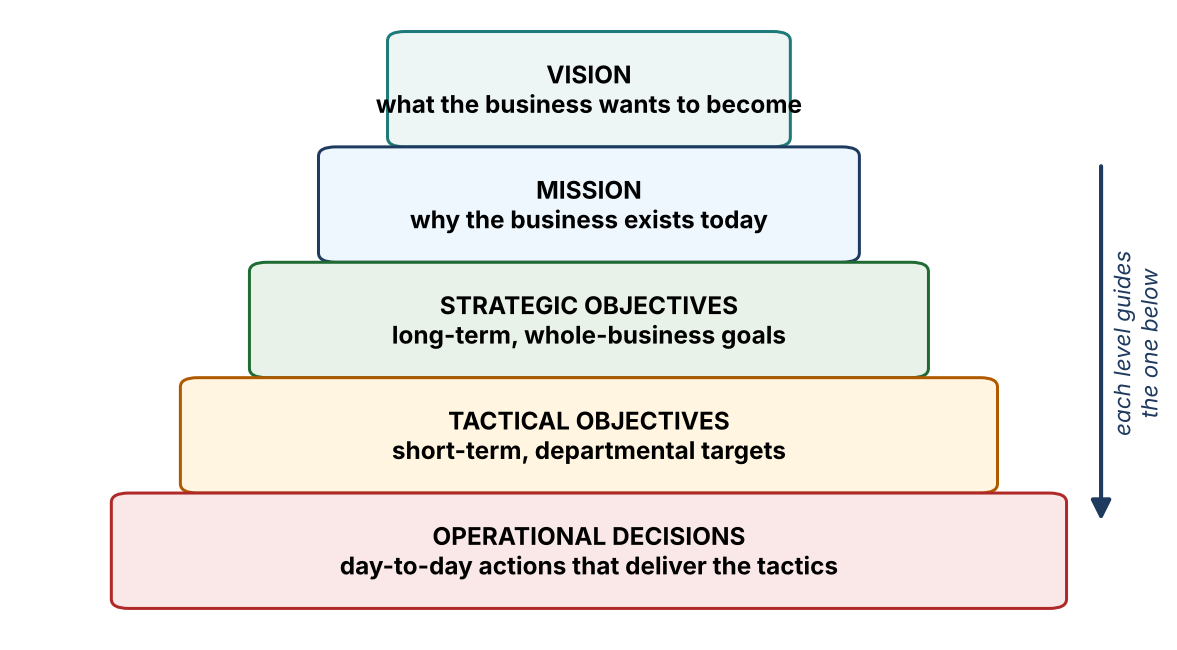
The hierarchy must connect: a strategic objective to 'double revenue in five years' might generate tactical objectives such as 'open 40 new stores this year' (operations), 'raise brand awareness to 60% in new regions' (marketing) and 'recruit and train 500 staff' (HR). If tactics do not add up to the strategy — or the strategy ignores the mission — the organisation pulls in different directions.
Senior managers set a strategic objective → departments translate it into tactical objectives → teams make day-to-day operational decisions to hit those tactics → results are measured and fed back → the strategy is confirmed or revised
- Builds brand image, reputation and customer loyalty, which supports premium pricing
- Attracts and retains employees and increasingly attracts investors who screen for responsible behaviour
- Reduces the risk of scandals, boycotts, fines and tighter regulation
- Secures the business's long-term 'licence to operate' with communities and governments
- Raises costs in the short run, which may hurt price competitiveness
- Benefits are hard to measure, so spending is vulnerable in downturns
- Risk of greenwashing — claiming responsibility in marketing while behaving otherwise — which destroys trust if exposed
- Some argue managers' duty is to shareholders, and social goals are for governments and charities
Whether CSR 'pays' depends on the time horizon and the honesty of the commitment. Genuine CSR embedded in strategy tends to strengthen a brand over years; bolt-on CSR used as advertising is quickly exposed on social media and can do more damage than doing nothing. Once CSR is legally required, as partly in India, it also stops being a differentiator and becomes a cost of doing business.
CSR is how many businesses operationalise sustainability: objectives for emissions, waste, sourcing and community welfare aim to ensure the business can keep operating — and keep its customers' trust — for generations, not just quarters.
Toolkit: Circular business models
A powerful way to turn CSR from cost into strategy is a circular business model: designing products and processes so materials are reused, repaired, refurbished or recycled rather than discarded. For example, a furniture maker that leases and refurbishes desks keeps materials in use, cuts input costs over time and creates a recurring revenue stream — aligning the ethical objective with profit and growth.
Question: Define the term mission statement. [2]
Question: Distinguish between strategic objectives and tactical objectives. [4]
Question: Explain one reason why a business's objectives might change over time. [4]
Question: Explain two benefits to a business of setting ethical objectives. [6]
Question: Discuss the view that corporate social responsibility is simply good marketing rather than genuine ethical behaviour. [10]
Question: Distinguish between strategic objectives and tactical objectives. [4]
Strategic objectives are long-term goals, usually spanning several years, set by senior management for the organisation as a whole — for example, a supermarket chain aiming to become market leader within five years. Tactical objectives, by contrast, are short-term targets, usually for a year or less, set by middle managers for individual departments in order to deliver the strategy — for the same supermarket, opening 25 new stores this year and raising own-brand sales by 10%.
The two differ in time-scale (years versus months), in who sets them (senior versus middle management) and in scope (whole organisation versus department), but they are connected: tactical objectives are the measurable steps by which a strategic objective is achieved.
- Contrasts the two terms on three distinct dimensions rather than defining them in isolation
- Uses one running example so the contrast is applied, not abstract
- Ends by linking the two levels — showing understanding of the hierarchy, not just the labels
Question: Discuss the view that corporate social responsibility is simply good marketing rather than genuine ethical behaviour. [10]
There is real force in the view. CSR activity is heavily publicised: firms issue glossy sustainability reports, attach causes to advertising campaigns and time donations for maximum visibility. Because customers increasingly prefer responsible brands, CSR can raise sales and justify premium prices — meaning a purely self-interested firm would behave exactly like an ethical one. The existence of greenwashing, where environmental claims outrun environmental behaviour, shows that for some firms the marketing is the point: the image of responsibility is bought more cheaply than responsibility itself.
However, the cynical view does not explain all CSR. Some commitments are costly, permanent and barely visible to consumers: paying suppliers above-market rates, re-engineering products for recyclability, or India's legally framed expectation that large firms spend 2% of profits on social programmes, which turns CSR into audited expenditure rather than advertising. Where CSR is embedded in objectives and budgets — as at firms like Patagonia, which restricts its own sales growth for environmental reasons — it constrains profit rather than serving it, which is the mark of a genuine ethical objective.
The fairest conclusion is that motive varies by firm and cannot be read from the advertising alone; the test is behaviour when ethics and profit conflict. CSR that survives a recession, applies in markets where no one is watching, and is reported transparently with failures included is genuine; CSR that appears only in campaigns is marketing. The view is therefore partly true — CSR is always also good marketing — but it is false as a generalisation, because for a significant and growing group of businesses the ethical commitment is real and measurable.
- Engages directly with the exact claim in the question rather than writing generally about CSR
- Offers substantiated arguments on both sides, each developed with mechanisms and examples
- Proposes a clear test ('behaviour when ethics and profit conflict') — synthesis, not summary
- Reaches a nuanced, justified conclusion that answers 'to what extent' the view holds
- Writing vision and mission definitions the wrong way round — vision is the future aspiration, mission is the present purpose
- Treating 'objectives' and 'strategies' as the same thing — an objective is the target; a strategy is the long-term plan to reach it
- Claiming profit maximisation is every firm's objective — the syllabus expects growth, profit, shareholder value and ethical objectives, and real firms trade these off
- Discussing CSR with examples but no theory — top answers use terms such as stakeholders, brand loyalty, greenwashing and long-term shareholder value
- Ignoring the command term 'Discuss' — answers that only praise or only attack CSR cannot leave the middle markbands
- Zomato's first full-year profit (₹351 crore, FY2023–24): Business Standard, 13 May 2024 — https://www.business-standard.com/amp/companies/results/zomato-q4-results-consolidated-profit-at-rs-175-crore-revenue-up-73-124051300785_1.html
- CSR spending of 2% of average net profits under Section 135, Companies Act 2013: TaxTMI — https://www.taxtmi.com/article/detailed?id=10455