Level: SL and HL
What businesses do, the four sectors they operate in, and why starting one is both harder and more promising than it looks.
Guiding question
Why do some new businesses flourish while others close within three years?
- I can describe the nature of business and the role of the four functions and four factors of production
- I can classify business activity into the primary, secondary, tertiary and quaternary sectors
- I can analyse the challenges and opportunities facing a new business and apply them to a real start-up
Every business, from a street-food stall in Mumbai to a software giant in the USA, exists for the same underlying reason: people have needs (essentials such as food, water and shelter) and wants (desires that make life more comfortable), and businesses organise scarce resources to satisfy them. A business is best understood as a decision-making organisation: it combines inputs, transforms them, and sells the resulting goods or services — usually, though not always, to make a profit.
The inputs of a business are the four factors of production. The transformation process turns them into outputs that customers value more than the original resources — the source of all added value.
| Factor of production | What it is | Example for an ice-cream maker |
|---|---|---|
| Land | All natural resources used in production | Milk, sugar, water, the plot the dairy stands on |
| Labour | The physical and mental effort of workers | Machine operators, drivers, accountants |
| Capital | Human-made resources used to produce other goods | Freezers, churns, delivery vans, cash |
| Enterprise | The skill of combining the other three factors and bearing the risk | The founder who invests savings and organises production |
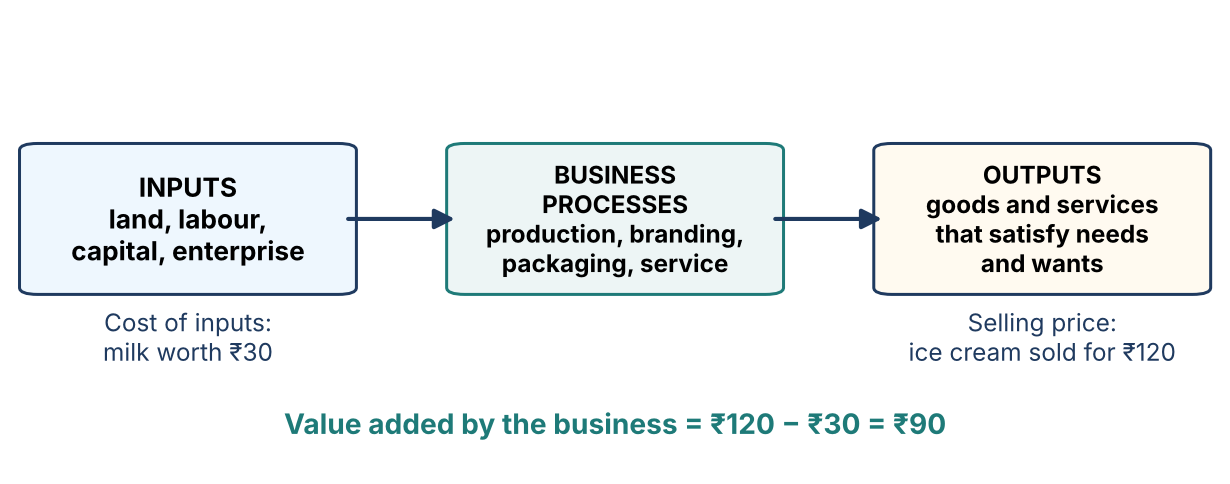
Goods are physical, tangible products (a scooter, a sandwich); services are intangible acts performed for the customer (a haircut, an insurance policy, a streaming subscription). To produce either, almost every business organises itself into four business functions, which you will study in Units 2 to 5:
- Human resource management — recruiting, training, motivating and organising people (Unit 2)
- Finance and accounts — raising funds and managing and reporting money (Unit 3)
- Marketing — identifying and satisfying customer needs profitably (Unit 4)
- Operations management — producing the good or service efficiently (Unit 5)
The four functions are interdependent → a marketing decision to launch a new product → needs finance to fund it, operations to make it and HR to staff it → a weakness in one function limits the performance of all the others
Business activity is classified by sector according to its stage in the chain of production. Each stage adds value to the output of the stage before it.
The tertiary sector provides services to consumers and other businesses (retail, transport, banking, tourism).
The quaternary sector is a subset of the tertiary sector focused on knowledge-based activities: information technology, research and development, data analysis, consultancy and education.
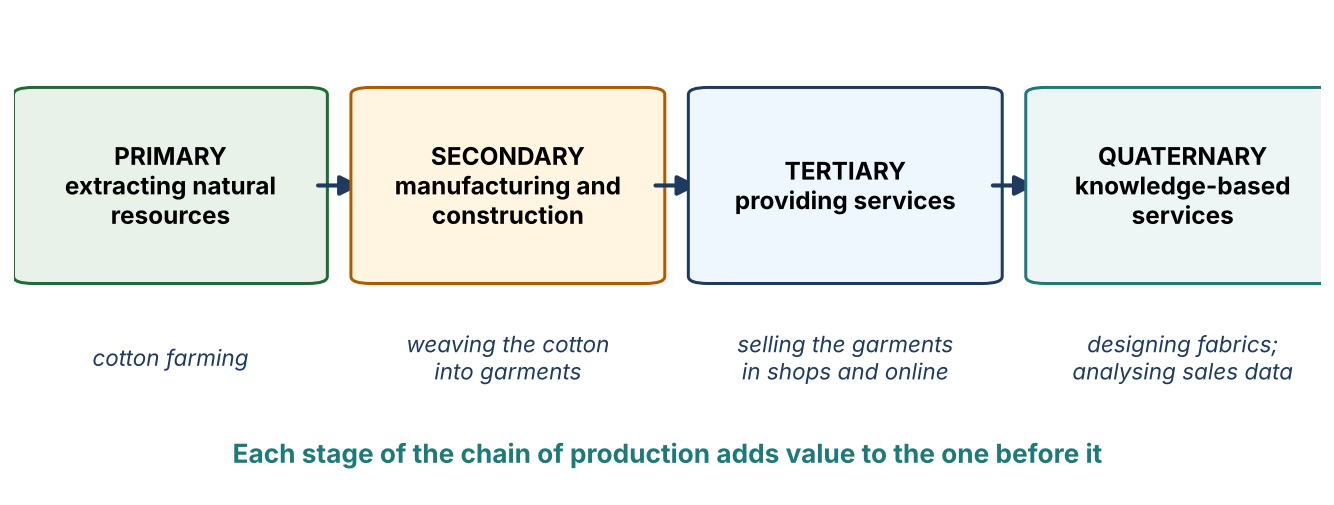
As economies develop, employment and output typically shift from the primary sector towards the secondary and then the tertiary and quaternary sectors — a process called sectoral change. Rising incomes increase demand for services, machines replace farm labour, and knowledge work grows fastest of all. A business must know its sector because sector trends shape its opportunities: a quaternary-sector start-up in Bengaluru rides a growing market, while a coal business faces a shrinking one.
An economy develops and incomes rise → demand shifts from basic goods towards services and experiences → resources (workers, capital) move into the tertiary and quaternary sectors → the structure of employment and of business opportunity changes
Sector classification is useful but blurred in practice: a single firm such as Reliance Industries spans oil extraction (primary), refining and petrochemicals (secondary), retail (tertiary) and digital services through Jio (quaternary). Vertical integration like this means many large businesses cannot be placed in one sector at all.
An entrepreneur is a person who takes the financial risk of planning, organising and managing a new business venture. People start businesses to earn profit, to be their own boss, to pursue an idea or passion, to fill a gap in the market, or because paid employment is unavailable. Whatever the motive, most start-ups face the same early tests.
- Lack of finance — banks see new firms as high-risk, so loans are costly or refused; many founders rely on savings, family or microfinance
- Cash-flow problems — customers pay late while rent, wages and suppliers must be paid now; profitable firms can still run out of cash
- Marketing problems — an unknown brand must win customers from established rivals with a small promotion budget
- Unestablished customer base — no loyal, repeat customers yet, so revenue is unpredictable
- People management — the founder must recruit, train and lead with little HR experience, and often cannot match the salaries larger firms pay
- Legal and administrative burdens — registration, taxes, licences and employment law absorb scarce time and money
- Production and quality problems — small scale means higher unit costs and little bargaining power over suppliers
- Growth — a successful niche can scale quickly, especially online, where a small firm can reach a national or global market from day one
- Flexibility and speed — small firms can change products, prices and methods faster than large bureaucratic rivals
- Closeness to the customer — founders serve customers personally, build loyalty and spot changing needs early
- Innovation — start-ups can exploit new technologies and business models that established firms are slow to adopt
- Autonomy and reward — the founder keeps control and, if the venture succeeds, the profit
Whether the opportunities outweigh the challenges depends on the sector (a quaternary start-up needs little capital; a factory needs a lot), the entrepreneur's own experience and savings, and the support environment — government schemes such as India's Startup India initiative, incubators and cheap digital tools have lowered the barriers, but they have also lowered them for competitors.
Successful entrepreneurs rarely win by copying: they re-imagine a product or process. Creative business planning — a new delivery model, a cheaper material, an underserved customer group — is often the only advantage a start-up has over larger, better-funded rivals.
Toolkit: Business plan and SWOT analysis
Before launch, an entrepreneur should prepare a business plan (the venture's objectives, target market, marketing plan, operations and finance in one document, often required by lenders) and a SWOT analysis of the idea: internal strengths and weaknesses, external opportunities and threats. Both tools force assumptions into the open where they can be tested.
Question: Define the term business. [2]
Question: Distinguish between the secondary sector and the tertiary sector, using one example of each. [4]
Question: Outline two reasons why an individual might choose to start their own business. [4]
Question: Explain two challenges that a newly opened restaurant is likely to face in its first year. [6]
Question: Discuss whether the opportunities of starting an online tutoring business outweigh the challenges for a recent graduate. [10]
Question: Explain two challenges that a newly opened restaurant is likely to face in its first year. [6]
One challenge is cash-flow problems. A new restaurant must pay rent, staff wages and food suppliers from its first week, but revenue builds slowly while the restaurant is unknown. Because food stock is perishable and many costs are fixed, cash flows out faster than it flows in, and the restaurant may be unable to pay its bills even if each meal sold is profitable.
A second challenge is building an unestablished customer base. Diners already have favourite restaurants, so the new owner must persuade them to switch. With a small marketing budget, the restaurant may rely on social media and word of mouth, which take months to generate regular, repeat customers — and until bookings become predictable, ordering stock and scheduling staff remain guesswork.
- Identifies two distinct challenges using precise business terminology (cash flow, customer base)
- Explains the mechanism behind each challenge, not just its name
- Applies every point to the restaurant context (perishable stock, bookings, diners switching)
- Matches its length to a 6-mark tariff — two developed paragraphs, no padding
Question: Discuss whether the opportunities of starting an online tutoring business outweigh the challenges for a recent graduate. [10]
An online tutoring start-up offers the graduate significant opportunities. Set-up costs are very low: tutoring is a tertiary/quaternary service needing little more than a laptop, video-conferencing software and subject knowledge the graduate already has, so the main start-up challenge — lack of finance — barely applies. The potential market is also unusually large, because an online tutor is not limited to one city; a tutor in Mumbai can teach students in Dubai or London, and flexible pricing lets the graduate serve several market segments. Finally, the graduate gains autonomy and flexibility, setting their own hours while the business grows. However, the same low barriers to entry are the central challenge: thousands of tutors and large platforms already compete online, so winning an unestablished customer base is difficult and may force low introductory prices. Revenue will be irregular at first, creating personal cash-flow pressure since tutoring income must also cover the graduate's living costs. The graduate must also handle marketing, scheduling, technology and accounts alone, with no business experience — a people-management and administrative burden that grows with every student. Overall, the opportunities are likely to outweigh the challenges, because the two biggest killers of new businesses — heavy start-up debt and high fixed costs — are nearly absent, so the graduate can survive a slow start. The judgement depends on differentiation: if the graduate can target a defined niche (for example, IB Economics students) and build a reputation through results and reviews, the low-cost model is sustainable; if they remain a generic tutor competing on price against established platforms, the low entry barriers that made starting easy will make succeeding very hard.
- Answers the actual question — weighs opportunities against challenges rather than listing both
- Uses course theory accurately (barriers to entry, fixed costs, market segments, cash flow)
- Applies each argument to the specific context of online tutoring by a recent graduate
- Reaches a justified conclusion with a clear 'it depends on' condition, as the 9–10 markband requires
- Defining a business only as 'something that makes profit' — many organisations (NGOs, some social enterprises) are businesses without profit as the main aim; the definition needs inputs, outputs and customer needs
- Confusing the quaternary sector with the whole tertiary sector — quaternary is specifically knowledge-based activity such as IT, R&D and consultancy
- Listing challenges or opportunities without explaining them — at AO2, every point needs a 'because…' that shows the mechanism
- Writing one-sided answers to 'Discuss' questions — the top markbands require balance and a substantiated conclusion
- Treating 'cash-flow problems' and 'lack of finance' as the same point — one is about timing of payments, the other about raising capital
- Zomato's founding as Foodiebay (2008) and July 2021 listing: YourStory, 'Walk down memory lane: Zomato's evolution from Foodiebay…', 24 July 2021 —
https://yourstory.com/2021/07/zomato-ipo-foodiebay-deepinder-goyal-foodtech-unicorn