Level: SL and HL
Everyone a business touches has a stake in what it does — and their interests rarely line up neatly.
Guiding question
When stakeholders want different things, whose interests should a business put first?
- I can identify the internal and external stakeholders of a business and describe their interests
- I can analyse areas of conflict (and of shared interest) between stakeholder groups
- I can evaluate how a business might respond when stakeholder interests collide
Internal stakeholders are members of the organisation itself — employees, managers and directors, and shareholders (owners).
External stakeholders are outside the organisation but affected by it — customers, suppliers, lenders, the government, the local community, pressure groups and even competitors.
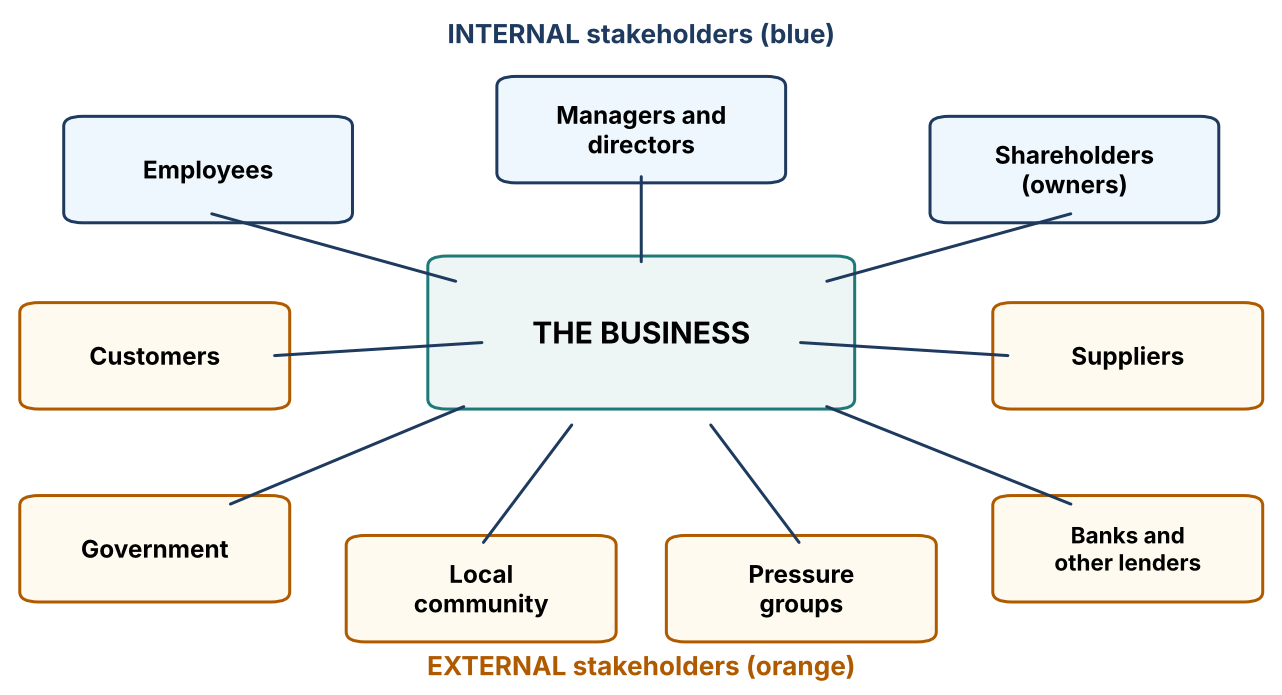
| Stakeholder | Main interests in the business |
|---|---|
| Employees | Job security, fair pay, safe conditions, training and promotion prospects |
| Managers and directors | Salaries and bonuses, status, achieving targets, career success |
| Shareholders (owners) | Dividends, a rising share value, sound long-term strategy |
| Customers | Quality, fair prices, reliable service, safe and ethical products |
| Suppliers | Regular orders, fair prices, prompt payment |
| Banks and other lenders | The business's liquidity and ability to repay with interest |
| Government | Taxes, employment, compliance with the law |
| Local community | Jobs, local spending, limited noise, traffic and pollution |
| Pressure groups | Changing the business's behaviour on a specific issue |
Note the difference between a shareholder (who owns part of the company) and a stakeholder (anyone with an interest in it): all shareholders are stakeholders, but most stakeholders own no shares. Note too that the same person can occupy several roles — an employee may own shares and live in the local community.
Stakeholders' interests overlap — everyone benefits from the business surviving — but they also conflict, because the money and attention given to one group is often taken from another. Managing a business is largely the art of managing these trade-offs.
| Conflict | What each side wants | Typical flashpoint |
|---|---|---|
| Shareholders vs employees | Higher profit and dividends vs higher pay and job security | Redundancies and automation announced to cut costs |
| Customers vs shareholders | Lower prices and better quality vs wider profit margins | Price rises; cheaper materials reducing quality |
| Business vs local community | Expansion and efficient operations vs quiet, clean surroundings | A new factory, mine or airport runway |
| Suppliers vs managers | Prompt payment and fair prices vs longer credit and discounts | A powerful buyer extending payment terms |
| Short-term vs long- term owners | Immediate dividends vs reinvestment for growth | How to use a year's record profit |
Management announces a cost-cutting restructure → shareholders anticipate higher profit and support it → employees fear redundancy and resist, perhaps via unions → morale, productivity and public image suffer during the dispute → the final outcome depends on each side's power and willingness to compromise
- Communication and consultation — explaining decisions early and listening reduces rumour and resistance
- Compromise and compensation — phased redundancies, retraining, community investment, better supplier terms
- Prioritisation — identifying which stakeholders have most power over the outcome and most interest in it, and engaging those first
- Changing the decision — genuine consultation sometimes produces a better option than the original plan
How a conflict should be resolved depends on the stakeholders' relative power and the firm's objectives and values. A business facing a powerful regulator or united workforce has little choice but to negotiate; one facing a weak, dispersed group may be tempted to ignore it — though social media has sharply increased the power of once-weak groups such as consumers and communities. Repeatedly favouring shareholders can be self-defeating if it drives away the employees and customers on whom profit ultimately depends.
Most stakeholder conflict is triggered by change — a relocation, automation, a new owner, a new strategy. The guide's conceptual lens applies directly: change may be essential for a business to achieve its aims, yet each change redistributes costs and benefits among stakeholders, which is precisely why it meets resistance.
Toolkit: STEEPLE analysis
Many external stakeholders enter a decision through the external environment. A STEEPLE analysis (social, technological, economic, environmental, political, legal, ethical factors) of a proposed project — say, a new plant — systematically surfaces the community, government and pressure-group reactions a business should anticipate before committing.
Question: Define the term stakeholder. [2]
Question: Distinguish between internal and external stakeholders, giving one example of each. [4]
Question: Explain one interest of employees and one interest of shareholders in a business's performance. [4]
Question: Explain how a conflict could arise between a business's suppliers and its managers. [6]
Question: A retail chain plans to replace half its checkout staff with self-service machines. Discuss how the business should respond to the conflicting interests of its stakeholders. [10]
Question: Explain how a conflict could arise between a business's suppliers and its managers. [6]
Suppliers want regular orders, fair prices and — above all — prompt payment, because their own cash flow depends on it. Managers, judged on profit and cash management, want the opposite: lower input prices and longer credit periods, because paying suppliers later keeps cash in the business.
Conflict arises when managers use their buying power to impose these terms. If a large retailer extends payment from 30 to 90 days, a small supplier must finance three months of production unpaid; it may have to borrow, cut its own workforce, or refuse the contract. The supplier may respond by lowering quality, deprioritising the retailer's orders or supplying a competitor — so the managers' short-term cash gain can become unreliable supply and damaged relationships, which is precisely why many firms now treat fair supplier terms as part of their ethical objectives.
- States each side's interest precisely before showing where they collide
- Develops the mechanism of conflict step by step with a concrete credit-period example
- Shows consequences flowing back to the business — analysis, not just description
Question: A retail chain plans to replace half its checkout staff with self-service machines. Discuss how the business should respond to the conflicting interests of its stakeholders. [10]
The automation plan sets stakeholders directly against each other. Shareholders and senior managers favour it: machines cut the largest operating cost — wages — so margins and dividends rise, and the chain stays price-competitive with rivals that have already automated. Many customers share this interest in lower prices and shorter queues, though others, especially elderly shoppers, value human service. Against them stand the checkout employees, who face redundancy, and the wider community and government, which absorb the unemployment and lost income tax.
The business should not treat this as a choice between 'stakeholders' and 'profit', because mishandling the people side destroys the financial case. A sudden mass redundancy risks strikes, negative publicity and boycotts — checkout staff are often long-serving local figures — and recruitment problems later. A better response combines the decision with measures that reduce the harm: phasing the change over two to three years so natural staff turnover absorbs much of it, retraining willing staff for customer-service, online-order and security roles that automation creates, offering fair voluntary redundancy terms, and keeping some staffed lanes to retain service-oriented customers.
Ultimately the business should proceed, because refusing efficiency gains that competitors are capturing would eventually threaten every stakeholder, including the remaining employees. But how it proceeds determines the outcome: the phased, consultative route costs more in the short run and depends on the firm's financial cushion and union relationships, yet it protects the brand, morale and community standing on which long-term shareholder value rests. The interests conflict in the short term far more than in the long term — and good stakeholder management consists of making that long term arrive intact.
- Maps the specific stakeholders of this decision and their interests before judging
- Proposes concrete management responses (phasing, retraining, consultation), not platitudes
- Weighs short-term against long-term interests to reach a justified, conditional conclusion
- Stays anchored in the retail context throughout
- Confusing stakeholders with shareholders — shareholders are just one stakeholder group
- Classifying shareholders as external — in this course the owners are internal stakeholders
- Listing stakeholders without stating their specific interest in the given scenario
- Describing a disagreement without the mechanism — who wants what, why the wants collide, and what each side can do about it
- Forgetting that stakeholders also share interests (survival of the business) — the best evaluations use this common ground
- Tata Nano plant moved from Singur to Sanand (October 2008): Business Standard, 'Singur to Sanand' — https://www.business-standard.com/article/beyond-business/singur-to-sanand- 111080600026_1.html