Level: SL and HL
Why businesses grow, why some deliberately stay small, and the five external routes a business can take when its own resources are not enough.
Guiding question
Is bigger always better — and if a business does grow, should it build or buy its way there?
- I can explain internal and external economies and diseconomies of scale and calculate average costs
- I can distinguish internal (organic) growth from external growth
- I can analyse the reasons for businesses to grow and the reasons to stay small
- I can analyse and evaluate the external growth methods: mergers and acquisitions, takeovers, joint ventures, strategic alliances and franchising
Diseconomies of scale are increases in average cost that arise when a business grows beyond its optimal size.
Internal economies and diseconomies arise from the growth of the business itself; external ones arise from the growth of the industry or region in which it operates.
| Internal economies of scale | Internal diseconomies of scale |
|---|---|
| Purchasing — bulk-buying discounts from suppliers | Communication problems — messages distorted or delayed through many layers |
| Technical — large, specialised machinery spreads its cost over huge output | Coordination problems — departments and sites pull in different directions |
| Financial — banks charge lower rates to large, safer borrowers | Poor motivation — workers feel like numbers, so productivity falls |
| Managerial — specialist managers raise efficiency | Slower decision-making — bureaucracy multiplies rules and meetings |
| Marketing — advertising costs spread over more units sold | |
| Risk-bearing — diversified products and markets spread risk |
External economies of scale benefit all firms in a growing industry or cluster: a pool of skilled labour, specialist suppliers, infrastructure and shared knowledge (for example, the software cluster in Bengaluru lowers hiring and supplier costs for every firm there). External diseconomies hit all firms as a cluster becomes congested: rising rents, wages bid upwards, traffic and overloaded infrastructure.
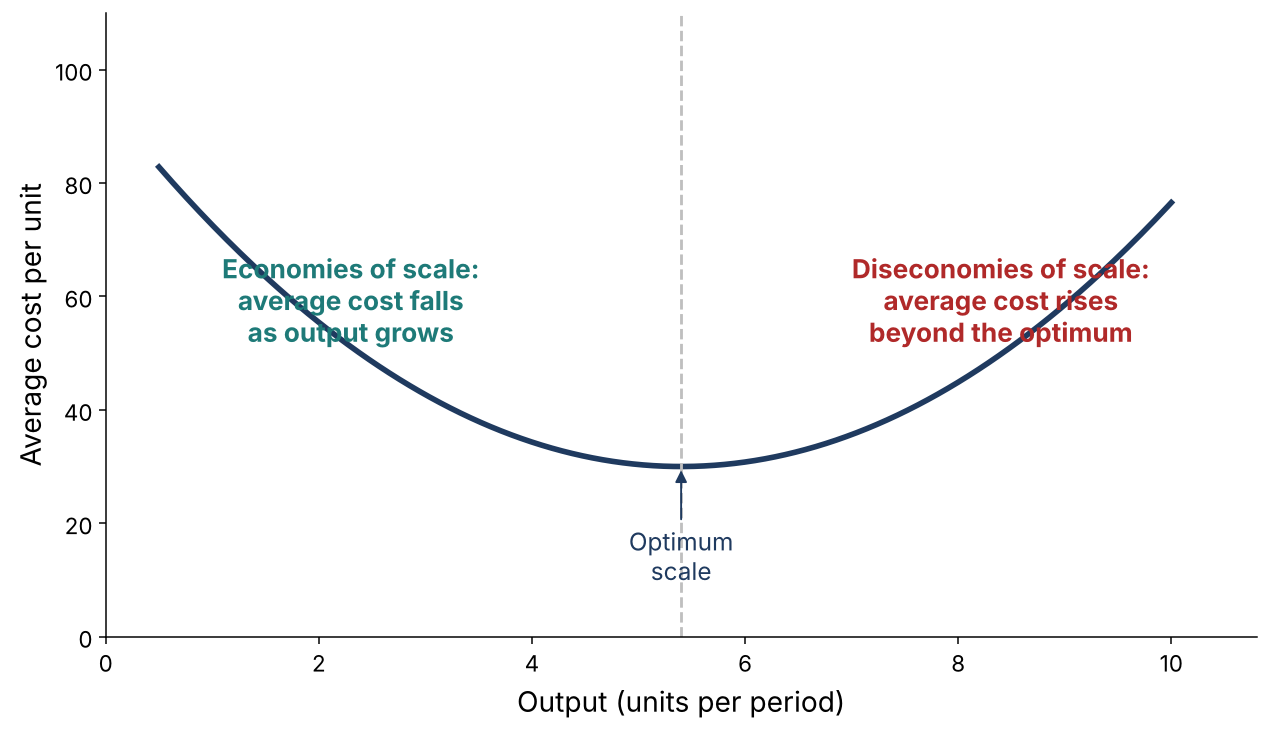
A soap maker's total costs are ₹2,00,000 per month when it produces 10,000 bars, and ₹5,60,000 per month when it produces 40,000 bars.
Average cost at 10,000 bars = 2,00,000 ÷ 10,000 = ₹20 per bar → Average cost at 40,000 bars = 5,60,000 ÷ 40,000 = ₹14 per bar
Quadrupling output raised total costs less than proportionately, so average cost fell by ₹6 per bar — the business is enjoying economies of scale.
A business doubles its output → bulk discounts, specialist staff and machinery cut the cost of each unit → it can undercut smaller rivals or keep a wider margin → profit funds further growth → until coordination and communication problems start pushing unit costs back up
External growth is expansion achieved by joining with or combining with other businesses, through mergers and acquisitions, takeovers, joint ventures, strategic alliances or franchising.
Organic growth is slower but keeps control, culture and quality in the founders' hands, and is usually financed step by step from retained profits. External growth is faster — capacity, brands and customers are acquired ready-made — but it is riskier, more expensive upfront and forces different organisations (and cultures) to work together.
- Economies of scale — lower unit costs improve margins or allow lower prices
- Greater market share and market power — more influence over prices, suppliers and distribution channels
- Higher profits to reward owners and reinvest
- Survival and security — large firms are harder to take over and can out-last price wars; spreading across products and markets reduces risk
- Status and managerial ambition — growth attracts talent, publicity, cheaper finance, and rewards for executives
- Control and independence — the owner keeps decision-making and the business's culture intact
- Avoiding diseconomies of scale — small firms stay flexible, fast and personal
- Serving a niche — specialist markets are often too small to interest large rivals, allowing premium prices
- Personal service and customer relationships — a key competitive advantage that scale tends to destroy
- Lower risk and stress — expansion means debt, dilution and regulatory burdens the owner may simply not want
- Legal and tax thresholds — in many countries, small firms face lighter regulation and compliance costs
The right size depends on the market and the owner's objectives. Where scale economies are powerful and products standardised (steel, telecoms, supermarkets), growth is close to compulsory — the largest competitor sets the cost benchmark. Where value comes from craft, service or trust, growth can destroy the very advantage it is meant to multiply. 'Growth' is a strategy, not an obligation.
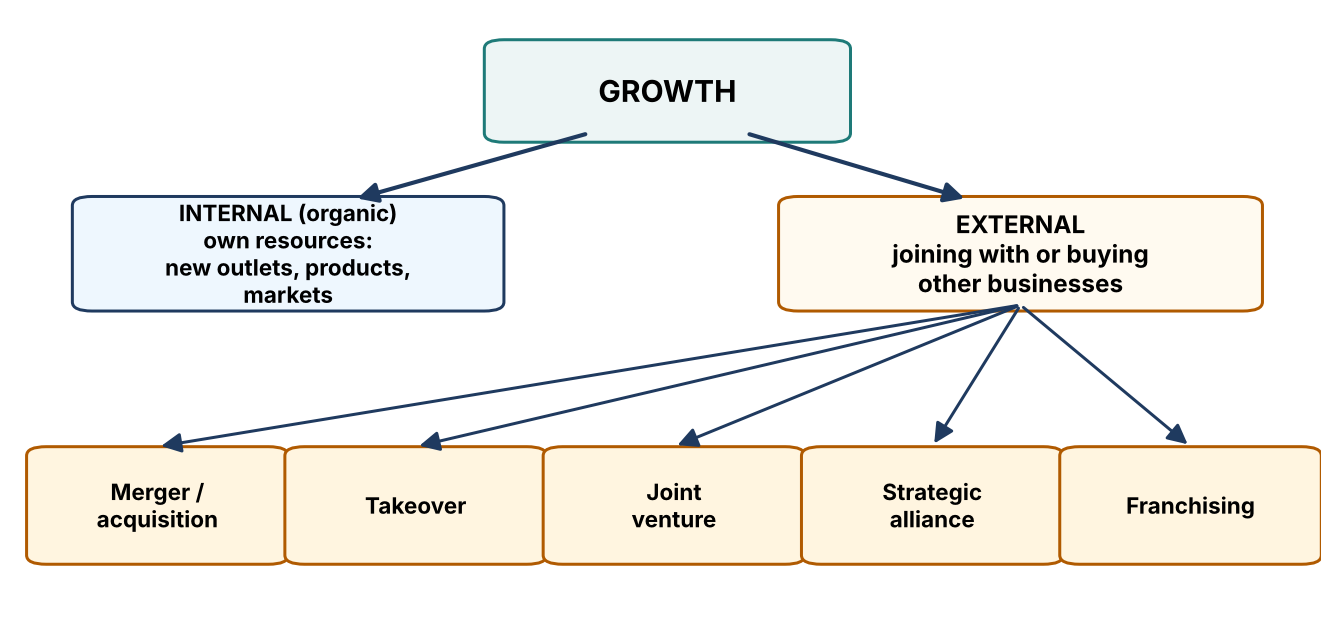
A joint venture is a separate business entity created by two or more organisations that share its ownership, costs, risks and profits for a specific purpose.
A strategic alliance is a cooperation agreement in which organisations share resources or capabilities for mutual benefit without creating a new entity or changing ownership. Franchising allows one business (the franchisee) to trade using the name, branding and business model of another (the franchisor) in return for an initial fee and ongoing royalties.
| Method | Key advantage | Key drawback |
|---|---|---|
| Merger / acquisition | Instant scale, brands, customers and know-how | High cost; culture clash — many deals destroy value |
| Takeover | Control gained even against the board's wishes | Premium price; hostility poisons staff relations |
| Joint venture | Shared cost and risk; local partner's knowledge | Shared control and profit; partners may fall out |
| Strategic alliance | Flexible, low-commitment cooperation | Weak control; partner may become a competitor |
| Franchising | Rapid expansion using franchisees' capital and energy | Franchisor loses some quality control; franchisee pays royalties and loses independence |
A business wants to enter an unfamiliar foreign market → a joint venture with a local firm shares costs and supplies local knowledge, contacts and legitimacy → market entry is faster and less risky than going alone → but profits and decisions are now shared → so the choice turns on whether speed and knowledge matter more than control
External growth is fast but fragile: studies repeatedly find that a large share of mergers and acquisitions fail to deliver the promised value, usually because of culture clash, overpayment and integration problems. The best method depends on the strategic need — franchising suits replicating a proven format, joint ventures suit unfamiliar markets, acquisitions suit buying technology or eliminating a rival — and on how much control the business is prepared to share. (HL students can link this choice to Porter's generic strategies: a cost-leadership strategy pushes towards scale-building methods, while a focus strategy may argue for staying small.)
Growth is the most disruptive change most organisations ever experience: structures, cultures and power shift, and the firm that results is not simply a larger version of the old one. Managing growth is therefore less about finding opportunities than about managing the change they bring — which is why so many mergers that make sense on paper fail in practice.
Toolkit: Ansoff matrix and decision trees
The Ansoff matrix frames where to grow — existing or new products, existing or new markets — with risk rising as the business moves away from what it knows. A decision tree then helps compare how to grow, by laying out the options (for example, joint venture vs organic entry), their estimated costs, probabilities and payoffs, and calculating each option's expected value.
Question: Define the term economies of scale. [2]
Question: A factory's total costs are $450,000 when it produces 50,000 units and $720,000 when it produces 90,000 units. Calculate the average cost at each output level and comment on your results. [4]
Question: Distinguish between a merger and a joint venture. [4]
Question: Explain two reasons why the owner of a profitable café might choose not to expand. [6]
Question: An Indian clothing retailer wants to enter the European market. Discuss whether it should do so through a joint venture with a European retailer or through organic growth. [10]
Question: A factory's total costs are $450,000 when it produces 50,000 units and $720,000 when it produces 90,000 units. Calculate the average cost at each output level and comment on your results. [4]
Average cost = total cost ÷ output.
At 50,000 units: 450,000 ÷ 50,000 = $9.00 per unit → At 90,000 units: 720,000 ÷ 90,000 = $8.00 per unit
Average cost falls by $1.00 per unit (about 11%) as output rises by 80%, so the factory is experiencing economies of scale over this range — larger output spreads fixed costs and may bring purchasing and technical economies. Growth is lowering the cost of every unit, strengthening the firm's ability to compete on price.
- Shows the formula and full working, so method marks are secure even if arithmetic slipped
- States units ($ per unit) with every figure
- The comment interprets the numbers using course theory (economies of scale), as the command term requires
Question: An Indian clothing retailer wants to enter the European market. Discuss whether it should do so through a joint venture with a European retailer or through organic growth. [10]
A joint venture offers the retailer what it most lacks: knowledge of European consumers, sizes, fashion cycles and regulation, plus ready-made store locations, logistics and relationships. Sharing the investment halves the capital at risk in an unfamiliar market, and the partner's established brand lends credibility that an unknown Indian chain would take years to build. For a distant, culturally different market, this speed and local insight substantially reduce the chance of expensive early mistakes.
Organic growth, however, preserves everything the joint venture gives away. The retailer would keep 100% of profits and full control of its brand positioning — crucial in fashion, where image is the product — and would avoid the classic joint-venture risks: disputes over strategy, diverging objectives, and a partner that learns its designs, suppliers and margins before potentially becoming a competitor. Entering gradually (perhaps online first, then flagship stores) lets it test demand with limited capital and adjust before committing further — though building awareness alone in a crowded European market could take years, and a slow entry gives incumbents time to respond.
On balance, the joint venture is the stronger route if the retailer's priority is speed and its main gap is market knowledge — provided the agreement protects its intellectual property and defines an exit route. If its priority is long-term brand control and it can afford a slow build, organic entry via e-commerce is safer. Given that clothing retail depends heavily on local taste and fast logistics, the balance tips towards the joint venture for physical retail, combined with retaining its own online channel — capturing the partner's knowledge while keeping a direct, wholly owned relationship with European customers.
- Argues both options fully, with mechanisms rather than lists
- Applies consistently to clothing retail and the India–Europe context
- Uses course concepts (risk sharing, control, brand, market knowledge) accurately
- Reaches a conditional, justified recommendation — and even synthesises a combined route
- Confusing economies of scale (lower average cost) with lower total cost — total costs rise with output; it is cost per unit that falls
- Mixing up internal/external growth with internal/external economies of scale — the same words label two different ideas in this topic
- Calling every acquisition a 'hostile takeover' — hostility refers to the target board's opposition, not the buyer's aggression
- Confusing a joint venture (new jointly owned entity) with a strategic alliance (cooperation without a new entity)
- Giving generic advantages and disadvantages in the 10-mark question without linking them to the scenario's industry and markets
- Tata Motors' acquisition of Jaguar Land Rover from Ford (2 June 2008): JLR media centre — https://media.jaguarlandrover.com/node/4917
- Domino's India store count (2,396 stores, December 2025 quarter): Free Press Journal — https://www.freepressjournal.in/business/jubilant-foodworks-q3-fy26-revenue-rises-134-to- 2439-crore-store-count-at-3594
- Air India–Vistara merger completed 12 November 2024: Air India press release — https://www.airindia.com/in/en/newsroom/press-release/vistara-merger-completed-second-airline.html
- Reliance–Disney (Viacom18–Star India) merger effective 14 November 2024: exchange4media — https://www.exchange4media.com/media-tv-news/reliance-disney-jv-transaction-completed- 138714.html