Level: SL and HL
When a company crosses borders, it brings jobs, technology and tax revenue — and takes decisions a host government cannot fully control.
Guiding question
Is the arrival of a multinational company good news for a host country?
- I can define a multinational company and explain why companies become multinational
- I can analyse the economic, social and environmental impacts of MNCs on host countries
- I can evaluate the overall impact of an MNC on a host country, recognising that it depends on the MNC, the industry and the host government
The host country is a country in which a foreign MNC establishes operations; the home country is where the MNC is headquartered.
MNCs expand abroad to reach new markets, cut production and transport costs, access raw materials and skills, overcome trade barriers, and spread risk across economies. For host countries — especially developing ones — their arrival is a double-edged event, bringing investment and jobs alongside competition and new dependencies.
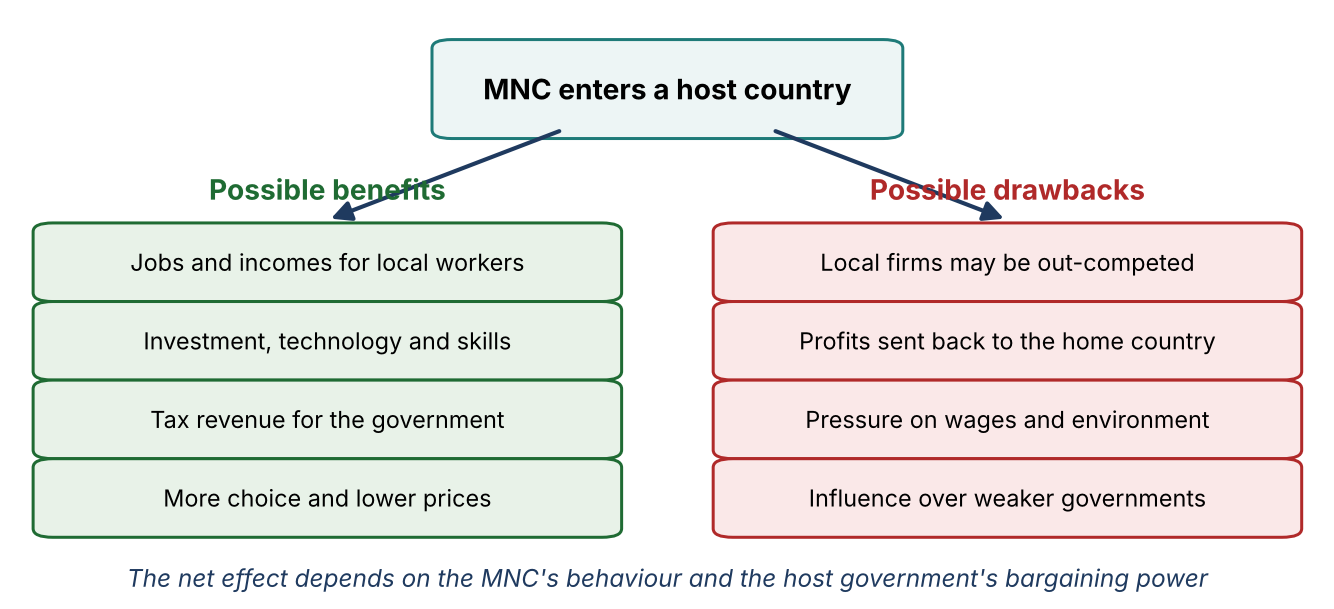
- Jobs and incomes — directly in the MNC's operations and indirectly among local suppliers, distributors and service providers
- Investment and infrastructure — factories, equipment and sometimes roads, ports and training facilities the host could not fund alone
- Technology and skills transfer — modern methods, management practices and training spread into the local economy as workers and suppliers learn them
- Tax revenue — corporate taxes, employee income taxes and indirect taxes fund public services
- More choice and lower prices — competition from the MNC can improve quality and reduce prices for consumers
- Exports and foreign currency — MNC output sold abroad improves the host's trade position
- Damage to local competitors — small domestic firms may be unable to match the MNC's scale, brands and prices, and may be forced out
- Repatriation of profits — profits may flow back to shareholders in the home country rather than being reinvested locally
- Footloose behaviour — an MNC may relocate when subsidies expire or cheaper locations appear, leaving sudden unemployment
- Environmental and social costs — resource extraction, pollution and workplace standards may be weaker than in the home country; local culture may be eroded by global brands
- Political influence and tax avoidance — large MNCs can pressure weaker governments for concessions and shift profits to low-tax countries
- Skilled-worker drain — the best local talent may be absorbed from domestic firms and public services
An MNC opens a plant in a host country → local hiring and supplier contracts inject incomes → skills and technology spread to local firms → but weaker local competitors lose sales and may exit → the net effect depends on whether the capability gained exceeds the competition displaced
- The MNC's behaviour — a long-term investor that trains, sources locally and pays taxes differs from one chasing subsidies and lax rules
- The industry — manufacturing tends to build supplier networks; pure extraction may leave little behind
- The host government's bargaining power and regulation — local-content rules, environmental enforcement and tax treaties shape who captures the gains
- The strength of local firms — capable domestic suppliers turn the MNC into a customer; weak ones meet it only as a competitor
A balanced judgement avoids both extremes. MNCs are neither saviours nor villains: the same company can raise productivity and wages in one host country and extract resources with little benefit in another. The impact depends on the match between the MNC's strategy and the host's ability to negotiate, regulate and absorb — which is why identical investments produce such different outcomes across countries.
MNCs face an ethical question domestic firms do not: which country's standards should they follow? Operating to the minimum legal standard of each host — on wages, safety or emissions — may be lawful yet widely judged unethical when the home country demands more. Companies that apply one global standard accept higher costs in exchange for consistency and reputation.
Toolkit: STEEPLE analysis
Before entering a host country, an MNC should run a STEEPLE analysis of it: social attitudes to foreign brands, technological infrastructure, economic growth and exchange rates, environmental rules, political stability, legal requirements (such as local-sourcing rules) and ethical expectations. The same framework helps a host government anticipate an MNC's likely impact. (HL students can extend the entry decision with simple linear regression, using past data to forecast demand in the new market.)
Question: Define the term multinational company (MNC). [2]
Question: Describe two reasons why a company might set up operations in another country. [4]
Question: Explain one benefit and one drawback for local businesses when an MNC enters their market. [4]
Question: Explain two ways in which a host government could increase the benefits it gains from an MNC's investment. [6]
Question: A global fast-food MNC plans to open 100 outlets in a developing country. Discuss the likely impact on the host country. [10]
Question: Explain one benefit and one drawback for local businesses when an MNC enters their market. [4]
One benefit is new business as suppliers. An MNC needs local inputs — components, ingredients, logistics, cleaning and security services — so capable local firms gain a large, reliable customer and often receive training and quality systems that make them more competitive with every client they serve.
One drawback is intensified competition. Local firms selling similar products now face a rival with global brands, huge marketing budgets and economies of scale that allow lower prices. Customers may switch to the MNC, squeezing local firms' revenues and forcing some, particularly small retailers and producers, out of the market altogether.
- Answers for local businesses specifically — not for the country, consumers or government
- Each point names a mechanism (supplier contracts, economies of scale) and follows it to a consequence
- Balanced structure mirrors the question's one-benefit-one-drawback demand
Question: A global fast-food MNC plans to open 100 outlets in a developing country. Discuss the likely impact on the host country. [10]
The investment will bring clear economic gains. One hundred outlets mean thousands of jobs — counter staff, managers, drivers — plus construction work and ongoing contracts for local food suppliers, who typically must meet the MNC's quality and hygiene standards and thereby upgrade their own capabilities. The government gains corporate and employment taxes, and consumers gain choice, predictable quality and competitive prices. Fast-food MNCs also transfer systems — supply-chain management, food-safety procedures, staff training — that spread into the wider hospitality industry as trained workers move on.
The drawbacks are equally real. Local food vendors and independent restaurants may lose customers to a rival with national advertising and scale purchasing, threatening livelihoods in a sector that often employs the poor. Much of the profit will be repatriated to the MNC's home country, and franchise fees flow the same way. There are also social and health concerns: heavy marketing of processed food can shift diets in countries already facing rising obesity, and global menus can displace local food culture. Environmental costs — packaging waste in particular — fall on municipalities with limited waste infrastructure.
The net impact depends on how the entry is structured and regulated. If outlets are franchised to local entrepreneurs, source most ingredients domestically and comply with strong food-labelling and waste rules, the host captures jobs, skills and tax while limiting the harms; if the MNC imports inputs and extracts concessions, the benefits thin considerably. On balance, for most developing countries the impact is moderately positive in employment and skills terms, but the government should actively shape it — through local-sourcing incentives and health regulation — rather than assume the benefits arrive automatically.
- Considers economic, social and environmental impacts, each developed in context
- Grounds every argument in the specifics of fast food and a developing country
- Weighs rather than lists, and concludes with a justified judgement plus policy conditions
- Acknowledges the limits of prediction — the hallmark of the 9–10 band
- Defining an MNC as 'a company that sells in many countries' — exporting alone is not enough; it must operate (produce or run facilities) in more than one country
- Writing one-sided answers that list only benefits or only drawbacks of MNCs
- Discussing the impact on the MNC when the question asks about the host country (or vice versa)
- Ignoring who the stakeholders are — top answers specify which groups in the host country gain and which lose
- Asserting impacts without mechanisms — 'MNCs create jobs' earns little until you show how (direct hiring, supplier contracts, induced local spending)