Governments, investors, banks and competitors all need to compare the size of businesses — to apply the right regulations, judge creditworthiness or assess market power. There are several methods, and no single measure is best: each suits some comparisons and misleads in others.
| Method | How it measures size | Main limitation |
|---|---|---|
| Number of employees | Counts people employed | A highly automated factory can be huge with few workers; part-time staff distort the count |
| Revenue (sales turnover) | Total value of sales in a period | High-price industries (aircraft) show large revenue with few units; says nothing about assets or efficiency |
| Capital employed | Total value of long-term finance invested in the business | Capital-intensive firms (steel) look large; labour-intensive ones (consultancies) look small |
| Market capitalisation | Share price × number of issued shares | Only works for listed companies; moves daily with the stock market mood |
| Market share | Business sales as a % of total market sales | Measures size relative to a market, not absolute size — a big fish in a tiny pond |
Profit is not a measure of size. A small firm can be highly profitable while a giant one makes losses — profit measures performance, not scale. The appropriate measure depends on the purpose: a bank assessing a loan looks at capital employed; a competition regulator looks at market share; an employment ministry counts employees.
A firm's shares trade at ₹250 and it has 40 million shares issued.
Market capitalisation = ₹250 × 40 000 000 = ₹10 000 million (₹1 000 crore)
If total sales in its market are ₹50 000 million and the firm's revenue is ₹7 500 million:
Market share = 7 500 ÷ 50 000 × 100 = 15%
Small businesses — from one-person services to family workshops — make up the overwhelming majority of businesses in every economy. Being small has genuine advantages as well as the obvious drawbacks.
| Advantages of being a small business | Disadvantages of being a small business |
|---|---|
| Close personal relationship with customers; | Limited finance — banks see small firms as risky |
| Advantages of being a small business | Disadvantages of being a small business |
| service can be tailored to each one | and charge more |
| Flexible: can adapt products and switch direction quickly | Few or no economies of scale, so unit costs are higher than large rivals' |
| Can profitably serve niche markets too small to interest large firms | Owner carries heavy workload and risk; one illness can stop the business |
| Simple structure: decisions are made fast, with low overheads | Little bargaining power with suppliers and large customers |
| Easier to motivate a small, close team | Hard to attract specialist managers and skilled staff |
A family business is one actively owned and managed by at least two members of the same family. Family firms range from corner shops to giants such as Tata (India), Walmart (USA) and BMW (Germany), where founding families remain major shareholders.
| Strengths | Weaknesses |
|---|---|
| Strong commitment, trust and shared values among owners | Family conflicts spill into the business — and business disputes into the family |
| Long-term outlook: building for the next generation, not the next quarter | Succession problems: the next generation may be unwilling or unable to lead |
| Decisions can be quick, with low monitoring costs between people who trust each other | Jobs may go to relatives over better-qualified outsiders, weakening management |
| Reputation and name are personally guarded, supporting quality | Reluctance to raise outside capital (to keep control) can starve growth |
- They provide the majority of jobs in most countries and absorb workers released by large firms
- They are a major source of innovation and competition, keeping big firms efficient
- They are the seedbed of future large firms — every multinational began small
- They serve local and niche markets that large firms ignore, and supply specialist parts and services to large firms
- They spread enterprise skills and incomes through every region, supporting development (Topic 1.1.2)
In some industries small firms are not just present but essential to how the industry works. Large manufacturers rely on networks of small component suppliers and subcontractors — a carmaker like Toyota buys thousands of parts from small specialist firms. In personal services (hairdressing, repairs, tuition), building trades and creative work, small size is the normal and efficient scale, because customers value personal attention and little capital is needed to compete.
Most owners want their business to grow — for higher profits, economies of scale (lower unit costs), greater market power, reduced risk through diversification, and the status and security that size brings. Growth can be internal or external.
- How: opening new outlets or factories; launching new products; selling into new regions or countries; hiring more staff; investing retained profits in capacity
- Why chosen: it is lower-risk and keeps control — the business expands what it already knows, at a pace it can manage and finance
- Drawback: it is slow; rivals growing by takeover can overtake an organically growing firm
A takeover (acquisition) occurs when one business buys control of another, by purchasing more than half of its shares. A takeover is friendly when the target's board recommends the offer, and hostile when the bidder appeals directly to shareholders against the board's wishes.
External growth is classified by the direction of integration — where the other business sits relative to the buyer.
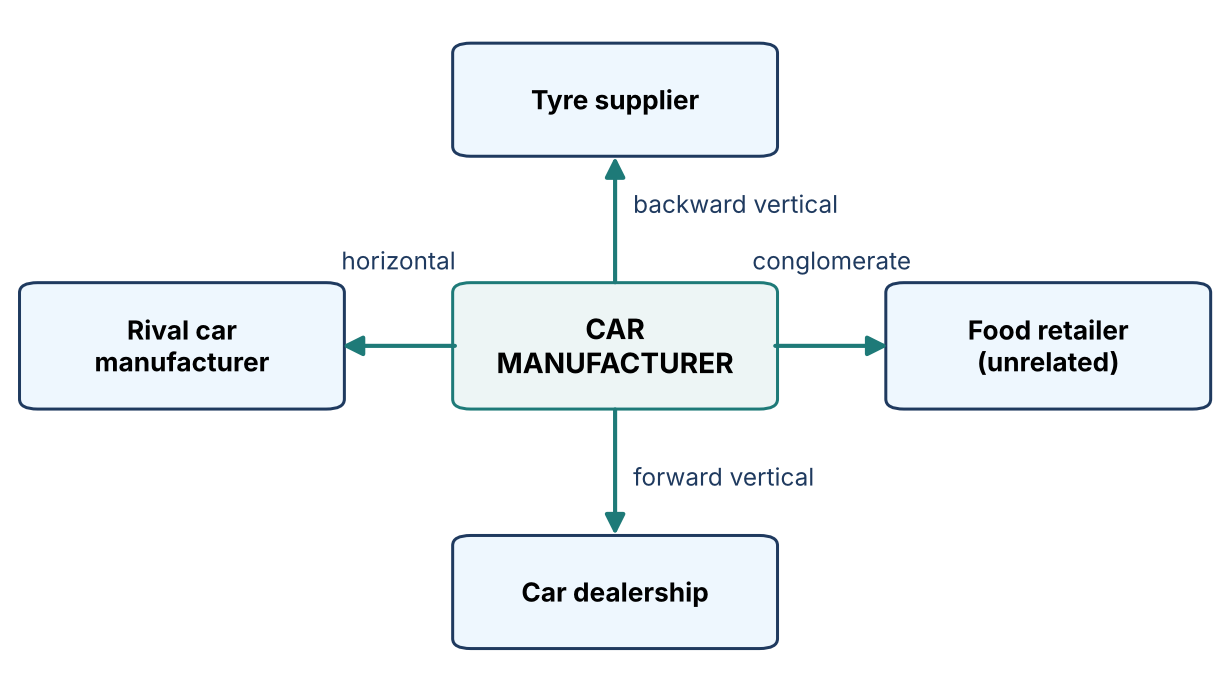
| Type | Combining with… | Main motives |
|---|---|---|
| Horizontal | A business at the same stage of the same industry (a rival) | Bigger market share; remove a competitor; economies of scale |
| Vertical backward | A supplier (earlier stage) | Secure supplies and their quality; capture the supplier's profit margin |
| Vertical forward | A customer / distributor (later stage) | Guaranteed outlets; control how the product is sold and priced |
| Conglomerate diversification | A business in a different industry | Spread risk across markets; enter growth industries |
| Stakeholder | Possible gains | Possible losses |
|---|---|---|
| Employees | Opportunities in a larger business | Redundancies where jobs are duplicated; culture clash and insecurity |
| Customers | Wider range; lower prices if cost savings are passed on | Less choice and higher prices if competition is removed |
| Shareholders (target) | Usually paid a premium above the market share price | Lose any future growth of the independent business |
| Stakeholder | Possible gains | Possible losses |
| Shareholders (buyer) | Growth and synergies if the deal works | Share price falls if the buyer overpaid |
| Suppliers | Larger orders from a bigger customer | Squeezed prices from a more powerful buyer; some dropped entirely |
| Community / government | Investment and secure large employer | Factory closures; reduced competition may need regulation |
- Culture clash: incompatible ways of working destroy cooperation and drive talent away
- Overpaying: the premium paid exceeds any realistic gain, so the buyer's shareholders lose
- Diseconomies of scale: the combined business becomes too complex to manage; communication and control weaken
- Loss of focus: managers spend years integrating systems instead of serving customers
- Expected synergies never appear: forecast cost savings prove optimistic
Two rivals merge → duplicated factories and head-office roles are cut → unit costs fall through economies of scale → the business can price more competitively → market share and profit rise — provided integration is managed well
Whether external growth succeeds depends less on the logic of the deal than on integration: culture, systems and key staff.
It depends on the price paid: a sound business bought too expensively is still a bad deal. Horizontal deals promise the clearest cost savings but attract regulator scrutiny; conglomerate deals spread risk but stretch management into industries it does not understand.
Both methods let a business grow without the cost and risk of a full takeover: partners share investment, technology and market access, and the arrangement can be unwound if it fails. They are especially important for entering foreign markets — a local partner contributes knowledge, contacts and sometimes legally required local ownership. The price is shared profits and shared control: slower decisions, possible disputes, and the risk of educating a future competitor. Tata Starbucks (Topic 1.2.2) shows the joint-venture route into India; airline code-sharing alliances show cooperation without shared ownership.
Question: Define the term 'market capitalisation'. [2]
Question: Explain one reason why the number of employees may be a misleading measure of the size of a software business. [3]
Question: Explain the difference between a merger and a hostile takeover. [4]
Question: Analyse two reasons why a soft-drinks manufacturer might take over one of its bottle suppliers. [8]
Question: Evaluate whether a family-owned restaurant chain should grow by taking over a rival chain rather than by opening its own new restaurants. [12]
Question: Analyse two reasons why a soft-drinks manufacturer might take over one of its bottle suppliers. [8]
This is backward vertical integration — combining with a business at an earlier stage of production. One reason is to secure supply. Bottling capacity is essential to the manufacturer: if the supplier failed, raised prices or served a rival first, drink production would stop. Owning the supplier guarantees bottles arrive in the quantities and quality needed, so production lines run without interruption and delivery promises to retailers are kept, protecting revenue and reputation.
A second reason is to capture the supplier's profit margin and control costs. The supplier's selling price includes its own profit; after the takeover the manufacturer obtains bottles at cost. Lower input costs either widen the profit margin on every drink sold or allow a price cut that wins market share from rivals who still pay full supplier prices. The manufacturer can also direct the supplier's investment — for example into lighter or recyclable bottles — aligning the supplier's priorities with its own strategy.
- AO1 — the integration is correctly named and defined (backward vertical)
- AO2 — applied specifically to bottles and drinks production, not a generic 'supplier'
- AO3 — each reason is built into a chain ending in a business outcome (uninterrupted production → protected revenue; lower input cost → margin or market share)
- Precision — exactly two reasons, each developed, matching the AO3 weighting
Question: Evaluate whether a family-owned restaurant chain should grow by taking over a rival chain rather than by opening its own new restaurants. [12]
A takeover means buying control of the rival; organic growth means opening new restaurants from the chain's own resources. The case for the takeover is speed and market power. Buying the rival instantly adds trading restaurants, trained staff and an existing customer base, in locations that might take years to find and fit out. It also removes a direct competitor, so the combined chain faces less price pressure and gains purchasing economies — buying ingredients for twice the restaurants at better rates — which cuts unit costs across the group. However, the risks are serious for a family business. A takeover needs large finance at once: heavy borrowing or selling shares, which may end the family's cherished control — the very thing family firms protect. Restaurant chains live on culture and consistency; absorbing a rival's managers, menus and habits risks a culture clash that drives away the staff and regular customers who made the rival worth buying. Many takeovers fail to deliver their promised gains because of exactly these integration problems, and an overpaid deal destroys value even when operations go smoothly.
Organic growth, by contrast, fits the strengths of a family firm: each new restaurant copies a proven format, is funded gradually from profits, and keeps ownership and standards firmly in family hands — at the cost of slower expansion that may let other rivals take the best sites first. On balance, the chain should prefer organic growth unless speed is genuinely decisive. The judgement depends on the market and the family's objectives: if attractive sites are scarce and a competitor may buy the rival instead, a friendly, fairly priced takeover could be justified; but if the family values control and its distinctive culture — as most do — the slower, self-funded route grows the business without betting it.
- AO1 — both growth methods are accurately defined and relevant concepts used (economies of scale, integration, control)
- AO2 — argument stays inside the restaurant and family-business context (sites, menus, family control)
- AO3 — developed chains for the takeover (speed, market power) and against it (finance, culture clash), plus the organic alternative
- AO4 — a clear recommendation with the conditions it depends on (scarcity of sites, family objectives, price of the deal)
- Using profit as a measure of business size. Fix: profit measures performance; size is measured by employees, revenue, capital employed, market capitalisation or market share.
- Mixing up backward and forward vertical integration. Fix: backward goes towards suppliers (earlier stage); forward goes towards the customer (later stage).
- Calling any large business a conglomerate. Fix: conglomerate integration specifically means combining with a business in a different industry.
- Asserting that takeovers 'always create economies of scale'. Fix: analyse the conditions — scale economies arise only if operations are genuinely integrated, and diseconomies are possible.
- Ignoring the stakeholder named in the question. Fix: if asked about the impact on employees, analyse employees — not shareholders or customers.