- Survival — the first objective of every new business, and of established ones in a recession: keep cash flowing and stay trading
- Profit maximisation — earning the greatest possible profit for the owners, the textbook assumption for private firms
- Profit satisficing — earning enough profit to satisfy the owners while pursuing other goals (leisure, independence); common among small family businesses
- Growth — in sales, outlets or market share, bringing economies of scale, security from takeover, and higher managerial status
- Increasing market share — becoming the market's leading brand, which strengthens pricing power and attracts the best distributors
- Ethical and environmental objectives — behaving in ways society considers right, even at some cost to profit
State-owned organisations rarely aim at profit maximisation. Their typical objectives are to provide a service to the whole community at an affordable price (or free), to meet government quality and coverage targets (a rural post office or railway line kept open at a loss), to use resources efficiently so taxpayers get value, and at most to break even or earn a modest surplus for reinvestment.
A social enterprise (Topic 1.2.2) must succeed on all three lines: it needs profit to survive and grow, but exists to deliver its social purpose, and increasingly to do so sustainably.
CSR activities include paying suppliers fairly and promptly, cutting emissions and waste, honest marketing, good working conditions, and community investment. Supporters argue CSR builds reputation, attracts customers and employees, and prevents costly conflicts and regulation; critics argue its costs raise prices and that some firms use CSR as public relations while behaving badly elsewhere.
- they give everyone in the business a shared sense of direction
- they are the basis of decision-making: options are judged by how well they serve the objectives
- they allow performance to be measured — actual results compared with the target
- they motivate managers and employees, especially when rewards are linked to achieving them
- they reassure investors and lenders that the business knows where it is going
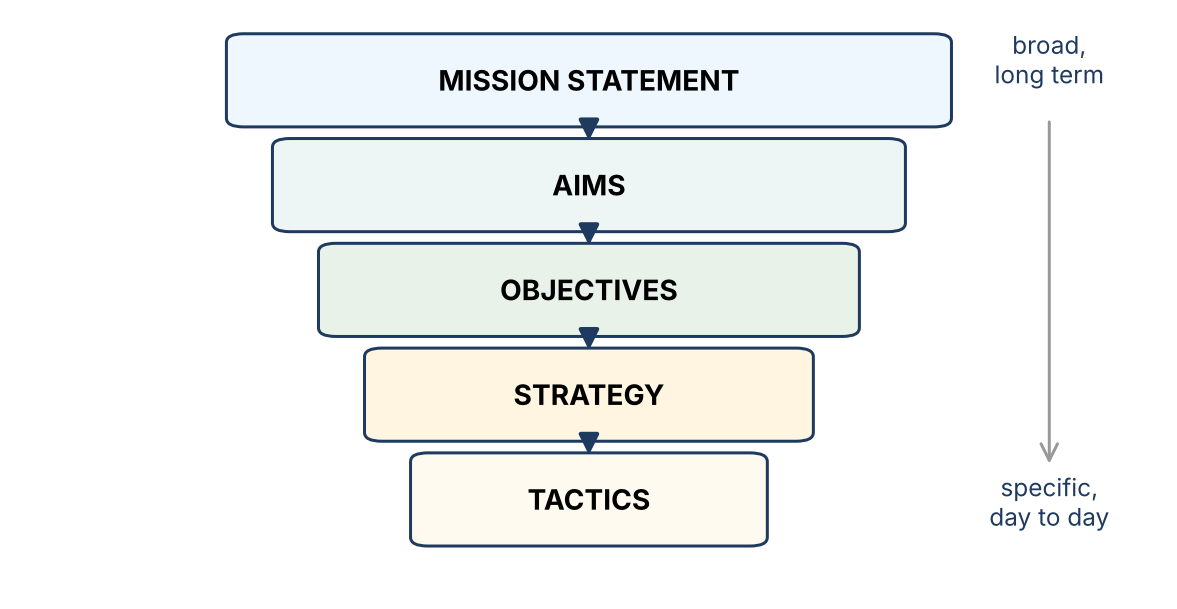
The mission is made real through a hierarchy: broad aims (long-term intentions), measurable objectives (specific targets that serve the aims), a strategy (the long-term plan of action to achieve the objectives), and tactics (the short-term, day-to-day decisions that carry out the strategy).
Objectives are the starting point and the yardstick of every major decision. A typical decision passes through these stages:
- 1. Set or review objectives — what is the decision meant to achieve?
- 2. Identify and analyse the problem or opportunity, gathering relevant data
- 3. Generate alternative courses of action
- 4. Evaluate the alternatives against the objectives (and the resources available)
- 5. Choose and implement the best option
- 6. Review the outcome against the original objectives — and learn from any gap
Objectives appear twice: they define what 'best' means at stage 4, and they are the benchmark for judging success at stage 6. Without clear objectives, a business cannot tell a good decision from a bad one.
Objectives are not fixed. They evolve with the business's situation:
- a start-up pursues survival; once established, the same firm targets growth and market share
- in a recession or crisis, growth objectives give way to survival and cash conservation
- a mature business may shift from growth to profit, dividends, or ethical and environmental goals
- new owners or managers bring new priorities — a founder's satisficing may become an investor's profit maximisation
- external pressure — regulation, competition, public opinion — forces objectives such as sustainability up the agenda
A corporate objective is translated downwards into targets for each department and individual, and into budgets — financial plans that allocate the money to achieve them (Topic 5.5). An objective of raising market share from 15% to 18% becomes a sales team target of 12 000 units, a marketing budget for the campaign, and output targets for production. In this way one objective coordinates the whole organisation.
Objectives only influence behaviour if people know and understand them. Clear communication gives employees direction and meaning, lets them see how their own targets contribute, and builds commitment — especially when staff are consulted in setting the targets. Poorly communicated or imposed objectives breed rumour, indifference or resistance; unrealistic ones demotivate as surely as none at all.
Objectives guide action best when they are SMART:
| Letter | Meaning | 'Increase revenue' becomes… |
|---|---|---|
| Specific | Precise about what is to be achieved | Increase revenue of the Mumbai store |
| Measurable | Expressed in numbers so progress can be checked | …by 10% |
| Achievable | Within the business's capability, so staff accept it | …with the current staff and new menu |
| Realistic | Sensible given resources and market conditions | …in a market growing at 6% |
| Time-limited | With a deadline | …by 31 December |
An ethical stance shapes both objectives and day-to-day activities: refusing child labour in the supply chain, honest advertising, fair wages, declining bribes to win contracts, cutting pollution below legal limits. Ethical conduct usually raises costs or sacrifices revenue in the short run — that is what makes it a real decision rather than a slogan.
Business adopts an ethical objective (e.g. fully sustainable packaging) → costs rise in the short run → reputation with customers, employees and investors strengthens → sales, recruitment and access to finance improve → long-run profit may be higher than under a purely profit-maximising policy
It depends on customers: ethics pays commercially only where enough buyers notice and will pay for it.
It depends on time horizon: ethical objectives usually cost in the short term and reward in the long term — a business fighting for survival may feel unable to afford them.
It depends on sincerity: claimed ethics exposed as public relations ('greenwashing') damages reputation more than making no claims at all.
Question: Define the term 'mission statement'. [2]
Question: Explain one reason why a new hair-dressing business might set survival rather than profit as its first objective. [3]
Question: Explain the difference between an objective and a strategy. [4]
Question: Analyse two benefits to a supermarket chain of setting SMART objectives for each of its stores. [8]
Question: Evaluate whether increasing profit should be the most important objective of a large clothing manufacturer. [12]
Question: Analyse two benefits to a supermarket chain of setting SMART objectives for each of its stores. [8]
One benefit is that SMART objectives make performance measurable. If each store is set a specific, time-limited target — say, 'raise revenue 8% by December' — head office can compare every store's actual sales against the same yardstick. Underperforming stores are identified early and helped or investigated, while successful managers' methods can be copied across the chain, so resources flow to where they improve results most.
A second benefit is motivation of store managers. An achievable, realistic target that a manager helped set gives a clear goal to work towards, and hitting it brings recognition or bonuses. Because the target is specific to their own store, managers cannot hide behind company-wide figures; effort translates visibly into results. Motivated managers push their teams harder on service and stock availability, raising sales across the chain — which is exactly the behaviour the objective was designed to produce.
- AO1 — SMART criteria are accurately understood and used (specific, measurable, achievable, time-limited)
- AO2 — consistently applied to a supermarket chain with per-store targets, not a generic business
- AO3 — each benefit is developed into a chain ending in a business outcome (better resource allocation; higher sales through motivation)
- Clarity — two distinct benefits in two paragraphs, matching the tariff
Question: Evaluate whether increasing profit should be the most important objective of a large clothing manufacturer. [12]
Profit is the surplus of revenue over total costs, and there is a strong case for putting it first. Profit is the manufacturer's source of survival and growth: it funds new machinery, design talent and marketing without costly borrowing, and it rewards the shareholders whose capital is at risk. If profit falls, investors sell, the share price drops, and the business becomes vulnerable to takeover — so pursuing profit also protects the independence that lets it pursue any other objective at all.
Profit also provides a single, clear measure of success across a large organisation. Factory managers, designers and sales teams in different countries can all be judged by their contribution to it, which simplifies decision-making: options are compared by their effect on the bottom line. However, an overriding profit objective can damage the business it is meant to serve. In clothing, the quickest routes to higher profit — cheaper fabrics, pressured suppliers, low-wage factories — invite exactly the scandals that have devastated apparel brands' reputations. Customers, especially younger ones, increasingly check how clothes are made; one exposed sweatshop can undo years of brand-building. Employees and investors are drawn to firms with wider objectives, and regulators and campaigners target firms with narrow ones. Objectives such as quality, ethical sourcing and sustainability are therefore not rivals to profit but often its long-run foundation.
Overall, increasing profit should be a central objective but not an absolute one. The best formulation for a large clothing manufacturer is profit subject to constraints — earned within ethical and environmental standards — or long-run profit rather than this year's maximum. The right balance depends on its market position and customers: a fast-fashion discounter under price pressure will weight profit heavily; a branded manufacturer whose value lies in reputation cannot afford to.
- AO1 — profit and alternative objectives are accurately defined and understood
- AO2 — the whole argument is grounded in clothing manufacturing (fabrics, suppliers, brand reputation, fast fashion)
- AO3 — developed analysis on both sides: profit as the engine of survival and growth; the dangers of profit-at-all-costs
- AO4 — a nuanced judgement ('a central objective, not an absolute one') with explicit dependencies (market position, customer type) rather than a yes/no assertion
- Treating 'aim', 'objective' and 'strategy' as interchangeable. Fix: aims are broad intentions; objectives are the measurable targets; strategy is the plan to achieve them.
- Writing the mission statement as a list of targets. Fix: a mission states purpose and values; the numbers belong in objectives.
- Claiming public sector organisations aim to maximise profit. Fix: their typical objectives are service provision, coverage and efficiency; at most break-even or a modest surplus.
- Describing the triple bottom line as 'three types of profit'. Fix: it is performance measured on three dimensions — economic, social and environmental.
- Evaluating 'profit vs ethics' as if a business must pick one forever. Fix: discuss balance, time horizon and conditions — when ethical objectives support long-run profit and when they genuinely cost.