Every business can be classified by the stage of production it operates in. Following a product from the ground to the customer passes through each sector in turn — the chain of production.
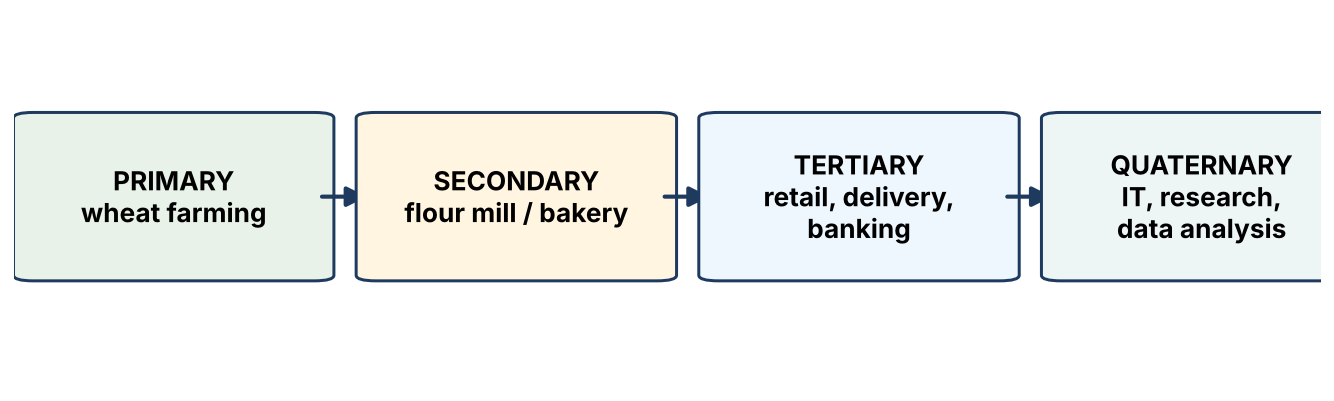
| Sector | Activity | Examples |
|---|---|---|
| Primary | Extracting natural resources from land or sea | Farming, fishing, mining, forestry, oil extraction |
| Secondary | Manufacturing and construction — turning raw materials into goods | Maruti Suzuki assembling cars; a bakery; housebuilding in Germany |
| Tertiary | Providing services to consumers and other businesses | Retailing, transport, banking, tourism, teaching |
| Quaternary | Knowledge-based services: information, research and technology | Infosys (IT services); biotech research labs in the USA; data analytics |
The public sector comprises organisations owned and controlled by the state (national or local government), usually providing services such as health, education, defence and public transport.
Most economies are mixed economies, containing both sectors. Public sector organisations typically pursue service quality and social objectives rather than profit alone; some state-owned enterprises (such as Indian Railways or Germany's Deutsche Bahn) sell services commercially while remaining publicly owned.
The balance between sectors shifts as an economy develops. Industrialisation is the growing importance of the secondary sector, typical of developing economies as workers move from farms to factories. De-industrialisation is the declining share of the secondary sector — and the rising share of the tertiary and quaternary sectors — typical of developed economies such as the UK and the USA.
| Reasons for the shift | Consequences |
|---|---|
| Rising incomes: as people grow richer they spend proportionately more on services (eating out, travel, streaming) than on goods | Jobs move between sectors: factory workers may lack the skills service employers need, causing structural unemployment |
| Cheaper manufacturing abroad: production relocates to lower-cost countries, hollowing out domestic industry | Regions built on one industry (mining towns, steel cities) decline and need regeneration |
| Technology: machines replace labour in farming and factories; digital business creates quaternary jobs | Developing countries gain factory jobs, exports and investment as production moves to them |
| Depletion of natural resources reduces primary output in some countries | Business opportunities change: growth markets shift to services, software and research |
The legal form of a business determines who owns it, who controls it, who keeps the profit and — critically — who is responsible for its debts.
Limited liability means the owners (shareholders) can lose only the amount they invested in the company; their personal assets are protected because the company is a separate legal entity.
This distinction matters enormously. Limited liability encourages people to invest in businesses they do not manage, because the most they can lose is known in advance — it is the foundation on which large companies raise capital from thousands of shareholders.
A sole trader is a business owned and controlled by one person, who may employ others but bears full responsibility alone. It is the most common form of business in the world — the local kirana store, a freelance designer in Singapore, a plumber in the UK.
| Advantages | Disadvantages |
|---|---|
| Quick and cheap to set up; few legal formalities | Unlimited liability — personal assets at risk |
| Owner keeps all the profit | Finance limited to the owner's savings and borrowing |
| Complete control and fast decision-making | Long hours; no one to share the workload or cover illness |
| Financial affairs stay private | Business usually ends when the owner retires or dies (no continuity) |
| Close personal relationship with customers | Owner must be multi-skilled — weak areas go unmanaged |
A partnership is a business formed by two or more people who share capital, responsibility, risks and profits — common for lawyers, accountants, doctors and family firms. A partnership agreement (deed) normally sets out capital contributions, profit shares and rules for disputes.
| Advantages | Disadvantages |
|---|---|
| More capital than a sole trader can raise alone | Unlimited liability for the partners (in a standard partnership) |
| Partners bring different skills and share the workload | Profits must be shared |
| Losses and responsibility are shared | Disagreements between partners can paralyse decisions |
| Affairs remain private; simple to form | Each partner is liable for the business actions of the others |
A private limited company (Ltd in the UK, Pvt Ltd in India) is a separate legal entity owned by shareholders, whose shares cannot be offered to the general public and are usually transferred only with the agreement of the other shareholders. Control commonly stays with a family or founding group.
| Advantages | Disadvantages |
|---|---|
| Limited liability for all shareholders | Legal formalities and costs to incorporate |
| Separate legal entity — the company continues even if an owner dies | Shares cannot be sold to the public, capping how much capital can be raised |
| Can raise capital by selling shares to family, friends and investors | Accounts must be filed and are less private than a sole trader's |
| Original owners usually keep control | Shareholders may find it hard to sell their shares |
A public limited company (plc; in India a listed public company) can sell its shares to the general public, usually through a stock exchange flotation (initial public offering, IPO). This gives access to very large amounts of capital — and brings outside scrutiny.
| Advantages | Disadvantages |
|---|---|
| Can raise very large capital by selling shares to the public | Expensive to float; strict disclosure and regulation |
| Limited liability and continuity | Accounts and strategy are public — competitors can study them |
| Shares are easy to buy and sell, attracting investors | Divorce of ownership and control: thousands of shareholders own, directors control |
| High public profile can help marketing and credit terms | Risk of a hostile takeover if the share price falls; pressure for short-term results |
Company floats as a plc → shares are sold to thousands of public investors → large capital is raised without loan interest → expansion can be funded on a new scale → but ownership is diluted among many shareholders → directors, not owners, control daily decisions — the divorce of ownership and control
| For the franchisee | For the franchisor |
|---|---|
| ✓ Trades under a proven brand — lower risk of failure | ✓ Rapid expansion using the franchisees' capital |
| ✓ Training, equipment and national advertising provided | ✓ Royalty income and fees with fewer management burdens |
| ✓ Easier to obtain bank finance | ✓ Motivated local owner-managers run each outlet |
| ✗ Fees and royalties reduce profit | ✗ A poorly run outlet damages the whole |
| For the franchisee | For the franchisor |
| brand | |
| ✗ Must follow the franchisor's rules — little independence | ✗ Profit per outlet is lower than owning it directly |
| ✗ Cannot sell the outlet without approval | ✗ Quality control across many franchisees is difficult |
A co-operative is owned and democratically controlled by its members — workers, customers or producers — usually on a one-member-one-vote basis, with profits shared among members. Strengths: members are committed because they own the business, and benefits stay with the people who create them. Weaknesses: capital is hard to raise (no outside shareholders), and decision-making can be slow with many member-owners.
| Advantages | Disadvantages |
|---|---|
| Shares costs and risks of a major project | Profits are shared |
| Each partner contributes different strengths (technology, local market knowledge) | Disagreements over objectives or control can wreck the venture |
| Common route into a foreign market with a local partner | Risk of handing valuable know-how to a future competitor |
Social enterprises sit between charities and conventional firms: they must still cover costs and compete for customers, but success is measured against a triple bottom line — economic, social and environmental (developed in Topic 1.4). Examples include SELCO (India), selling affordable solar systems to low-income households, and the UK's Big Issue, which creates earning opportunities for homeless sellers.
The appropriate form depends on the need for capital, the attitude to risk (is unlimited liability acceptable?), the desire for control and privacy, and the size and ambitions of the business. As a business grows, its legal form often changes with it — most commonly sole trader → private limited company → public limited company.
| Advantages of changing (e.g. sole trader to Ltd; Ltd to plc) | Disadvantages of changing |
|---|---|
| Gains limited liability, protecting the owners' personal assets | Costs and legal formalities of incorporation or flotation |
| Access to much more capital for expansion | Loss of control as new shareholders gain votes |
| Continuity: the business survives changes of owner | Less privacy — accounts must be published |
| Greater status with banks, suppliers and large customers | A plc faces short-term profit pressure and takeover risk |
It depends on why capital is needed: if growth plans genuinely require outside funds, the loss of some control may be a price worth paying; if not, the extra cost and disclosure bring little benefit.
It depends on the owners' objectives: a family seeking independence may rightly stay private (as Dyson has); founders seeking rapid national growth may need a flotation.
Changing form does not change the underlying business — a weak business does not become strong by becoming a plc.
Question: Define the term 'quaternary sector'. [2]
Question: Explain one reason why limited liability encourages people to invest in companies. [3]
Question: Explain the difference between a private limited company and a public limited company. [4]
Question: Analyse two advantages to an entrepreneur of opening a fast-food outlet as a franchisee rather than starting an independent restaurant. [8]
Question: Evaluate whether a successful two-partner firm of accountants should convert to a private limited company. [12]
Question: Analyse two advantages to an entrepreneur of opening a fast-food outlet as a franchisee rather than starting an independent restaurant. [8]
One advantage is that the franchisee trades under a proven brand. Customers already know and trust the franchisor's name and menu, so the new outlet attracts sales from its first day instead of spending months building a reputation. Higher early revenue means the outlet reaches break-even sooner, which greatly reduces the risk of running out of cash — the most common cause of failure for independent new restaurants.
A second advantage is the support package the franchisor provides: training in proven operating methods, tested recipes, approved suppliers and national advertising. The entrepreneur avoids expensive trial-and-error in areas where they lack experience, so food quality and costs are controlled from the start. Banks recognise this lower risk and are more willing to lend to franchisees, making the start-up finance itself easier and cheaper to obtain.
- AO1 — accurate knowledge of what a franchise involves (brand, training, suppliers, advertising)
- AO2 — applied throughout to a fast-food outlet (menu, food quality, restaurant failure rates)
- AO3 — each advantage is developed into consequences (earlier break-even → lower cash risk; lower risk → easier bank finance)
- Balance — two distinct advantages, developed to similar depth, matching the 8-mark tariff
Question: Evaluate whether a successful two-partner firm of accountants should convert to a private limited company. [12]
A private limited company is a separate legal entity whose shareholders have limited liability, while the partners currently have unlimited liability for the firm's debts. The strongest argument for converting is risk protection. An accountancy firm can face large claims if a client suffers loss from an error in its work; as partners, both owners could lose their homes and savings to meet such a claim. As shareholders in a company they would risk only their invested capital, and this security may also give them the confidence to take on bigger clients and grow.
Conversion would also help the firm raise finance and keep the business going. A company can sell shares to a new senior accountant or outside investor without the legal upheaval of rewriting a partnership, and it continues as the same legal entity if one owner retires — valuable for keeping long-term clients who want continuity.
However, conversion brings real costs. Incorporation involves legal fees and ongoing administration, and the company's accounts must be filed and disclosed, ending the privacy the partners now enjoy. Profits may face different tax treatment, and in many countries professional rules require accountants to carry indemnity insurance anyway — which already covers the main risk that limited liability protects against. If the partners have no plans to expand or bring in investors, the benefits may be largely theoretical.
Overall, the firm probably should convert, because for a professional practice the downside of unlimited liability is potentially catastrophic while the costs of incorporation are modest and one-off. The decision depends mainly on their growth intentions and the protection their insurance already provides: a firm content to stay small, fully insured and private loses little by remaining a partnership, but a firm with ambitions to add partners, staff and larger clients gains protection, continuity and flexibility that outweigh the loss of privacy.
- AO1 — precise knowledge of partnerships, private limited companies and limited liability
- AO2 — argument is rooted in the accountancy context (negligence claims, client continuity, indemnity insurance)
- AO3 — developed chains on both sides: protection and finance for; cost, disclosure and insurance against
- AO4 — a clear, justified recommendation with explicit 'it depends' factors (growth plans, existing insurance), not a repeat of earlier points
- Writing that limited liability protects 'the business' from debts. Fix: it protects the owners — the company itself remains fully liable for its debts.
- Confusing 'public limited company' with 'public sector'. Fix: a plc is privately owned by shareholders; the public sector is owned by the government.
- Claiming a sole trader 'cannot employ anyone'. Fix: a sole trader has one owner but may employ many workers.
- Listing franchise advantages for the wrong party. Fix: read whether the question asks about the franchisee or the franchisor — their advantages are different.
- In evaluation, recommending conversion 'because limited liability is good'. Fix: weigh it against the costs (fees, disclosure, control) and state what the decision depends on in this firm's situation.