Every business, from a street-food stall in Mumbai to a global carmaker in Japan, exists for the same underlying reason: people have needs (essentials such as food, water and shelter) and wants (desires that make life more comfortable), but the resources available to satisfy them are limited. The purpose of business activity is to combine scarce resources to produce goods and services that satisfy these needs and wants, usually with the intention of making a profit.
To produce anything, a business must bring together four types of resource, known as the factors of production.
| Factor | What it is | Example for a bakery |
|---|---|---|
| Land | All natural resources used in production | The plot the shop stands on; wheat; water |
| Labour | The physical and mental effort of workers | Bakers, cashiers, a delivery rider |
| Capital | Human-made resources used to produce other goods | Ovens, mixers, the delivery van, cash registers |
| Enterprise | The skill of combining the other three factors and taking the risk of production | The founder who invests savings and organises the business |
Adding value is central to all business activity. The transformation process turns inputs that customers would pay little for into outputs they will pay much more for. The difference does not come from nowhere — it is created by branding, convenience, quality, design and customer service, and it must cover all the other costs of the business (wages, rent, marketing) before any profit remains.
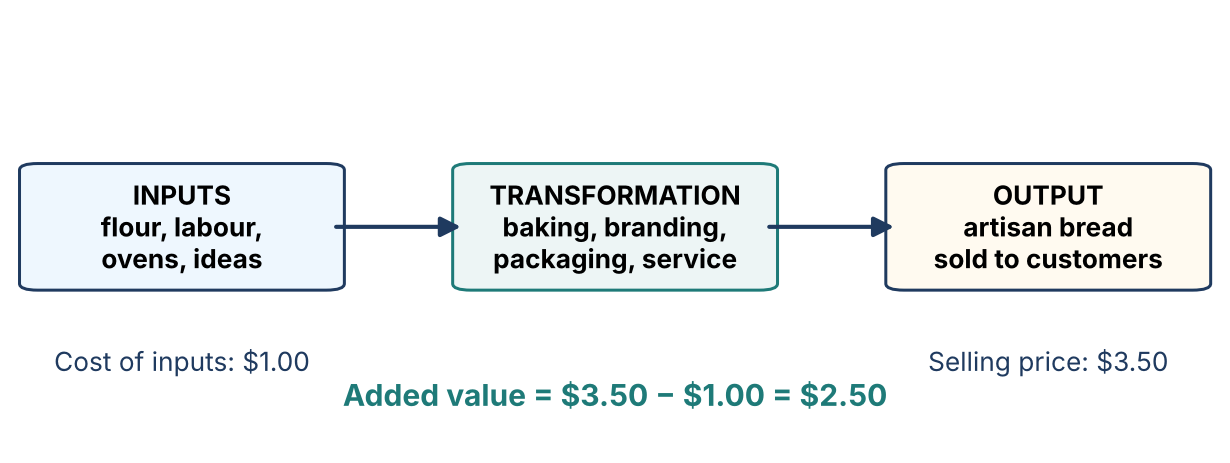
Business improves design and branding → customers perceive the product as worth more → selling price can rise faster than input costs → added value per unit increases → more is available to cover costs and generate profit
Resources are scarce but wants are unlimited — this is the basic economic problem. Because no individual, business or government can have everything, every economic decision involves choice, and every choice has a cost: the next best alternative that is given up.
Businesses operate in an environment that never stands still. New technologies appear, consumer tastes shift, competitors launch rival products, laws and taxes change, and economic conditions move between growth and recession. A business that fails to monitor and adapt to this dynamic environment risks losing customers to rivals that do. Change creates opportunities for new
enterprises (food-delivery apps, electric scooters) at the same time as it creates threats to established ones (video-rental shops, printed directories).
| Common reasons for success | Common reasons for failure |
|---|---|
| Clear understanding of customer needs, backed by market research | No real demand for the product; research skipped or ignored |
| Sufficient finance and careful cash-flow management | Running out of cash, even while profitable on paper |
| Skilled, motivated people and strong leadership | Poor management skills and over-reliance on one person |
| Flexibility — adapting products and methods as the market changes | Failure to respond to new competitors or technology |
| Effective planning and realistic objectives | Over-expansion that outruns resources and systems |
Most new businesses that fail do so in their first three years, and a shortage of cash is the most common immediate cause — a reminder that cash and profit are not the same thing (developed further in Topic 5.1).
| Type | Where it operates | Example |
|---|---|---|
| Local | One town or region only | A family-run tiffin service in Pune; a plumber in Leeds (UK) |
| National | Across most of one country | A supermarket chain trading only within Brazil |
| International | Sells (exports) to other countries but produces at home | A Kenyan tea producer exporting to Europe |
| Multinational | Owns operations (factories, offices) in more than one country | Tata Motors with plants in India and the UK; Toyota producing in Japan, the USA and Europe |
An intrapreneur is an employee who uses entrepreneurial skills — creativity, initiative and risk-taking — to develop new products or projects within an existing business.
- Innovation and creativity — spotting gaps in the market and original ways to fill them
- Commitment and self-motivation — long hours and persistence through setbacks
- Risk-taking — willingness to invest money and time with no guarantee of success
- Multi-skilled flexibility — in a start-up the founder is marketer, accountant and manager at once
- Leadership and communication — persuading lenders, suppliers, employees and customers to believe in the idea
- Self-confidence and resilience — recovering from rejection and failure and trying again
Entrepreneurs are the driving force of new business creation. Their role includes:
- generating the business idea and testing whether real demand exists
- providing or raising the start-up capital, often risking personal savings
- organising the factors of production — premises, equipment, people
- making the key early decisions on product, price and market
- bearing the risk of failure in exchange for the chance of profit
Established businesses can become slow and bureaucratic. Encouraging intrapreneurship helps them stay innovative: employees close to customers and processes often see opportunities that senior managers miss. Benefits include faster innovation, retention of ambitious staff who might otherwise leave to found rivals, and a culture that responds quickly to the dynamic environment. The business, not the employee, carries the financial risk — which is also why intrapreneurs may feel less urgency than entrepreneurs.
- Lack of finance — banks are reluctant to lend to untested ideas without collateral or a trading record
- Lack of business know-how — technical skill in a product is not the same as skill in marketing, accounting or managing people
- Red tape and regulation — licences, registration and tax compliance cost time and money
- Risk of failure — fear of losing savings (and, with unlimited liability, personal assets) deters many
- Competition — established firms enjoy brand loyalty and economies of scale
- Finding the right idea, premises and employees in the first place
Uncertainty exists when unforeseen events occur that could not have been predicted or quantified in advance.
An entrepreneur can estimate the risk that a new café fails to attract enough customers and plan for it (market research, cash reserves). No plan, however, could have quantified in advance the uncertainty of a sudden pandemic closing all cafés — uncertainty cannot be calculated, only responded to with flexibility.
- Job creation — new businesses employ people directly and create work for suppliers
- Economic growth — more output (GDP) and higher incomes
- Tax revenue — profits, wages and sales generate taxes that fund public services
- Reduced imports / increased exports — local production replaces foreign goods and may be sold abroad
- Innovation and productivity — new methods and technologies spread through the economy
- Social mobility — enterprise offers a route out of poverty independent of inherited wealth
Entrepreneur starts a successful business → jobs are created and incomes rise → households spend more with other local businesses → government collects more tax → spending on infrastructure and education improves → the environment for further enterprise strengthens
- to obtain finance — banks and investors will rarely lend without one
- to force the entrepreneur to think through every aspect of the venture before money is committed
- to provide a benchmark: actual performance can later be compared with the plan
- to give direction to employees and reassure suppliers and landlords
| Element | What it contains |
|---|---|
| Executive summary | A one-page overview of the whole plan |
| The business and its product | What will be sold, the value added, legal structure, the people involved |
| The market | Market research results: target customers, market size, competitors |
| Marketing plan | How the product will be priced, promoted and distributed |
| Operations plan | Premises, equipment, suppliers and production methods |
| Human resources | Staff needed, their roles and cost |
| Financial forecasts | Start-up costs, sources of finance, cash-flow forecast, forecast income statement, break-even estimate |
| Benefits | Limitations |
|---|---|
| Improves the chance of obtaining loans and investment | Forecasts are only estimates — they can create false confidence |
| Forces careful research and planning, reducing the risk of failure | Takes significant time that a founder could spend trading |
| Gives clear objectives against which progress can be measured | A rigid plan may be followed even when the market has changed |
| Helps identify problems (e.g. cash shortages) before they occur | The dynamic, uncertain environment quickly makes plans outdated |
| Communicates the vision to employees and partners | A good plan does not guarantee good day-to- day management |
It depends on who the plan is for: a plan is almost essential when external finance is needed, but a self-funded sole trader may gain less from a formal document.
It depends on how the plan is used: reviewed and updated regularly it stays useful; treated as a one-off exercise to satisfy the bank, its value fades quickly.
It depends on the environment: in fast-moving markets the thinking behind the plan matters more than the document itself.
Question: Define the term 'opportunity cost'. [2]
Question: Explain one way a hair salon could add value to its service. [3]
Question: Explain the difference between an entrepreneur and an intrapreneur. [4]
Question: Analyse two barriers that an entrepreneur might face when starting a new food-delivery business. [8]
Question: Evaluate the importance of a business plan to the success of a new business. [12]
Question: Analyse two barriers that an entrepreneur might face when starting a new food-delivery business. [8]
One barrier is a lack of finance. A food-delivery start-up needs money for an app, marketing and rider payments before any revenue arrives. Banks are reluctant to lend to a founder with no trading record or collateral, because the risk of default is hard to judge. If the entrepreneur cannot raise enough capital, the service may launch in too small an area to be noticed, so customer numbers stay low, revenue fails to cover fixed costs and the business runs out of cash before it can establish itself.
A second barrier is competition from established firms. Large delivery platforms already enjoy strong brand recognition and economies of scale, so they can charge restaurants lower commission and offer customers discounts that a new entrant cannot match. This means the entrepreneur must either accept very thin margins or spend heavily on promotion to win customers, both of which drain the limited start-up capital and lengthen the time before the business becomes profitable — increasing the chance it fails first.
- AO1 — two relevant barriers are accurately identified and defined (lack of finance; competition)
- AO2 — every point is applied to the food-delivery context (app costs, rider payments, platform commission), not left generic
- AO3 — each barrier is developed into a chain of consequences ending in an impact on the business (cash runs out; profitability delayed)
- Structure — two balanced paragraphs, one barrier each, matching the mark allocation
Question: Evaluate the importance of a business plan to the success of a new business. [12]
A business plan is a written document setting out a new business's objectives, market, strategies and financial forecasts. It is important first because it unlocks finance. A bank asked to lend to a new bakery will want to see a cash-flow forecast and evidence of market research; without a plan the loan is likely to be refused, the bakery cannot buy its ovens, and the business never starts. The plan therefore directly determines whether the venture can be funded at all. Second, writing the plan forces the entrepreneur to test the idea before risking money. Preparing a sales forecast makes the founder research how many customers exist and what rivals charge. If the numbers show the bakery cannot break even on the local high street, the entrepreneur can change location or pricing — or abandon the idea — before savings are lost. In this way planning reduces the biggest cause of early failure, which is discovering too late that costs exceed realistic revenue.
However, a plan is built on forecasts, which are only estimates. If a new competitor opens nearby or ingredient prices rise, the actual outcome will differ from the plan, and a founder who follows the document rigidly may respond too slowly. A plan also costs time: weeks spent writing are weeks not spent finding customers. Success ultimately depends on the quality of daily decisions, customer service and cash control, none of which a document can guarantee. Overall, a business plan is very important but not sufficient for success. It matters most when external finance is needed and in the start-up phase, where it disciplines the entrepreneur's thinking. Its value then depends on how it is used: as a living document that is reviewed against actual results it continues to guide decisions, but as a one-off exercise written only to satisfy a lender it contributes little. The plan improves the odds of success; the entrepreneur's flexibility and management skill decide it.
- AO1 — accurate definition of a business plan and relevant knowledge of its contents and purposes
- AO2 — sustained application to a concrete new-business context (the bakery: ovens, high street, ingredient prices)
- AO3 — two developed chains of analysis for importance, and a developed counter-analysis of the limitations
- AO4 — a supported judgement that weighs both sides and identifies what the answer depends on (need for finance; how the plan is used), rather than sitting on the fence
- Defining added value as 'profit'. Fix: added value is selling price minus the cost of bought-in materials only; profit also subtracts wages, rent and all other costs.
- Writing that a multinational is any business that 'sells in many countries'. Fix: it must own operations in more than one country; selling abroad alone makes it international.
- Treating risk and uncertainty as the same thing. Fix: risk can be estimated and planned for; uncertainty involves unforeseeable events and cannot be quantified.
- Listing qualities of an entrepreneur without development in an 'analyse' question. Fix: build each point into a chain — quality → what it enables → effect on the business.
- Evaluating business plans with 'it has advantages and disadvantages'. Fix: make a judgement and state what it depends on (purpose of the plan, how it is used, how fast the market changes).