Note the difference from a shareholder, who owns part of a company. Every shareholder is a stakeholder, but most stakeholders — employees, customers, the local community — own nothing. Stakeholders divide into two groups:
External stakeholders are groups outside the business with an interest in it: customers, suppliers, lenders, the government and the local community.
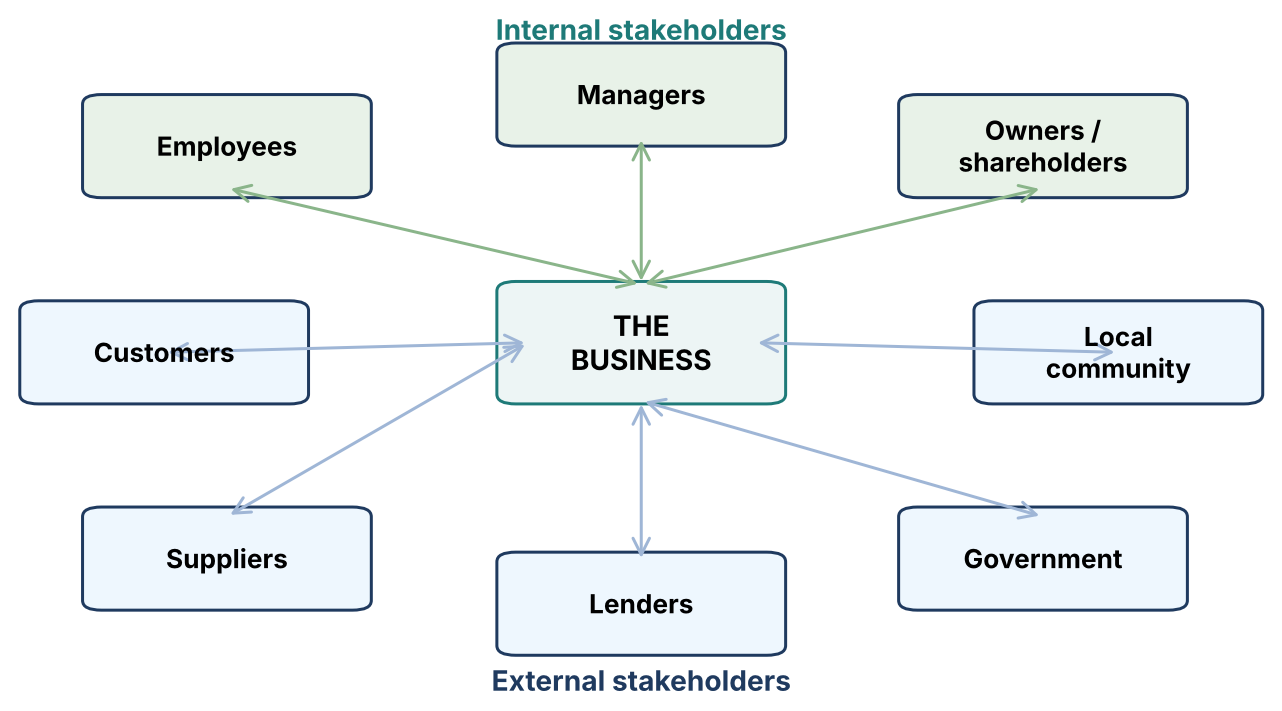
Each stakeholder plays a role in the business's success, holds rights it can legitimately expect, and owes responsibilities in return. The relationship runs both ways.
| Stakeholder | Role | Rights (what they can expect) | Responsibilities (what they owe) |
|---|---|---|---|
| Owners / | Provide capital; bear | Share of profit (dividends); | Provide capital as |
| Stakeholder | Role | Rights (what they can expect) | Responsibilities (what they owe) |
| shareholders | risk; appoint directors | a say in major decisions; honest information | promised; vote and oversee responsibly |
| Employees | Supply the labour and skills that create output | Fair pay, safe conditions, a contract, respect | Work honestly and competently; follow reasonable instructions |
| Managers | Plan, organise and control operations | Authority to act; fair reward for performance | Act in the business's interest, not only their own; account to owners |
| Customers | Buy the output — the source of all revenue | Safe products, honest information, fair prices, redress when things go wrong | Pay on time; make honest claims |
| Suppliers | Provide materials and services the business depends on | Fair prices, prompt payment, honest dealing | Deliver on time, at the agreed quality |
| Lenders | Provide loan finance | Interest and repayment as agreed; honest accounts | Supply funds as agreed; fair terms |
| Government | Sets the legal framework; provides infrastructure | Payment of taxes; obedience to laws | Apply laws consistently; provide stable conditions and services |
| Local community | Hosts the business; supplies workers and custom | Jobs for local people; protection from pollution, noise and congestion | Accept reasonable business activity; support local enterprise |
Almost every significant decision helps some stakeholders and harms others, and stakeholders do not simply absorb the impact — they react, and their reactions feed back into the business's results.
| Decision | Stakeholders affected | Likely reactions |
|---|---|---|
| Close a factory and relocate production abroad | Employees, local community, suppliers | Strike or protest; union negotiation; community campaigns; local suppliers seek new customers |
| Cut prices to win market share | Customers, shareholders, competitors | Customers buy more; shareholders question lower margins; rivals retaliate with their own cuts |
| Automate a production line | Employees, shareholders, customers | Job-loss resistance and falling morale; shareholders welcome lower costs; customers may gain lower prices |
| Delay payments to | Suppliers, lenders | Suppliers tighten terms, demand cash up |
| Decision | Stakeholders affected | Likely reactions |
| improve cash flow | front, or stop supplying; credit rating suffers | |
| Invest in cleaner, quieter equipment | Community, government, shareholders | Community support; easier planning permission; shareholders accept lower short-term profit for reputation |
Stakeholders exert influence through the levers they hold: shareholders vote and sell shares; employees work well, badly, or not at all; customers take their spending elsewhere; suppliers and lenders set terms; governments legislate, tax and license; communities campaign and lobby. The more a business depends on a group, the greater that group's influence over its decisions.
Decisions are not made in a vacuum and then imposed. Managers anticipate stakeholder aims before deciding: a wage offer is set with union expectations in mind; a price with customer reactions in mind; a factory site with community and government responses in mind. Powerful stakeholders effectively hold a veto — no supermarket chain prices in ways that drive its customers away, and no manufacturer ignores the standards its biggest buyer demands.
How a business is accountable: published annual reports and accounts to shareholders and lenders; consultation and works councils for employees; honest labelling, service standards and complaint procedures for customers; tax returns and regulatory filings for government; community meetings and increasingly social and environmental reporting for the wider public. Why it must be: the law requires much of it; stakeholders who are informed and respected keep supplying the capital, labour, materials and custom the business depends on; and concealment, when exposed, destroys trust faster than bad news honestly told.
Stakeholder aims pull in different directions, so conflict is built into business decision-making. Classic conflicts include:
- Shareholders vs employees — higher dividends and lower costs vs higher wages and secure jobs
- Customers vs shareholders — lower prices and better quality vs wider profit margins
- Managers vs owners — growth, status and salaries vs profitability and dividends
- Business vs community/government — cheap production vs clean air, quiet streets and tax revenue
- Short term vs long term — this year's profit vs investment whose payoff is years away
Directors prioritise shareholder dividends → pay rises are withheld to protect margins → employee morale and effort fall; the best staff leave → quality and service decline → customers switch to rivals → revenue and ultimately dividends fall — the neglected stakeholders strike back
Which stakeholder matters most depends on the decision: lenders dominate when refinancing; employees when skills are scarce; customers always, in the long run, because they supply every rupee of revenue.
It depends on dependence and alternatives: a stakeholder the business cannot replace (a sole supplier, a licensing government) has power; one with many alternatives has little. Managing stakeholders is about balance over time, not picking a permanent winner — businesses that systematically favour one group find the others withdrawing the cooperation it relied on.
When objectives change (Topic 1.4.2), the balance of gains and losses between stakeholders changes with them. A shift from growth to profit typically means cost-cutting: employees face redundancy fears, suppliers face squeezed prices, while shareholders gain. A shift towards survival in a downturn hits almost everyone — investment, orders, jobs and dividends are all cut to conserve cash. A new environmental objective pleases community, government and many customers, but may cost shareholders in the short run and demand new skills from employees. Businesses that explain the change, and cushion the losers, keep stakeholder cooperation through the transition.
Question: Define the term 'stakeholder'. [2]
Question: Explain the difference between a shareholder and a stakeholder. [3]
Question: Explain one way a business can be accountable to its customers. [3]
Question: Analyse how a supermarket's decision to open 24 hours a day might affect two of its stakeholder groups. [8]
Question: Evaluate whether shareholders are the most important stakeholder group for a large airline. [12]
Question: Analyse how a supermarket's decision to open 24 hours a day might affect two of its stakeholder groups. [8]
Employees are directly affected. Round-the-clock opening requires night shifts, so some staff face disruption to sleep and family life, which can lower morale and raise staff turnover; others, such as students, may welcome the extra paid hours at night rates. If the supermarket imposes the rota without consultation, resentment and absence are likely to rise, increasing recruitment and training costs — whereas negotiated shift premiums could turn the change into a motivator for those who want the work.
The local community is affected in opposite directions at once. Residents near the store suffer night-time noise from deliveries, cars and trolleys, and may complain to the council or oppose the store's future planning applications, straining relations the business depends on. At the same time, shift workers in the community — nurses, drivers, factory staff — gain the convenience of shopping at any hour, and extra night jobs are created locally. The net community reaction will shape how freely the supermarket can operate and expand in the area.
- AO1 — two stakeholder groups correctly identified with accurate understanding of their interests
- AO2 — rooted in the 24-hour supermarket context (night shifts, deliveries, shift-working customers)
- AO3 — effects are developed into consequences for the business (turnover and costs; planning relations), and reactions are considered, not just impacts
- Balance — recognises that impacts within one group can be both positive and negative
Question: Evaluate whether shareholders are the most important stakeholder group for a large airline. [12]
Shareholders own the airline and provide its risk capital, and there is a strong case for their primacy. Airlines are extraordinarily capital-hungry — aircraft cost hundreds of millions each — and the funds come from shareholders directly or from lenders reassured by a healthy share price. Directors are legally accountable to shareholders, who can remove them, and if returns disappoint, the share price falls and the airline struggles to finance its fleet or becomes a takeover target. Serving shareholders is therefore not optional; it underwrites the airline's ability to operate at all.
However, other stakeholders hold power that shareholders cannot override. Passengers supply every unit of revenue, and in an industry of thin margins and easy comparison websites, an airline that lets fares, safety or service slip loses them within a booking season. Employees — especially pilots and licensed engineers — are scarce, unionised and able to ground the entire operation by striking; no dividend survives a cancelled schedule. Governments license routes, allocate airport slots and enforce safety rules: their displeasure can shrink the business overnight. Each of these groups can destroy shareholder value faster than shareholders can create it.
The deeper point is that these interests are connected, not ranked: satisfied passengers and motivated crews are precisely what generates the profits shareholders want. 'Most important' therefore depends on the horizon and the situation. In a refinancing crisis, shareholders and lenders dominate decisions; during a strike, employees do; in daily operations, passengers do. Overall, shareholders are the most important group in ultimate control but not in daily priority. The airline best serves its shareholders by putting passengers and safety first and employees close behind, because long-run shareholder returns are the result of satisfying the stakeholders who fly, crew and license its aircraft — not an objective that can be pursued at their expense.
- AO1 — accurate definitions and knowledge of stakeholder groups and their claims
- AO2 — thoroughly applied to the airline industry (aircraft finance, slots, pilot strikes, booking websites)
- AO3 — developed chains for shareholder primacy and for the power of passengers, employees and government
- AO4 — a sophisticated judgement distinguishing ultimate control from daily priority, with explicit conditions (horizon, situation) — evaluation, not a list of both sides
- Using 'shareholder' and 'stakeholder' interchangeably. Fix: shareholders own shares; stakeholders are all groups with an interest — employees, customers, community and more.
- Classifying customers or suppliers as internal stakeholders. Fix: internal means within the business — employees, managers, owners. Everyone else is external.
- Describing impacts on stakeholders without their reactions. Fix: analysis improves when you follow the impact to the reaction and back to the business (job cuts → strike → lost output).
- Claiming every decision harms some stakeholder, so businesses 'cannot win'. Fix: show how businesses manage conflict — consultation, compensation, communication — rather than ending the analysis at the conflict.
- In 'most important stakeholder' evaluations, asserting a winner with no conditions. Fix: the strongest answers say when and why a group matters most — by decision, dependence and time horizon.