Level: SL and HL
Governments need to know how much an economy produces, how fast it is growing and how living standards compare. National income statistics answer these questions, though not perfectly.
3.1.1 National income accounting and the circular flow
Definition
National income accounting is the system used to measure the total value of goods and services produced in an economy over a period of time, usually a year or a quarter.
National income accounting is the system used to measure the total value of goods and services produced in an economy over a period of time, usually a year or a quarter.
The circular flow of income shows that every unit of spending on output becomes income for someone. So national output can be measured in three equivalent ways:
| Approach | What is added up |
|---|---|
| Output approach | The value of all final goods and services produced by firms (value added at each stage) |
| Income approach | All incomes earned by factors of production: wages, rent, interest and profit |
| Expenditure approach | All spending on final goods and services: C + I + G + (X − M) |
In principle, output = income = expenditure, because the value of what is produced must equal what is spent on it, and that spending is received as income.
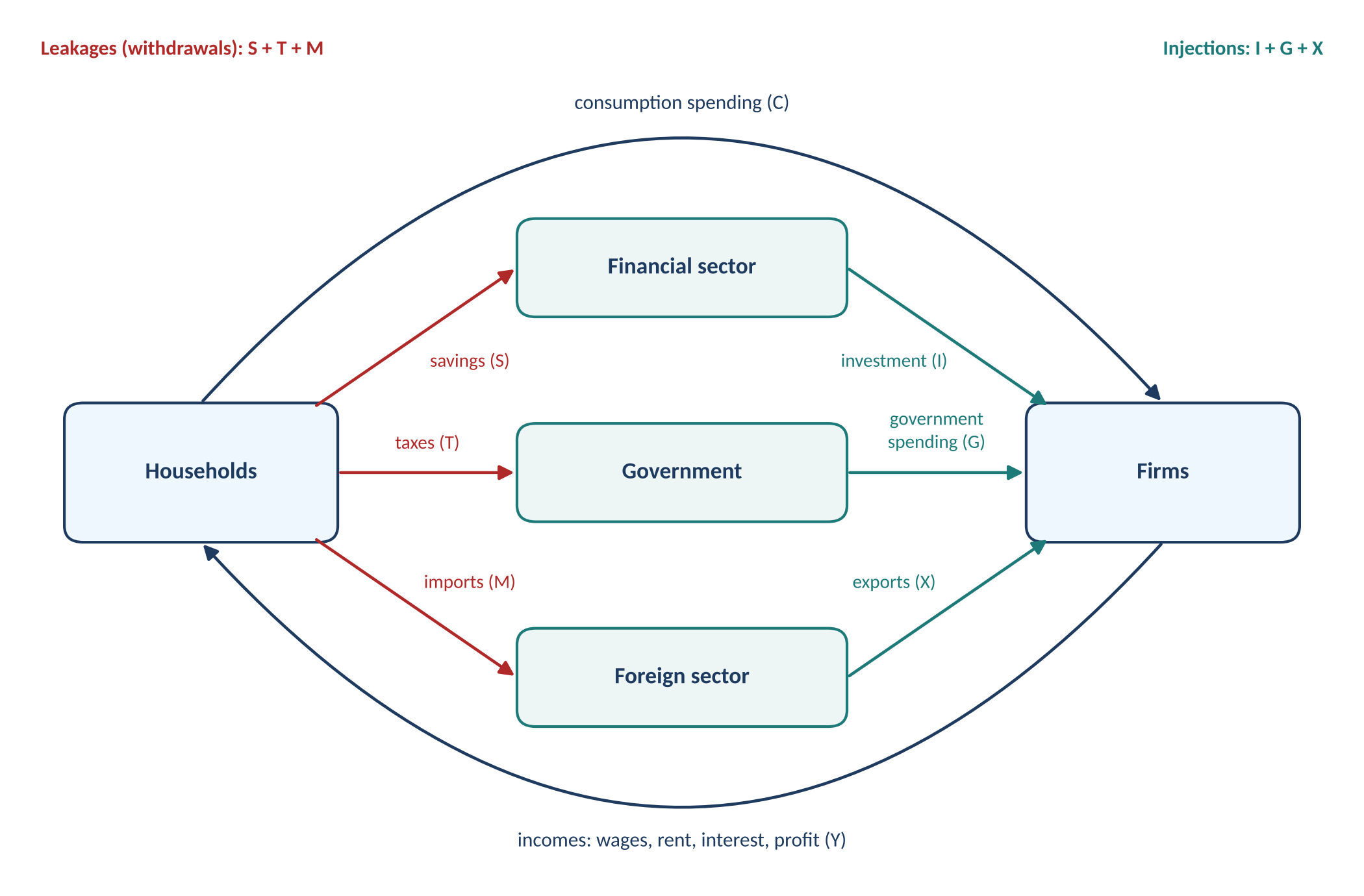
Figure 1: the circular flow of income with leakages and injections
🔒 Also in the full notes
- 3.1.2 Gross domestic product (GDP)
- 3.1.3 Gross national income (GNI)
- 3.1.4 Nominal and real GDP and GNI
- 3.1.5 Real GDP and GNI per capita, and purchasing power parity
- 3.1.6 The business cycle
- 3.1.7 Using GDP or GNI to measure economic well-being
- 3.1.8 Alternative measures of well-being
- Exam practice: 6 questions with mark allocations
- 2 exemplar answers with full model answers and examiner commentary