- Free goods are not scarce and have no opportunity cost, e.g. air, sunlight.
- Private goods are provided by private firms for profit. They are rivalrous (one person's use reduces availability to others) and excludable (people who do not pay can be prevented from using them). Examples: private cars, Ola/Uber rides, a mobile phone, a private beach resort.
Analysis chain (AO2): Private goods are excludable → firms can charge a price and stop non-payers → they can earn profit → the market provides them; free goods are not scarce → zero opportunity cost → no price.
- A free good can become an economic good: clean air in Delhi is now scarce, so people pay for air purifiers.
- Water is a free good in some places and a scarce economic good in others.
Because non-payers cannot be excluded, people can free ride: use the good without paying. Private firms cannot earn profit, so the market does not supply them (market failure) and the government provides them, financed by taxation.
Quasi-public goods have some but not all of the properties of public goods, e.g. beaches and parks. They can become overcrowded, polluted and noisy because of free riding.
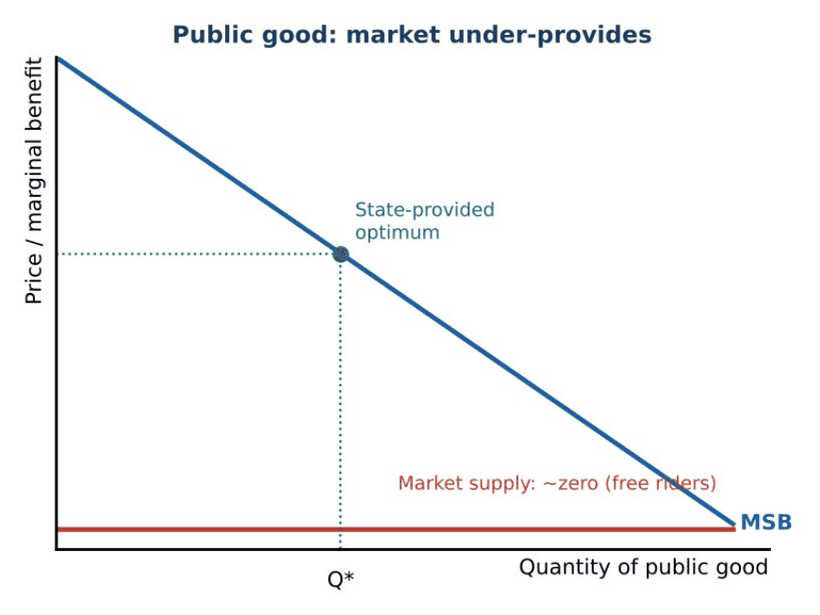
Analysis chain (AO2): Non-excludable → people cannot be stopped from benefiting → they free ride and do not pay → firms cannot earn revenue → the market fails to provide the good (missing market).
- Some goods are quasi-public: roads can become rival when congested and excludable through tolls (FASTag).
- Government provision needs funding through taxation, which has an opportunity cost and depends on accurate estimates of demand.
Examples: education and healthcare (state schools, government hospitals). Governments encourage consumption through subsidies, free provision or information campaigns. Without intervention there is under-consumption and market failure.
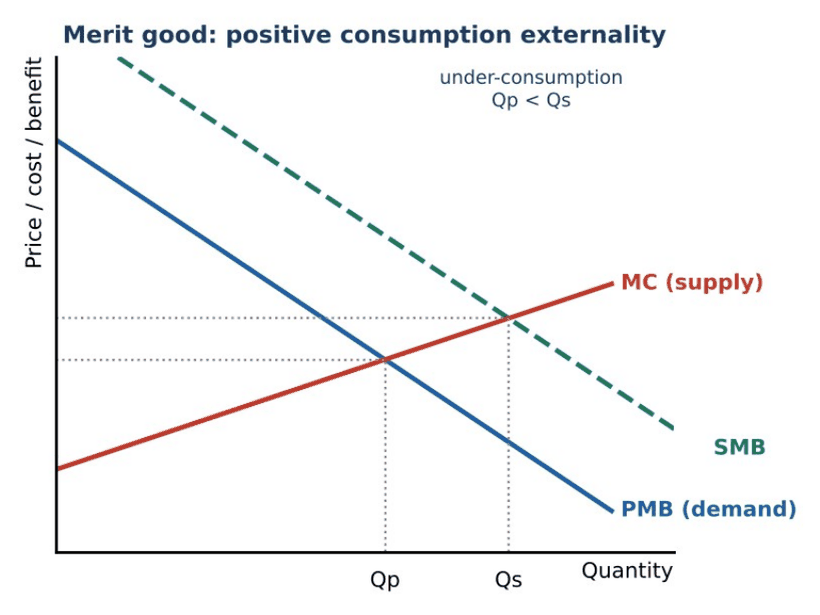
Analysis chain (AO2): Consumers have imperfect information and underestimate the private benefits → demand is too low → the good is under-consumed relative to the socially optimal level → market failure.
- Deciding what counts as a merit good is a value judgement by government.
- Consumers may under-consume because they cannot afford the good, not only because of poor information.
Examples: cigarettes, alcohol, drugs. Governments respond with taxes, bans, age limits, advertising restrictions and health warnings.
| Type | Rivalrous? | Excludable? | Examples |
|---|---|---|---|
| Private good | Yes | Yes | Car, phone, Ola ride |
| Public good | No | No | Defence, street lighting |
| Merit good | Usually yes | Usually yes | Education, healthcare, vaccines |
| Demerit good | Yes | Yes | Cigarettes, alcohol, drugs |
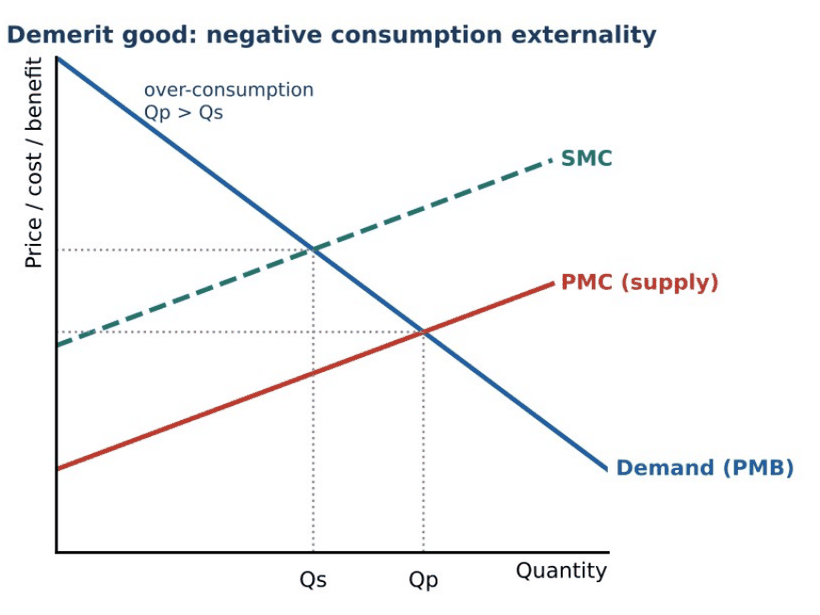
Analysis chain (AO2): Consumers have imperfect information and underestimate the private costs (health damage, addiction) → demand is too high → the good is over-consumed → market failure.
- Classifying a good as demerit is a value judgement; people may knowingly accept the risk.
- Addiction makes demand price-inelastic, so price-based policies may have only a small effect on consumption.
| No. | Question | Marks | Model answer |
|---|---|---|---|
| 1 | Using the characteristics of public and private goods, compare a lighthouse with an electric light bulb bought from a shop. | 8 | ✓ below |
| 2 | Explain why the free market fails to provide public goods, and assess whether the government should always provide them directly. | 8 | ✓ below |
| 3 | With examples, distinguish between free goods and public goods and consider whether a market economy can ever provide public goods. | 8 | |
| 4 | Explain why merit goods are under-consumed and demerit goods are over-consumed, and consider whether imperfect information is the only reason. | 8 | |
| 5 | Explain why bus and metro services are classified as private goods rather than public goods and consider whether they should be provided by the private sector alone. | 8 | |
| 6 | Consider whether a beach or a highway can be classified as a public good. | 8 |
Question: Using the characteristics of public and private goods, compare a lighthouse with an electric light bulb bought from a shop. [8]
[AO1 Knowledge & understanding] A public good has two characteristics: it is non-rivalrous (one person's consumption does not reduce the amount available to others) and non-excludable (once provided, people who do not pay cannot be prevented from benefiting). A private good is rivalrous and excludable.
[AO2 Analysis] A lighthouse is non-rivalrous: when one ship uses the light to navigate safely, the light is still fully available to every other ship in the area, so the marginal cost of an extra user is zero. It is also non-excludable: the light shines for all ships, and the operator cannot prevent a ship that has not paid from seeing it. Because ship owners can benefit without paying, they have an incentive to free ride. A private firm therefore cannot charge for the service and would not supply it, so the market fails and the service is usually provided by the government (in India, lighthouses are run by the Directorate General of Lighthouses and Lightships) and financed by taxes or port dues. A light bulb is a private good. It is rivalrous: if one household buys and uses a bulb, that bulb is not available to anyone else. It is excludable: a shop will not hand over a bulb unless the customer pays the price. Because producers can charge for bulbs and make a profit, the market supplies them through the price mechanism.
[AO3 Evaluation] In practice, some economists point out that lighthouses have historically been financed privately through charges on ships using nearby ports, which shows that public goods can sometimes be made partly excludable. The classification depends on the characteristics of the good, not on who provides it.
- AO1: both characteristics of public goods and of private goods defined.
- AO2: applies each characteristic separately to the lighthouse and to the light bulb, explains the free-rider problem and why the market will or will not supply each.
- AO3: the "private lighthouse" counter-argument; classification depends on characteristics.
Question: Explain why the free market fails to provide public goods, and assess whether the government should always provide them directly. [8]
[AO1 Knowledge & understanding] A public good is non-rivalrous (one person's consumption does not reduce the amount available to others) and non-excludable (people who do not pay cannot be prevented from benefiting). Examples include street lighting, national defence and flood defences.
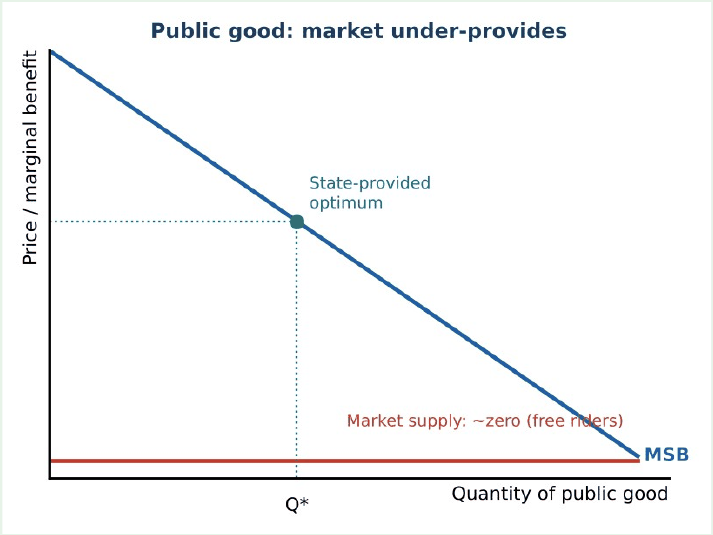
[AO2 Analysis] Because a public good is non-excludable, people can benefit without paying, so they have an incentive to free ride. A private firm therefore cannot collect enough revenue to cover its costs, even though the good has a high social value. As a result, the free market provides none of the good (a missing market). For example, no private firm would build street lighting in Mumbai and try to charge each passer-by.
[AO3 Evaluation] Direct government provision, financed by taxation, can solve this problem. However, the government may not know how much people value the good, so it may provide too much or too little, and tax finance has an opportunity cost. The government does not always need to produce the good itself: it can pay private firms to build and run it, as with many highway projects built under public–private partnerships. Some goods, such as roads, can also become excludable through tolls (FASTag), so the private sector can provide them directly.
- AO1: both characteristics defined accurately with examples.
- AO2: free-rider chain explained, leading to a missing market.
- AO3: limitations of government provision and alternatives (PPPs, tolls) to show it need not always be direct.