7.1.1 Definition and calculation of total utility and marginal utility
Definition: Utility is the satisfaction (benefit) a consumer gains from consuming a good or service. Total utility (TU) is the total satisfaction from consuming a given quantity. Marginal utility (MU) is the change in total utility from consuming one more unit: MU = ΔTU ÷ ΔQ.
| Cups of chai | Total utility (utils) | Marginal utility (utils) |
|---|---|---|
| 0 | 0 | – |
| 1 | 10 | 10 |
| 2 | 18 | 8 |
| 3 | 24 | 6 |
| 4 | 28 | 4 |
| 5 | 30 | 2 |
| 6 | 30 | 0 |
| 7 | 28 | −2 |
Worked calculation
MU of the 3rd cup = TU(3) − TU(2) = 24 − 18 = 6 utils. TU of 4 cups = sum of MUs = 10 + 8 + 6 + 4 = 28 utils. TU is at its maximum (30) when MU = 0 (6th cup). A 7th cup has negative MU: TU falls to 28.
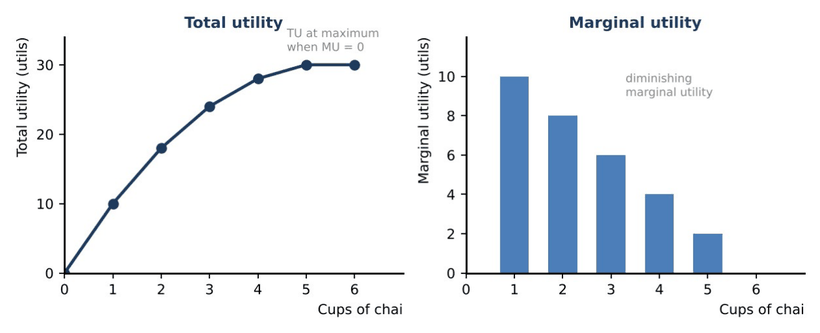
Figure: Total utility rises at a decreasing rate while marginal utility falls
🔒 Also in the full notes
- 7.1.2 Diminishing marginal utility
- 7.1.3 Equi-marginal principle
- 7.1.4 Derivation of an individual demand curve
- 7.1.5 Limitations of marginal utility theory and its assumptions of rational behaviour
- Exam practice: 2 practice questions
- 3 exemplar 20-mark essays with full model answers, mark breakdowns and common mistakes