7.2.1 Meaning of an indifference curve and a budget line
Definition: An indifference curve (IC) shows all combinations of two goods that give a consumer the same level of satisfaction (utility). A budget line shows all combinations of two goods a consumer can just afford with a given income and given prices.
- ICs slope downwards: to keep utility constant, more of X requires less of Y.
- ICs are convex to the origin because of a diminishing marginal rate of substitution (MRS): the more X a consumer has, the less Y they will give up for one more unit of X.
- Higher ICs (further from the origin) represent higher utility; ICs never cross.
- Budget line: intercepts are M/Py and M/Px; slope = −Px/Py.
- Consumer equilibrium is where the budget line is tangent to the highest attainable IC: MRS = Px/Py. This is the ordinal equivalent of the equi-marginal principle and does not require utility to be measured.
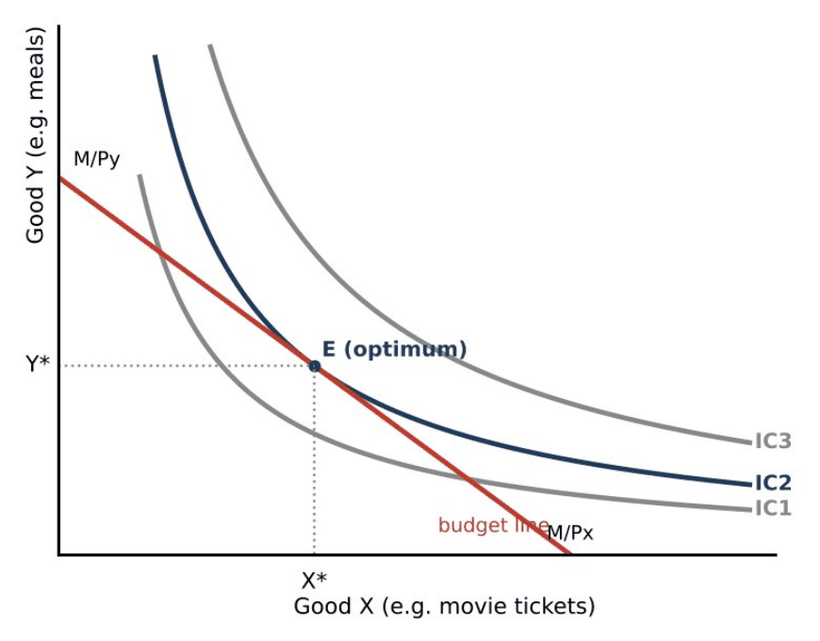
Figure: Consumer equilibrium: the budget line is tangent to the highest attainable indifference curve
Budget line calculation
Income M = $120; Px = $10; Py = $4. Maximum X = 120 ÷ 10 = 12 units; maximum Y = 120 ÷ 4 = 30 units. Slope = −Px/Py = −2.5: each extra unit of X costs 2.5 units of Y.
🔒 Also in the full notes
- 7.2.2 Causes of a shift in the budget line
- 7.2.3 Income, substitution and price effects for normal, inferior and Giffen goods
- 7.2.4 Limitations of the model of indifference curves
- Exam practice: 2 practice questions
- 3 exemplar 20-mark essays with full model answers, mark breakdowns and common mistakes