Rocks are the starting point for every mineral, metal and fossil fuel we use. This topic explains how the three rock types form, how they change into one another, and why some let water through.
The Earth's crust is made of rock, and every rock belongs to one of three groups. The group depends on how the rock formed. You need to know two or three named examples of each group and be able to describe how each one forms.
Sedimentary rock forms when sediments (rock fragments, shells or mud) are deposited in layers, then compacted and cemented together.
Metamorphic rock forms when existing rock is changed by heat and/or pressure without melting.
Both granite and basalt form from molten rock, but they cool at different speeds, and this controls the size of their crystals.
| Feature | Granite | Basalt |
|---|---|---|
| Where it cools | Deep underground (intrusive) | At or near the surface, often as lava (extrusive) |
| Cooling rate | Slow (thousands of years) | Fast (days to years) |
| Crystal size | Large, easily seen | Small, hard to see |
| Colour | Light (pink, white, grey) | Dark grey to black |
| Typical setting | Large masses under mountains | Lava flows, ocean floor |
The rule to remember: slow cooling gives large crystals, because the minerals have more time to grow. Fast cooling gives small crystals.
Granite is widely quarried in Karnataka and Rajasthan for building stone, and forms the Cairngorm mountains in Scotland, UK.
All sedimentary rocks form in layers (strata), usually in water. The process has the same steps each time:
- Weathering and erosion break existing rock into fragments.
- Transportation: rivers, wind or ice carry the fragments away.
- Deposition: the fragments settle in layers, often in lakes or seas.
- Compaction: new layers on top press down and squeeze out water.
- Cementation: dissolved minerals crystallise between grains and glue them together.
| Rock | What it is made of | How it forms |
|---|---|---|
| Limestone | Calcium carbonate, mainly shells and skeletons of sea organisms | Remains of marine organisms collect on warm, shallow sea floors, then are compacted and cemented |
| Sandstone | Sand grains (mainly quartz) | Sand deposited by rivers, seas or wind is compacted and cemented |
| Shale | Very fine clay and mud particles | Mud settles slowly in calm water; compaction squeezes the flat particles into thin layers |
Metamorphic rocks form when heat and pressure change an existing rock, usually deep underground or near magma, or where tectonic plates push together. The rock does not melt: its minerals recrystallise into a new, usually harder, rock.
| Parent rock | Change | Metamorphic rock | Properties |
|---|---|---|---|
| Limestone | Heat (and some pressure) | Marble | Interlocking crystals, harder than limestone, can be polished |
| Shale (or mudstone) | Pressure (and some heat) | Slate | Splits into thin flat sheets, impermeable, used for roofing |
Rocks are constantly, but very slowly, being broken down, moved and remade. The rock cycle shows how any rock can be changed into another type over millions of years.
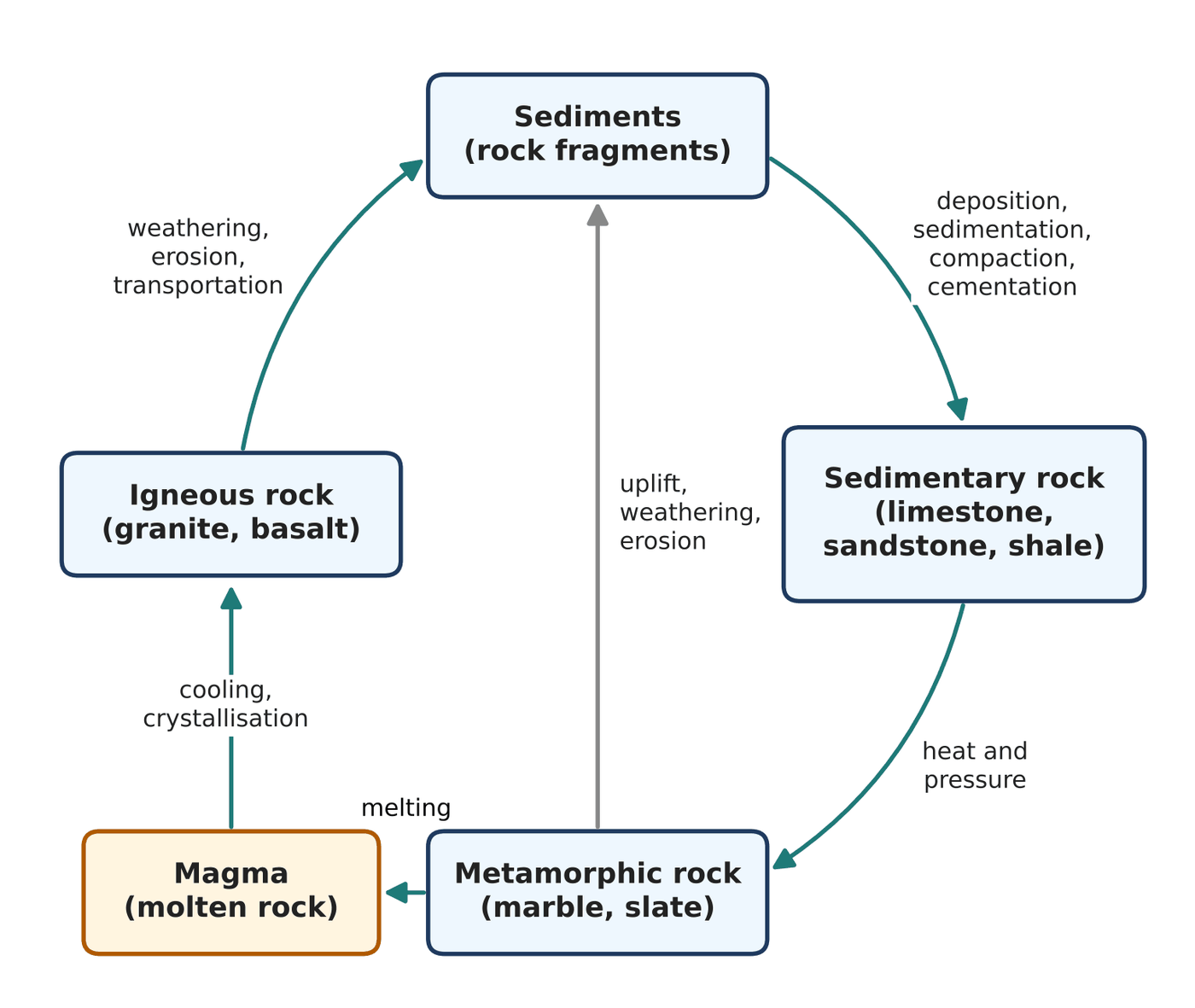
You must be able to describe each of these eight processes, and interpret a rock cycle diagram (identify a process from an arrow, or a rock from its position).
| Process | What happens |
|---|---|
| Weathering | Rock is broken down in place, by physical (freeze-thaw), chemical (acid rain) or biological (roots) action |
| Erosion | Rock fragments are removed and worn away by moving water, wind or ice |
| Transportation | Fragments are carried to a new location |
| Deposition | Fragments are dropped when the water or wind slows down and loses energy |
| Sedimentation | Particles settle out in layers on the bed of a lake or sea |
| Compaction | Weight of overlying layers squeezes sediments, pushing out water |
| Cementation | Dissolved minerals crystallise and glue grains together into solid rock |
| Crystallisation | Minerals form crystals as magma or lava cools |
Igneous rock exposed at the surface → weathering breaks it into fragments → erosion and transportation carry them to the sea → deposition and sedimentation form layers → compaction and cementation form sedimentary rock → burial brings heat and pressure → metamorphic rock → deeper burial melts it to magma → cooling and crystallisation form new igneous rock
Students often mix these up. Weathering breaks rock down where it is. Erosion involves movement: the fragments are carried away. In an answer, use both words correctly.
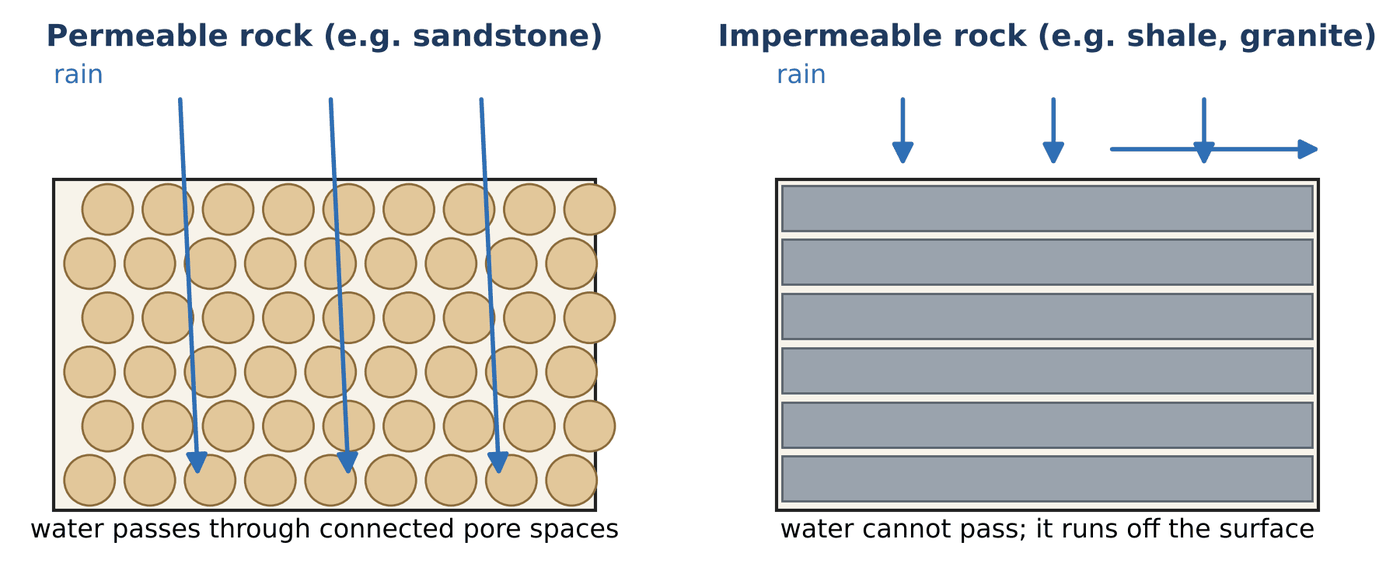
Pore spaces are the tiny gaps between grains. A rock is permeable if its pores are large and connected, so water can flow from one to the next. Permeability matters to environmental managers because it controls where groundwater collects, how fast pollution can spread, and whether a rock layer can hold oil or gas underground (see 1.6).
| Permeable | Impermeable |
|---|---|
| Most sedimentary rocks, for example limestone and sandstone | Igneous rocks (granite, basalt), metamorphic rocks (marble, slate) and some sedimentary rocks, such as shale |
| Grains with connected gaps between them, or cracks and joints that water can pass through | Interlocking crystals (igneous and metamorphic) or tightly packed flat clay particles (shale) leave no connected gaps |
Note that shale is sedimentary but impermeable, because its clay particles are so small and flat that the pores do not connect. This is a favourite exam trap.
Question: State the difference between the formation of granite and the formation of basalt. [2]
Question: Define the term permeability. [2]
Question: Name one sedimentary rock that is impermeable. [1]
Question: Describe how sandstone forms. [3]
Question: Explain why marble is harder than the limestone it formed from. [2]
Question: Using Figure 1, identify the process that changes metamorphic rock into magma, and the process that changes magma into igneous rock. [2]
Question: A student says, "Weathering and erosion are the same thing." Suggest why this statement is incorrect. [2]
Question: Suggest why a town on a sandstone layer is more likely to get its water from wells than a town on granite. [3]
Question: Describe how limestone forms and how it can change into marble. [4]
Limestone forms on warm, shallow sea floors from the shells and skeletons of marine organisms, which are made of calcium carbonate. When the organisms die, their remains are deposited in layers. The weight of new layers compacts the older ones and squeezes out water, and dissolved minerals cement the fragments together to form limestone.
If the limestone is later buried deeply or comes close to magma, heat and pressure cause its minerals to recrystallise without melting. This forms marble, a harder metamorphic rock with interlocking crystals.
- Correct origin: shells and skeletons of marine organisms (AO1).
- Uses process terms in order: deposition, compaction, cementation (AO1).
- Names heat and pressure as the cause of change to marble (AO1).
- States that the rock does not melt, separating metamorphism from igneous formation (AO1).
Question: A rock sample has large, interlocking crystals and is light pink. Suggest whether it is granite or basalt, and explain your answer. [3]
The rock is most likely granite. Large crystals mean the magma cooled slowly, which happens deep underground where the surrounding rock insulates it. Basalt cools quickly at the surface, so it has small crystals and is dark in colour rather than light pink.
- Makes a clear choice (AO3: judgement based on evidence).
- Links crystal size to cooling rate (AO1).
- Uses the colour evidence and contrasts with basalt (AO2: uses the information given).
- Writing "igneous rocks form from lava" only. Fix: say molten rock (magma or lava) cools and crystallises; granite forms from magma underground.
- Saying metamorphic rock forms by "melting". Fix: heat and pressure change it without melting; melting produces magma.
- Classifying all sedimentary rocks as permeable. Fix: shale is sedimentary but impermeable.
- Defining permeability as "how much water a rock holds". Fix: it is the ability of water to pass through pore spaces.
- Listing rock cycle processes without saying what each one does. Fix: give the action, for example "compaction: weight of layers squeezes out water".