Almost everything we build or use, from phones to roads, starts as rock dug out of the ground. This topic covers how it is extracted, why a mine is opened in one place and not another, what extraction does to people and the environment, and how damaged land can be restored.
A mineral is a naturally occurring solid with a fixed chemical make-up, such as haematite (an iron mineral) or bauxite (an aluminium mineral). An ore is worth mining only when it contains enough of the useful mineral to make a profit. The proportion of useful metal in an ore is called the ore grade: high-grade ore contains a lot of metal, while low-grade ore contains little.
Extraction methods fall into three groups. The method chosen depends mainly on how deep the deposit is and how concentrated it is.
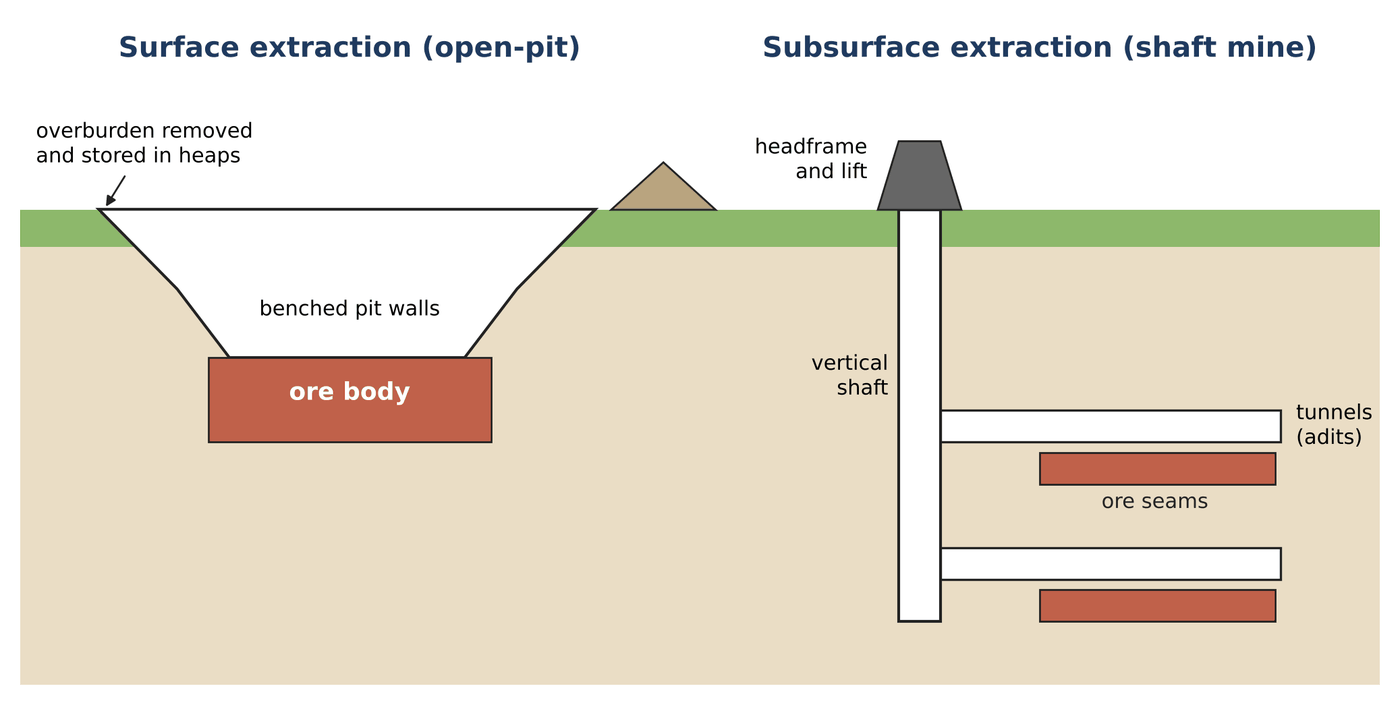
Surface extraction is used when the deposit is near the surface. The soil and rock covering the deposit, called overburden, is removed first and stored in heaps.
| Method | How it works | Typical use |
|---|---|---|
| Opencast / open-pit / open-cut | A large, deep pit is dug, with stepped sides (benches) so that the walls do not collapse. Rock is blasted, loaded and carried out by truck. | Metal ores such as copper and iron; granite and limestone quarries |
| Strip mining | Long strips of overburden are removed to expose a shallow, flat-lying layer. Each new strip's overburden is dumped into the previous strip. | Shallow, horizontal coal seams |
In India, most coal is mined by opencast methods in states such as Jharkhand, Odisha and Chhattisgarh.
Subsurface extraction is used when the deposit is too deep to dig a pit economically.
- Shaft mining: a vertical shaft is sunk to the deposit, with horizontal tunnels branching off. Miners and machinery travel down in lifts, and ore is brought up the shaft.
- Deep mining: the same principle at great depth, often thousands of metres down, where rock temperatures are high and ventilation and cooling are needed.
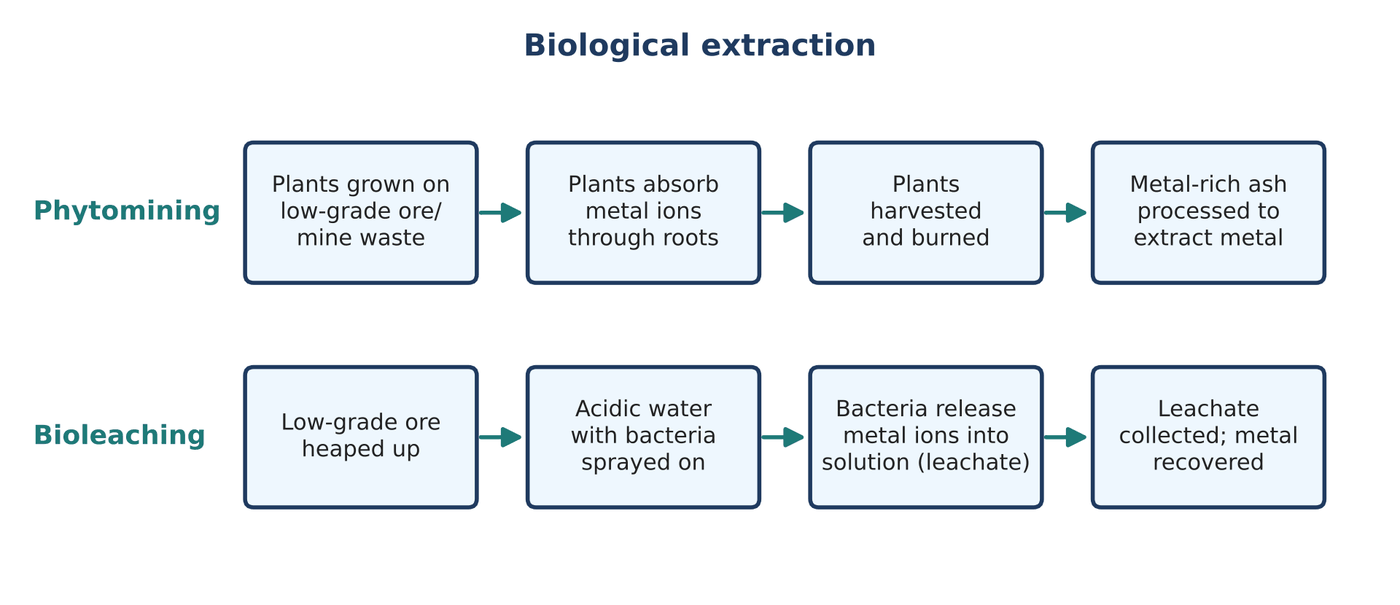
Biological methods use living organisms to extract metals, usually from low-grade ores or mine waste that would be too expensive to process by traditional methods.
| Method | How it works |
|---|---|
| Phytomining | Plants that absorb metals are grown on low-grade ore or mine waste. Their roots take up metal ions, which build up in the plant. The plants are harvested and burned, and the metal is extracted from the ash. |
| Bioleaching | Bacteria are used to release metal from ore. Acidic water containing the bacteria is sprayed over heaps of low-grade ore; the bacteria produce a solution containing metal ions (leachate), which is collected and the metal is recovered from it. |
Before a mining company opens a mine, it must decide whether extraction is technically possible, profitable and allowed. Eight factors are involved.
| Factor | Why it matters |
|---|---|
| Exploration | Geologists must first find and map the deposit, using surveys, test drilling and samples. Exploration is expensive and many sites are rejected. |
| Geology | The type of rock, its depth and the shape of the deposit decide which method can be used and how safe it will be. |
| Accessibility and terrain | Remote, mountainous or forested sites need new roads, railways and power lines, which raise costs. |
| Quantity and quality (ore grade) | A large, high-grade deposit gives more metal per tonne mined, so it is more profitable. |
| Climate | Extreme cold, heat or heavy monsoon rain can stop work, flood pits and raise costs. |
| Environmental impact assessment (EIA) | A study of the likely environmental and social effects. A poor EIA can lead to refusal of permission, or to conditions that add cost. |
| Supply and demand | High demand and limited supply push up the price of the mineral, making poorer deposits worth mining. |
| Cost and profit | The company will only mine if expected income is greater than the costs of extraction, processing, transport and restoration. |
Demand for lithium for electric-vehicle batteries rises → global lithium price increases → lower-grade or more remote deposits become profitable → companies explore new sites → more mines open
Extraction brings both benefits and costs. You must be able to describe and explain these impacts.
- Loss of habitat and biodiversity: vegetation and soil are cleared for the pit, spoil heaps, roads and buildings, so organisms lose their homes and food sources.
- Air pollution: blasting and heavy trucks produce dust; machinery releases exhaust gases.
- Land pollution: waste rock and tailings (finely ground waste left after processing) can contain toxic metals.
- Noise pollution: blasting, drilling and trucks disturb wildlife and nearby residents.
- Visual pollution: large pits and spoil heaps scar the landscape.
- Water pollution: rainwater running through waste rock can become acidic and carry dissolved metals into rivers (acid mine drainage); silt washed from bare ground clogs rivers.
- Water usage: processing ore uses large volumes of water, reducing supply for farms and towns, especially in dry areas.
- Waste management: huge volumes of overburden and tailings must be stored safely. Poorly built tailings dams can collapse.
- Employment: mines create jobs directly and in related services (transport, catering, construction). When a mine closes, many jobs are lost at once.
- Local and national economies: mining companies pay taxes and royalties; exports earn foreign currency; local businesses gain customers.
- Facilities and infrastructure: new roads, railways, electricity, schools and clinics may be built for the mine and also serve the local community.
- Negative social effects can include displacement of people from their land and health problems from dust and polluted water.
Opencast coal mine opens → forest and farmland cleared → local people lose land and income from farming → some gain mine jobs, others migrate → dust and polluted water affect health of those who stay
When extraction ends, the land can be restored (returned to a natural or productive state) or repurposed (given a new use).
| Strategy | What it involves |
|---|---|
| Replacement of overburden | Stored overburden and topsoil are put back to fill the pit and rebuild the land surface. |
| Soil improvement | Fertilisers, compost or lime are added to improve nutrient levels and pH so that plants can grow. |
| Bioremediation | Organisms (bacteria, fungi or plants) are used to break down or remove pollutants from the soil or water. |
| Tree planting | Native trees stabilise soil with their roots, reduce erosion and provide habitats. |
| New use | How it works |
|---|---|
| Landfill | The empty pit is lined and used to dispose of waste, then covered and landscaped. |
| Lakes | Pits are allowed to fill with water, creating lakes for water storage, fishing or wildlife. |
| Recreation | Sites become parks, sports grounds, golf courses or tourist attractions. |
| Nature reserves | Restored sites are managed to encourage wildlife. |
Many old quarries around Delhi, for example in the Aravalli hills, have filled with water and become lakes. Some are now being restored as parks and biodiversity areas.
| Strategy | Benefits | Limitations |
|---|---|---|
| Replacing overburden and soil improvement | Restores land for farming or forest; reduces visual pollution | Expensive; soil structure and nutrients take years to recover |
| Bioremediation | Cheaper and less disruptive than digging out polluted soil | Slow; works only for some pollutants; organisms need the right conditions |
| Tree planting | Reduces erosion; creates habitats; stores carbon | Trees may grow poorly on infertile spoil; needs aftercare |
| Landfill | Fills the pit and earns income | Risk of leachate polluting groundwater; methane emissions |
| Lakes | Cheap; provide water, recreation and habitats | Steep sides can be dangerous; water may be acidic or polluted |
| Recreation and nature reserves | Jobs, tourism, community and educational value | High start-up cost; needs long-term funding and management |
- It depends on who pays: if mining companies must set aside money for restoration before mining starts, restoration is far more likely to happen.
- It depends on the level of pollution: a heavily contaminated site may only be safe as a fenced landfill or reserve, not as farmland.
- It depends on local needs: a lake may suit a dry region needing water storage, while a city may gain more from a park.
- It depends on time: restoration often takes decades, so its success should be judged over the long term.
Question: Define the term ore. [1]
Question: Describe how phytomining is used to extract a metal. [3]
Question: State two differences between open-pit mining and shaft mining. [2]
Question: Explain how the ore grade of a deposit affects the decision to extract it. [2]
Question: Suggest why an environmental impact assessment is carried out before a mine is opened. [2]
Question: Describe two ways in which extraction can cause water pollution. [4]
Question: Explain how a new mine can have positive effects on the local economy. [3]
Question: Discuss the benefits and limitations of turning an old quarry into a lake. [4]
Question: Discuss the benefits and limitations of strategies for managing a landscape damaged by opencast mining. [6]
Question: An opencast coal mine in a rural area is closing. Discuss the benefits and limitations of strategies to manage the damaged landscape. [6]
One strategy is to replace the stored overburden and topsoil and improve the soil with fertiliser and compost. This benefits local people because the land can be used for farming again and the visual pollution of the pit is removed. However, it is expensive, and soil structure and nutrients may take many years to recover, so crop yields may be low at first.
Trees could also be planted. Their roots bind the soil and reduce erosion, and they create new habitats and store carbon. A limitation is that trees may grow slowly on infertile spoil and need aftercare to survive.
Alternatively, the pit could be allowed to fill with water to form a lake. This is cheap and can provide water storage, fishing and recreation. However, water draining through coal waste may be acidic, and steep sides can be dangerous to swimmers.
Overall, a combination is best: restore most of the land for farming and forest, and use the deepest part as a lake. Success depends on whether the mining company has set aside money for restoration and on long-term monitoring.
- Three named strategies, each correctly described (AO1).
- A benefit and a limitation given for each, applied to a rural coal mine (AO2).
- Develops points with reasons, such as "acidic water from coal waste" (AO1, AO2).
- Ends with a justified judgement that says what success depends on (AO3).
- Calling any rock an ore. Fix: an ore must contain useful minerals and metals, usually enough to be worth extracting.
- Describing phytomining without the harvest-burn-ash steps. Fix: state that plants are harvested and burned, and metal is extracted from the ash.
- Writing "mining causes pollution" with no type or cause. Fix: name the type (dust, noise, acid mine drainage) and say how mining causes it.
- In "Discuss" questions, giving only benefits. Fix: give benefits and limitations, then a judgement.
- Confusing restoration with repurposing. Fix: restoration returns land to a natural or productive state; repurposing gives it a new use.