Tropical cyclones are the most powerful storms on Earth, bringing extreme winds, torrential rain and coastal flooding. This topic covers where and how they form, their impacts, and how their impacts can be reduced.
Tropical cyclones are called by different names in different parts of the world: hurricanes in the Atlantic and north-east Pacific, typhoons in the north-west Pacific, and cyclones in the Indian Ocean and South Pacific. Weaker systems are called tropical storms.
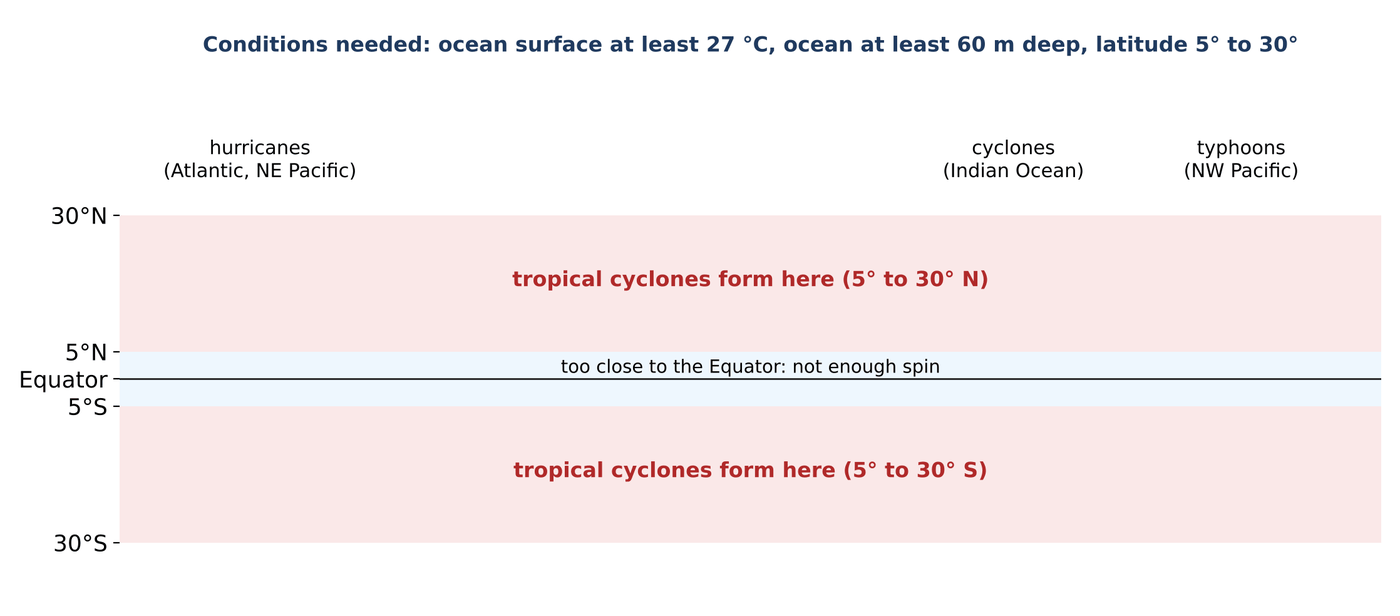
| Condition | Why it is needed |
|---|---|
| Form between 5° and 30° latitude north or south of the Equator | Near the Equator (within about 5°) the Earth's rotation does not provide enough spin for the storm to rotate; beyond about 30° the sea is too cool |
| Ocean temperature of at least 27 °C | Warm water evaporates rapidly; when the water vapour condenses in rising air, it releases the heat energy that powers the storm |
| Ocean depth of at least 60 m | A deep layer of warm water is needed so that the storm does not stir up cooler water from below and weaken |
Once formed, the storm is carried by winds, usually westwards and then towards the poles. It weakens over land or cooler water, because it loses its supply of warm, moist air. Hazards include very strong winds (in severe cyclones they exceed 119 km per hour, and the strongest exceed 250 km per hour), torrential rain, and a storm surge: a rise in sea level pushed onto the coast by the winds and low pressure.
- 6.2.2 Impacts of tropical cyclones
- 6.2.3 Managing the impacts before, during and after a tropical cyclone
- 6.2.4 Benefits and limitations of cyclone management strategies
- Exam practice: 7 practice questions
- 1 exemplar answer with a full model answer and mark breakdown
- Where students commonly lose marks