Floods affect more people worldwide than any other natural hazard. This topic covers the physical and human causes of flooding, its impacts, how those impacts can be managed, and the benefits floods bring.
6.3.1 Causes of flooding
Definition A flood happens when water covers land that is normally dry, for example when a river overflows its banks or the sea floods a coast.
| Cause | How it increases flooding |
|---|---|
| (a) Land relief | Steep slopes make water run off quickly into rivers; flat, low-lying land such as floodplains and deltas floods easily because water collects there |
| (b) Saturated soil | When soil is already full of water after long rain, no more can infiltrate, so it runs off over the surface |
| (b) Compacted soil | Soil squashed by machinery or animals has fewer pore spaces, so less water infiltrates |
| (b) Soil erosion | Eroded soil is washed into rivers, silting them up so they hold less water (see 2.3.2) |
| (c) Deforestation | Fewer trees means less interception and transpiration, so more water reaches rivers, more quickly |
| (c) Agricultural practices | Bare fields, ploughing up and down slopes, and drainage ditches speed up run-off |
| (c) Urbanisation | Concrete, tarmac and roofs are impermeable, so rain cannot infiltrate; drains carry water rapidly to rivers; building on floodplains puts more property at risk |
| (d) Climate change | Rising sea levels increase coastal flooding; an increase in extreme weather events brings more intense rainfall and stronger storms |
| (e) Storm surges and tsunamis | Coastal floods caused by low-pressure storms pushing the sea onto the land, or by giant waves from undersea earthquakes |
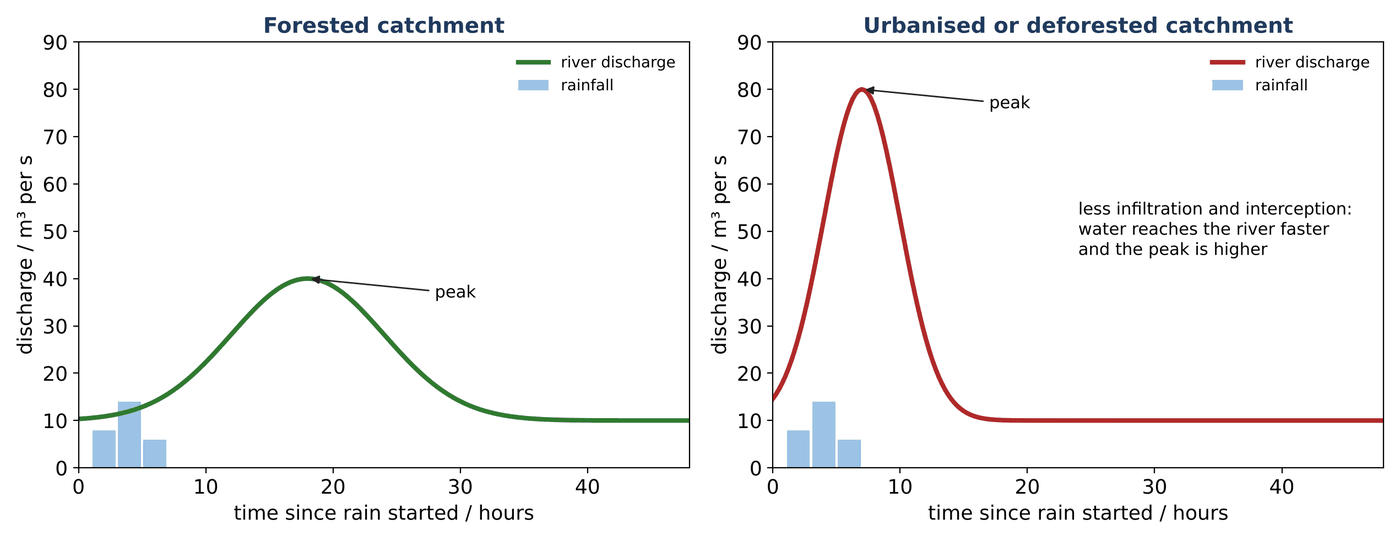
Figure 1: Flood hydrographs for a forested catchment and an urbanised or deforested catchment
A flood hydrograph shows how river discharge changes after rain. In an urbanised or deforested area, the peak discharge is higher and arrives sooner after the rain, so the river is more likely to flood.
Analysis chain
Wetlands and lakes in a growing city are built over → impermeable surfaces replace soil → rain cannot infiltrate and flows quickly into drains → rivers rise rapidly → urban flooding
Example In 2015, extreme rainfall caused severe flooding in Chennai. Studies blamed the scale of the flood partly on rapid urbanisation, which had built over many of the city's lakes and wetlands and blocked drainage channels.
🔒 Also in the full notes
- 6.3.2 Impacts of flooding
- 6.3.3 Managing the impacts before, during and after flooding
- 6.3.4 Benefits and limitations of flood management strategies
- 6.3.5 Opportunities provided by flooding
- Exam practice: 7 practice questions
- 1 exemplar answer with a full model answer and mark breakdown
- Where students commonly lose marks