Level: SL and HL
A four-box audit of where a business stands today: what it does well and badly inside, and what helps or threatens it outside.
Guiding question
How can a business see its own position clearly enough to make a sound strategic decision?
Success criteria
- I can explain what SWOT analysis is and distinguish internal from external factors
- I can construct a SWOT analysis for a business in a case study
- I can use a SWOT analysis to support and evaluate a strategic decision
1. What it is and when to use it
Definition SWOT analysis is a strategic planning tool that assesses a business's internal strengths and weaknesses and the external opportunities and threats it faces, usually in relation to a specific decision or objective.
| Helpful to the objective | Harmful to the objective | |
|---|---|---|
| Internal (within the firm's control) | Strengths — e.g. brand, skills, patents, low costs, cash | Weaknesses — e.g. weak cash flow, skills gaps, old equipment |
| External (outside the firm's control) | Opportunities — e.g. growing markets, new technology, government support | Threats — e.g. new competitors, recession, regulation, rising costs |
Level: SL and HL. The guide suggests using SWOT in all five units: assessing a start-up (1.1), a change in structure (2.2), sources of finance (3.2), marketing planning (4.2) and location or outsourcing decisions (5.4). It works best when focused on one decision ('Should Kesar Chai Co. franchise?') rather than the whole business in general.
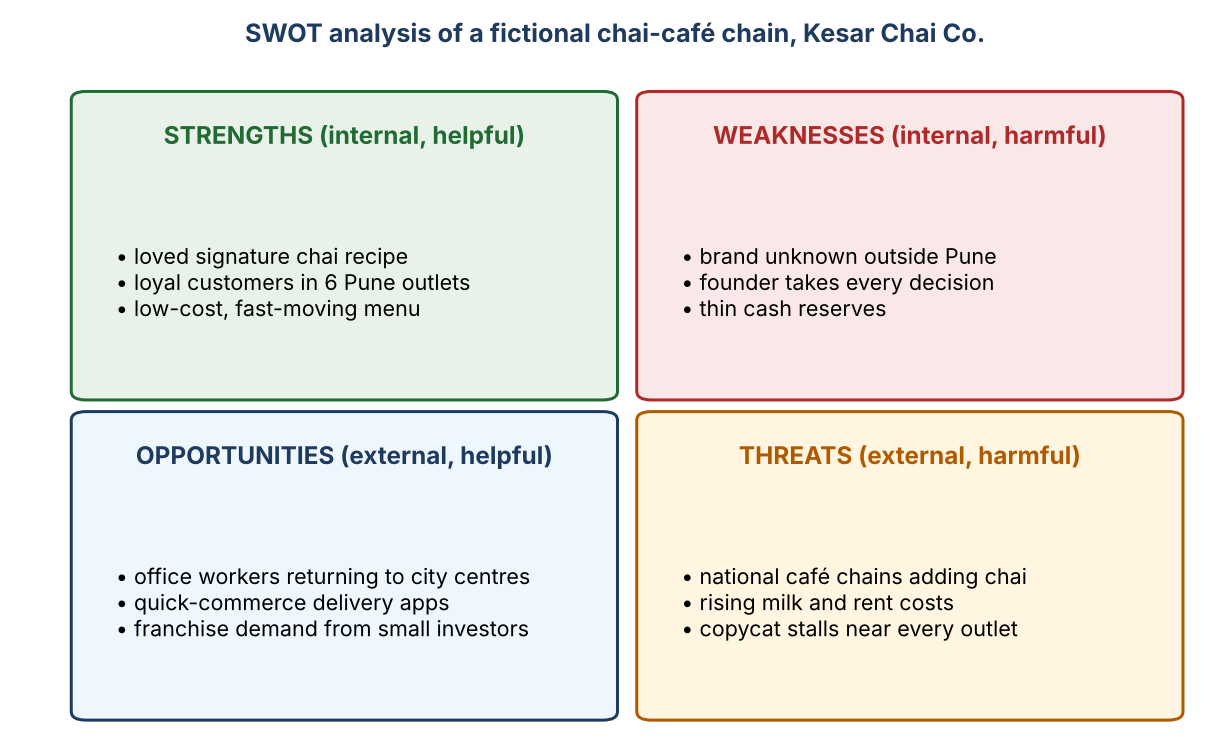
Figure 1: A completed SWOT analysis
🔒 Also in the full toolkit page
- 2. Worked example
- 3. Blank template
- 4. Exam-style question
- Exam practice: 3 questions with mark allocations
- 1 exemplar answer with model answers and examiner-style commentary
- Where students commonly lose marks