Level: SL and HL
Four routes to growth, ranked by how far each takes a business away from what it already knows.
Guiding question
When a business wants to grow, how far from its comfort zone should it go?
Success criteria
- I can explain the four growth strategies in the Ansoff matrix
- I can classify a business's growth options using the matrix
- I can evaluate the risk and suitability of each growth strategy
1. What it is and when to use it
Definition The Ansoff matrix is a planning tool that classifies growth strategies according to whether a business sells existing or new products in existing or new markets, giving four strategies: market penetration, product development, market development and diversification.
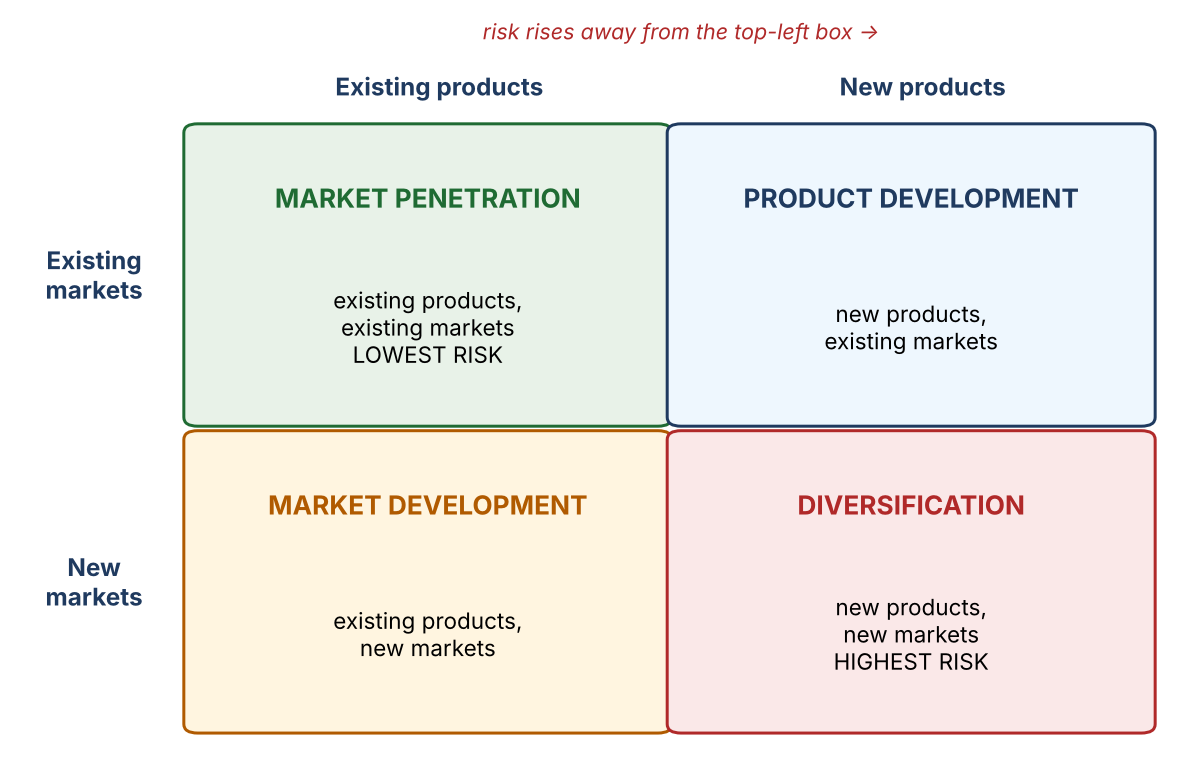
Figure 1: The Ansoff matrix
| Strategy | What it means | Risk |
|---|---|---|
| Market | Sell more of existing products to existing | Lowest: the firm knows |
| penetration | customers — promotions, loyalty schemes, competitive pricing | both product and market |
| Product development | New products for existing customers — new flavours, models, services | Medium: new product, familiar customers |
| Market development | Existing products in new markets — new regions, countries or segments | Medium: proven product, unfamiliar customers |
| Diversification | New products in new markets — related or unrelated to current business | Highest: everything is new; but spreads risk across markets |
Level: SL and HL. The guide suggests the Ansoff matrix for units 1 and 4 — growth and evolution (1.5) and marketing planning (4.2).
🔒 Also in the full toolkit page
- 2. Worked example
- 3. Blank template
- 4. Exam-style question
- Exam practice: 3 questions with mark allocations
- 1 exemplar answer with model answers and examiner-style commentary
- Where students commonly lose marks