HL only This topic is for Higher Level students.
Having the right materials, in the right amount, at the right time — and measuring how well capacity, labour and capital are used.
Guiding question
How much stock is 'enough' — and how can a business measure whether its operations are efficient?
- I can explain the local and global supply chain process
- I can evaluate just-in-time (JIT) versus just-in-case (JIC)
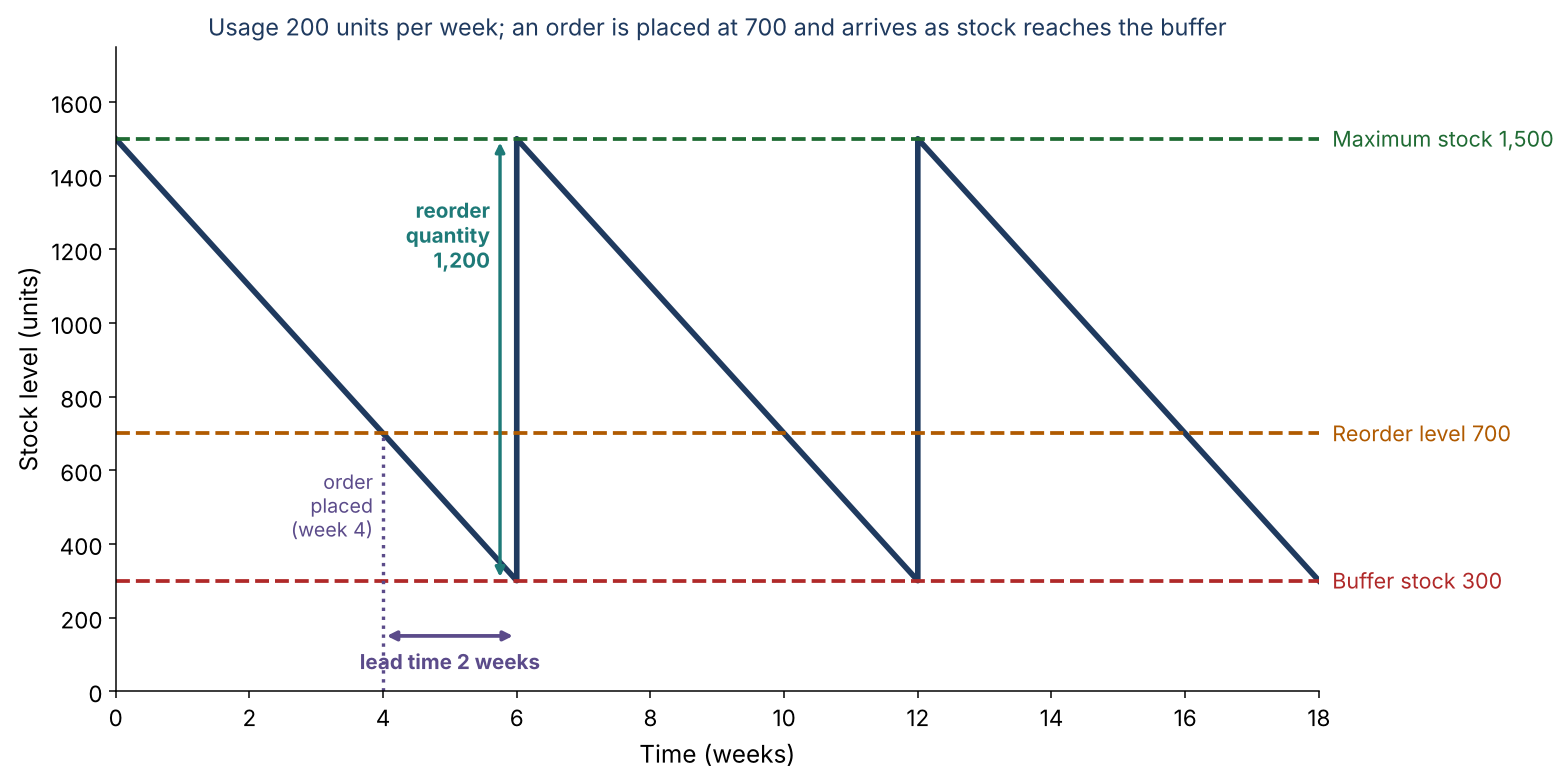
- I can construct and interpret stock control charts using lead time, buffer stock, reorder level and reorder quantity (AO4)
- I can calculate and interpret capacity utilisation, defect rate, labour and capital productivity, productivity rate and operating leverage (AO4)
- I can calculate and compare cost to buy (CTB) and cost to make (CTM)
HL only
This entire topic is HL only. The capacity utilisation and productivity rate formulas are on the official formula sheet; the others must be learned.
Local supply chains source from nearby suppliers: shorter lead times, easier communication and quality control, lower transport emissions, and support for the local economy — but often higher
costs and less choice. Global supply chains source internationally: lower costs, specialist suppliers and scale — but longer lead times, exposure to exchange rates, tariffs, political risk and disruption, and harder monitoring of ethical standards. Effective supply chain management coordinates the chain with shared information, reliable partners and contingency plans (5.7).
- 5.6.2 Just-in-time (JIT) versus just-in-case (JIC) (HL only)
- 5.6.3 Stock control charts (HL only)
- 5.6.4 Capacity utilisation rate (HL only)
- 5.6.5 Defect rate (HL only)
- 5.6.6 Productivity and operating leverage (HL only)
- 5.6.7 Cost to buy (CTB) and cost to make (CTM) (HL only)
- Exam practice: 5 questions with mark allocations
- 2 exemplar answers with model answers and examiner-style commentary
- Where students commonly lose marks