HL only This topic is for Higher Level students.
Fires, floods, cyberattacks, product recalls, pandemics: no business can prevent every crisis, but it can decide how ready it is.
Guiding question
Is it worth paying today for a plan to deal with a disaster that may never happen?
- I can distinguish crisis management from contingency planning
- I can explain the factors that affect effective crisis management: transparency, communication, speed and control
- I can evaluate the impact of contingency planning for a given organisation in terms of cost, time, risks and safety
HL only
This entire topic is HL only. It draws on stakeholders (1.4), communication (2.6) and production planning (5.6).
Contingency planning is preparing, in advance, for possible crises: identifying risks, assessing their likelihood and impact, and developing and rehearsing responses.
Crisis management is the actions taken by an organisation during and after a crisis to limit damage and recover.
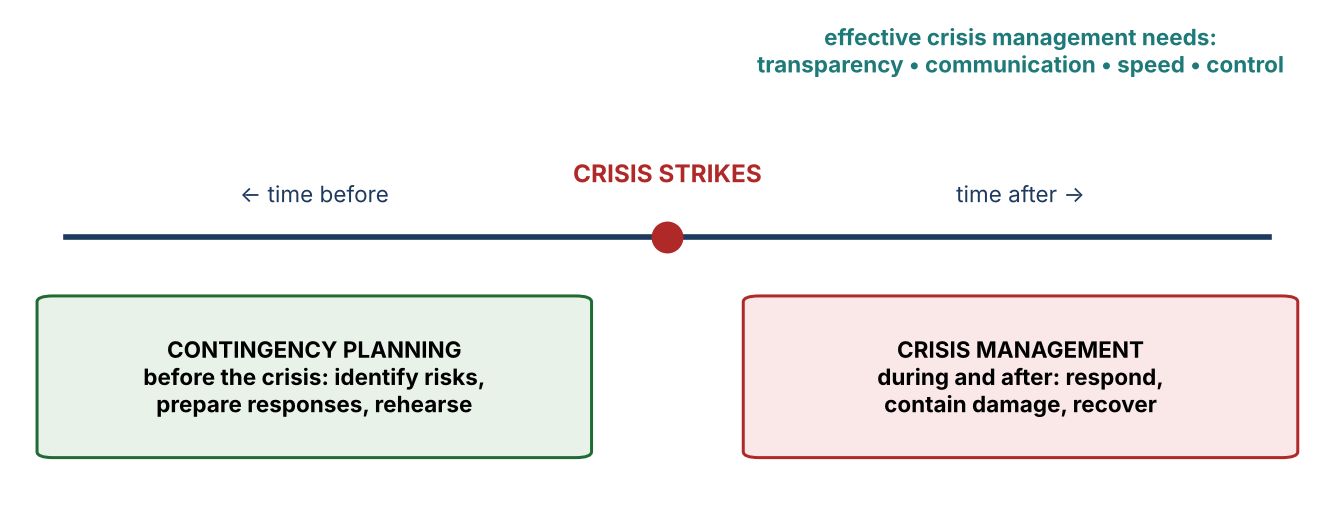
Contingency planning typically involves: identifying potential crises (natural disasters, accidents, IT failures, cyberattacks, supplier collapse, product contamination, key-person loss, reputational scandals); assessing their probability and impact; preparing responses (backup suppliers, data backups, evacuation procedures, insurance, crisis-communication templates); assigning responsibilities to a crisis team; and rehearsing through drills and simulations. Crisis management then puts these plans into action — and improvises where the plan did not foresee events.
- 5.7.2 The factors that affect effective crisis management (HL only)
- 5.7.3 The impact of contingency planning: cost, time, risks and safety (HL only)
- Exam practice: 5 questions with mark allocations
- 2 exemplar answers with model answers and examiner-style commentary
- Where students commonly lose marks