HL only This topic is for Higher Level students.
Selling abroad multiplies the size of the prize — and every risk the business already knew how to manage at home.
Guiding question
Should a successful domestic business take its products to the world — and if so, should it change them or keep them the same?
- I can explain the opportunities of entering and operating in international markets
- I can explain the threats of entering and operating internationally, including cultural, economic, political and legal factors
- I can evaluate whether a business should enter a particular international market, and whether to standardise or adapt its marketing mix
HL only
This entire topic is HL only. It draws together the marketing mix (4.5), multinational companies (1.6), growth methods (1.5) and Hofstede's cultural dimensions (2.5).
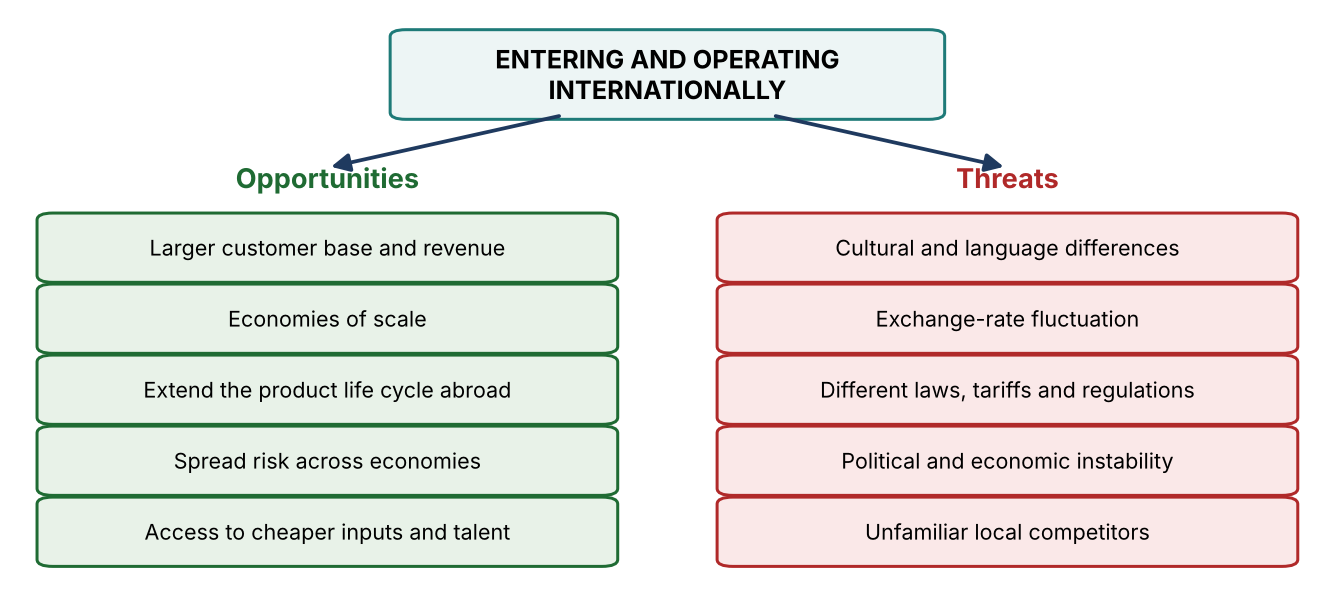
- A larger customer base — more potential sales and revenue, especially when the home market is saturated
- Economies of scale — higher output lowers unit costs across all markets
- Extending the product life cycle — a product in maturity at home may be in growth abroad
- Spreading risk — a downturn in one country can be offset by growth in another
- Access to resources — cheaper inputs, skilled labour and new ideas
- Brand prestige — international presence can strengthen the brand at home too
- Cultural differences — tastes, values, religion, language, colours, humour and buying habits differ; brand names can translate badly
- Economic factors — exchange-rate fluctuations, different income levels, inflation and recession
- Political and legal factors — tariffs and quotas, product standards, advertising and labelling laws, data rules, political instability, possible nationalisation
- Competition — local firms understand customers and enjoy loyalty and established distribution
- Practical challenges — longer supply chains, higher logistics costs, managing staff at a distance
Exchange-rate risk: an Indian exporter sells a product for ₹8,300 and wants to keep that rupee price.
At ₹83 = $1, the US price is 8,300 ÷ 83 = $100.00 → If the rupee weakens to ₹88 = $1, the US price falls to 8,300 ÷ 88 = $94.32 — more competitive abroad → If the rupee strengthens to ₹78 = $1, the US price rises to 8,300 ÷ 78 = $106.41 — less competitive
Exchange rates the firm cannot control change its competitiveness overnight.
A global (standardised) strategy uses the same marketing mix everywhere: lower costs, consistent brand and economies of scale — but it may ignore local tastes. A localised (adapted) strategy changes product, price, promotion and other Ps for each market: better fit, but higher costs and a less uniform brand. Many firms 'think global, act local' — a standard core brand with local adaptations.
An Indian ed-tech firm enters a Middle Eastern market → it adapts content to the local curriculum, language and payment habits → local parents trust the product, so adoption grows → but adaptation raises development costs → success depends on whether the market is large enough to repay the localisation
International expansion is neither automatically good nor reckless; its value depends on the fit between the product and the market, the business's resources, and the entry method (exporting, franchising, joint venture or direct investment — see 1.5). Low-commitment methods such as exporting or franchising limit risk but also control and returns; joint ventures add local knowledge at the cost of shared profit. Thorough research, a STEEPLE scan and a cautious entry into one market at a time usually beat an ambitious multi-country launch.
The guide's inquiry statement — why globalisation brings many changes to business activity — applies directly: entering international markets changes products, structures, cultures and risks. Businesses that treat foreign markets as larger versions of home tend to stumble; those that expect to change themselves tend to succeed.
Toolkit: Hofstede's cultural dimensions and STEEPLE (HL)
Hofstede's cultural dimensions (power distance, individualism vs collectivism, uncertainty avoidance, masculinity vs femininity, long-term orientation, indulgence) help predict how advertising messages, sales approaches and service styles will be received — for example, family-centred, collective messages may resonate more in collectivist cultures. A STEEPLE analysis of the target country completes the picture of external threats and opportunities.
- Exam practice: 5 questions with mark allocations
- 2 exemplar answers with model answers and examiner-style commentary
- Where students commonly lose marks