Level: SL and HL. Sections marked HL only are for Higher Level students.
Three ways to interrogate the same question: if we spend the money now, will the future pay us back enough — and soon enough?
Guiding question
How should a business compare money spent today with money that arrives, uncertainly, over years?
- I can calculate and interpret the payback period and the average rate of return (ARR) (AO3, AO4)
- HL: I can calculate and interpret net present value (NPV) using discount factors
- I can evaluate investment opportunities using quantitative results alongside qualitative factors
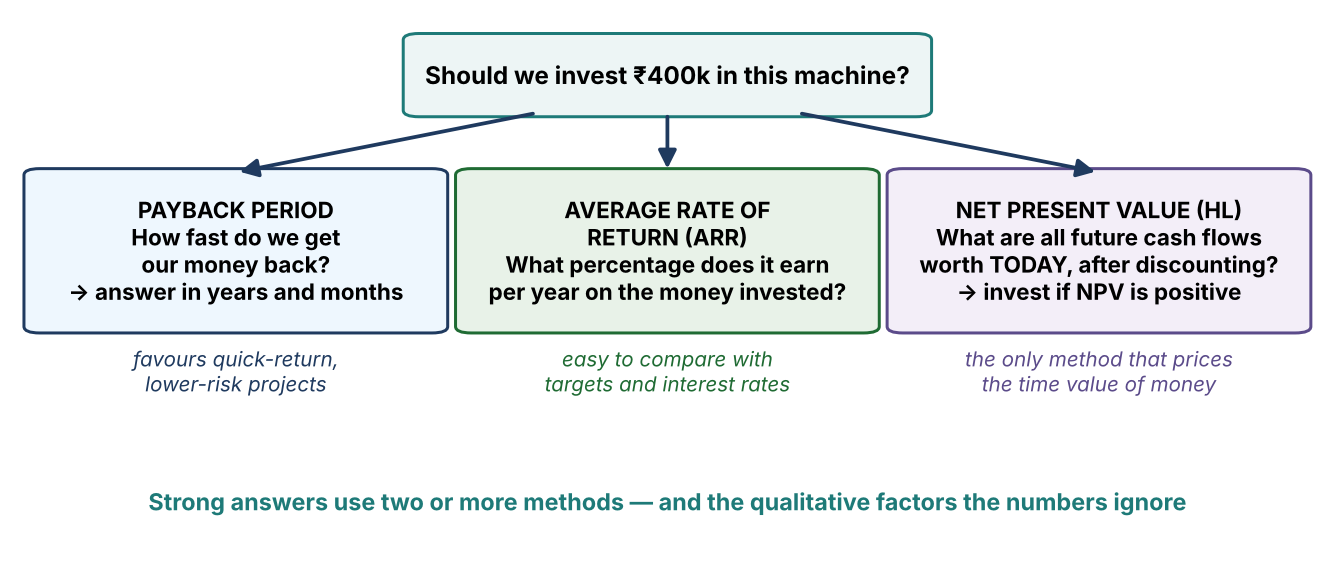
Payback period is the time needed for an investment's net cash inflows to repay its initial cost. Average rate of return (ARR) = average annual profit ÷ initial investment × 100, where average annual profit = (total net returns − initial cost) ÷ number of years.
A workshop considers a ₹4,00,000 machine with expected net cash inflows of ₹1,20,000 (year 1), ₹1,60,000 (year 2), ₹1,80,000 (year 3) and ₹1,80,000 (year 4).
Cumulative: year 1 = 1,20,000; year 2 = 2,80,000 — still short of 4,00,000 → Needed in year 3: 1,20,000 of year 3's 1,80,000 → 1,20,000 ÷ 1,80,000 × 12 = 8 months → Payback = 2 years 8 months → Total returns = 6,40,000; average annual profit = (6,40,000 − 4,00,000) ÷ 4 = 60,000 → ARR = 60,000 ÷ 4,00,000 × 100 = 15%
Payback answers 'how fast is our money back?'; ARR answers 'what does it earn per year, on average?' — compare 15% against the firm's target return and against what the ₹4,00,000 could earn elsewhere.
| Method | Strengths | Weaknesses |
|---|---|---|
| Payback | Simple; emphasises liquidity and early risk; good when technology dates quickly | Ignores everything after payback; ignores timing within the paid-back flows; says nothing about profitability |
| ARR | Uses all years' returns; a % easily compared with targets and interest rates | Ignores the timing of cash (a rupee in year 4 counts like year 1); averages hide shapes |
- 3.8.2 Net present value (HL only)
- Exam practice: 5 questions with mark allocations
- 2 exemplar answers with model answers and examiner-style commentary
- Where students commonly lose marks