Level: SL and HL
Businesses do not close because they are unprofitable this month; they close because the money runs out on a Tuesday.
Guiding question
Why do profitable businesses fail — and how does a one-page forecast prevent it?
- I can explain the difference between profit and cash flow
- I can construct and interpret a cash flow forecast (AO4)
- I can explain the relationship between investment, profit and cash flow
- I can evaluate strategies for dealing with cash flow problems
Profit is revenue earned minus costs incurred in a period — recorded when sales are made, not when money moves.
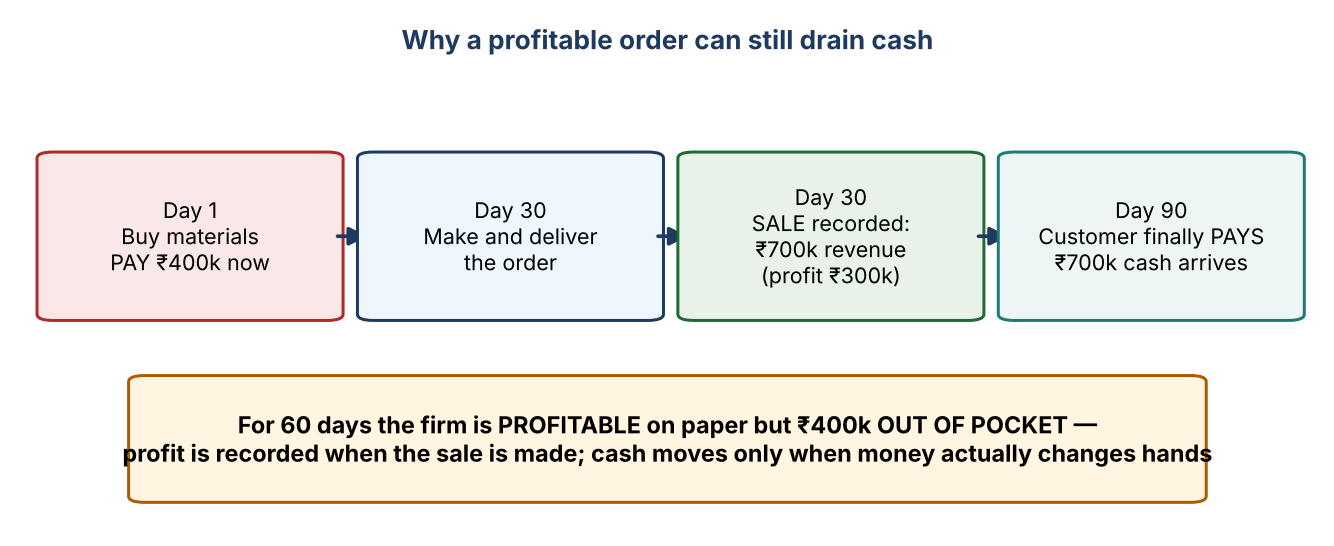
The two diverge because of timing and categories. Credit sales create profit today and cash months later; buying stock consumes cash now but touches profit only when goods sell; capital expenditure drains cash in one gulp while profit absorbs it gradually as depreciation; loan receipts and owner's capital are cash in but never profit; loan repayments and dividends are cash out but not costs. A business can therefore be profitable and cash-starved (fast growth swallowing cash into stock and debtors) or cash-rich and unprofitable (living off a loan while trading at a loss) — the first kills quickly, the second slowly.
- 3.7.2 Cash flow forecasts
- 3.7.3 The relationship between investment, profit and cash flow
- 3.7.4 Strategies for dealing with cash flow problems
- Exam practice: 5 questions with mark allocations
- 2 exemplar answers with model answers and examiner-style commentary
- Where students commonly lose marks