Every operation combines the four factors of production (first met in Topic 1.1.1) — but operations managers must decide the right combination of them:
| Factor | Operations decisions it involves | Example: a car plant |
|---|---|---|
| Land | Site location, size and layout; natural resources and raw materials used | Factory site near a port; steel, rubber, water |
| Labour | How many workers, with what skills, on which shifts | Assembly workers, engineers, quality inspectors |
| Capital | Machinery, equipment, technology and buildings used | Robotic welding lines, paint shops, testing rigs |
| Enterprise | Organising the other factors and taking the risks of production decisions | Managers deciding to add an electric-vehicle line |
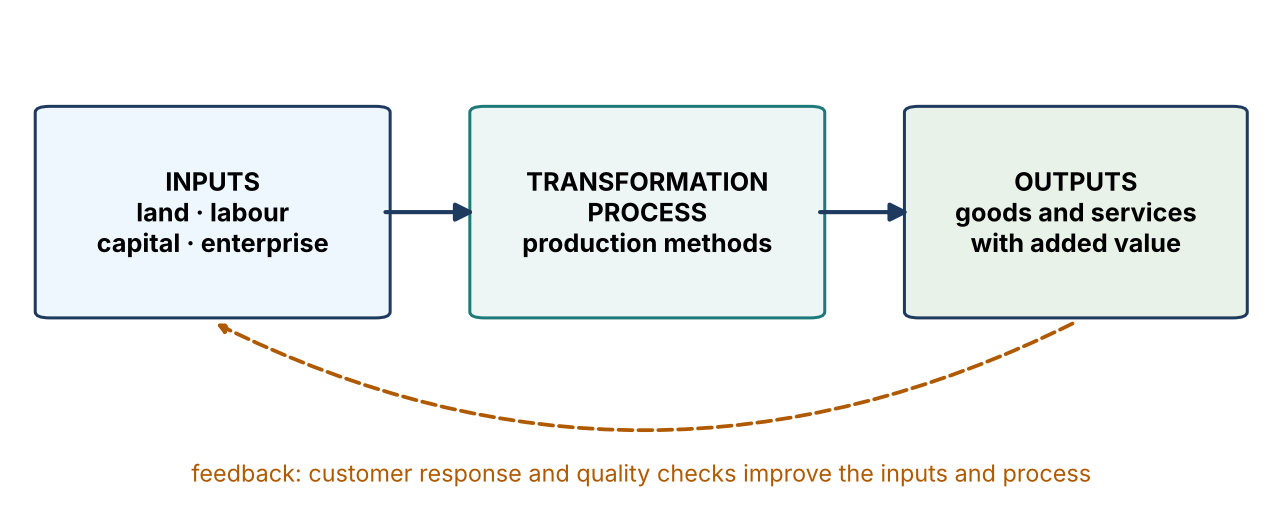
| Stage | Manufacturing example (bakery) | Service example (hospital) |
|---|---|---|
| Inputs | Flour, ovens, bakers, electricity | Doctors, nurses, medicines, scanners, buildings |
| Transformation | Mixing, baking, packaging | Diagnosis, treatment, care |
| Outputs | Bread and cakes for sale | Patients treated and recovered |
| Feedback | Customer complaints about stale bread → change recipe or delivery times | Patient outcomes and waiting times → change staffing or procedures |
Added value (Topic 1.1.1) is the difference between the selling price and the cost of bought-in materials. Operations management adds value in two ways: by raising the value customers place on the output (better quality, design, speed, reliability, customisation) and by reducing the cost of producing it (less waste, higher productivity, cheaper processes). Either way, the gap between price and input cost widens.
Operations manager redesigns the production layout → less movement of materials and fewer delays → output per worker rises and waste falls → cost per unit falls while quality is maintained → added value per unit increases, raising profit or allowing a lower price
- 4.1.2 Efficiency, effectiveness, productivity and sustainability
- 4.1.3 Capital intensive and labour intensive operations
- 4.1.4 Operations methods: job, batch, flow, mass customisation
- Exam practice: 5 practice questions
- 2 exemplar answers with full model answers and mark breakdowns
- Where students commonly lose marks