Capacity utilisation is the proportion of a business's maximum capacity that is actually being used, expressed as a percentage.
Capacity utilisation (%) = actual output in a period ÷ maximum possible output in that period × 100
A Pune bottling plant can fill 2 400 000 bottles a month. Last month it filled 1 680 000.
Capacity utilisation = 1 680 000 ÷ 2 400 000 × 100 = 70%
A hotel with 250 rooms sold 6 000 room-nights in a 30-day month.
Maximum capacity = 250 × 30 = 7 500 room-nights; capacity utilisation = 6 000 ÷ 7 500 × 100 = 80% (hotels call this the occupancy rate)
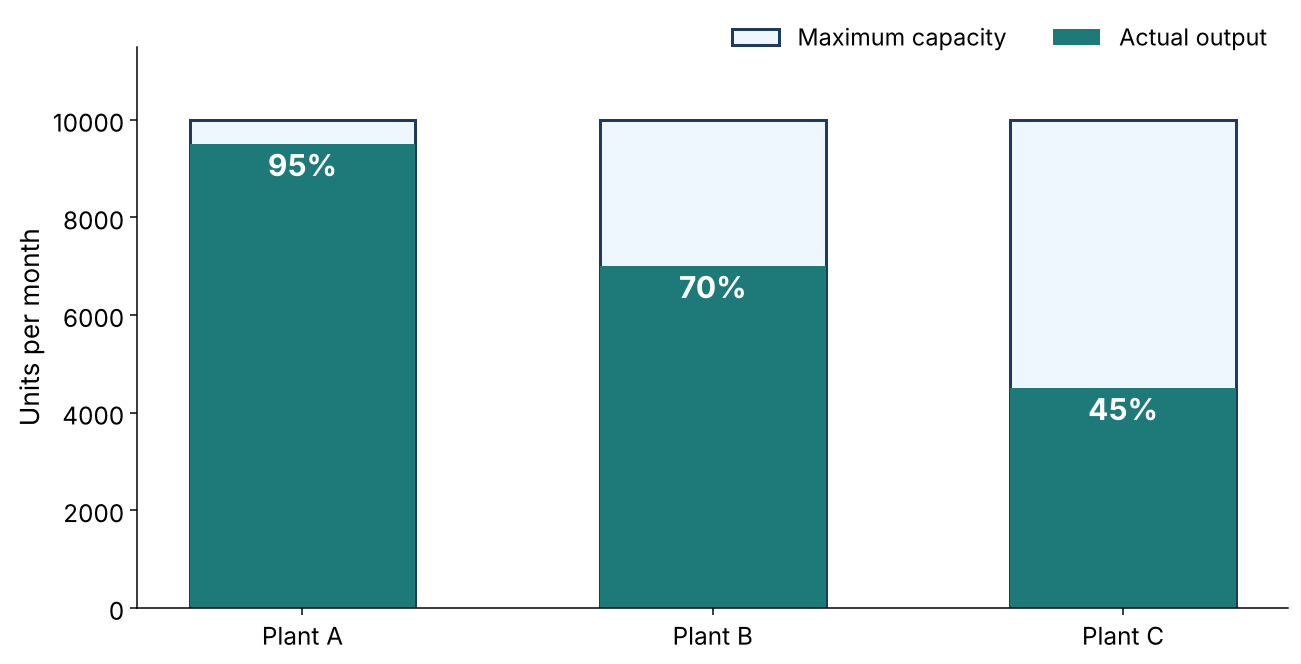
Fixed costs (rent, machinery depreciation, salaried staff) do not change with output. The more of its capacity a business uses, the more units these fixed costs are spread across, so fixed cost per unit falls as capacity utilisation rises.
A factory's fixed costs are $90 000 per month; maximum capacity is 10 000 units.
At 45% utilisation (4 500 units): fixed cost per unit = 90 000 ÷ 4 500 = $20.00
At 70% utilisation (7 000 units): fixed cost per unit = 90 000 ÷ 7 000 = $12.86
At 95% utilisation (9 500 units): fixed cost per unit = 90 000 ÷ 9 500 = $9.47
Higher utilisation more than halves the fixed cost carried by each unit, improving competitiveness and profit margins.
| Operating with low capacity utilisation (spare capacity) | Operating at or near full capacity |
|---|---|
| ✗ High fixed cost per unit — lower margins or higher prices | ✓ Low fixed cost per unit — more competitive and profitable |
| ✗ Idle machines and staff may lower morale and raise fears of job losses | ✓ Busy, successful image; secure jobs |
| ✗ Signals weak demand to customers and investors | ✗ No spare capacity to accept new orders — customers may go to rivals |
| ✓ Can meet sudden increases in demand quickly | ✗ No time for machine maintenance — breakdowns become more likely |
| ✓ Time available for maintenance and training | ✗ Pressure on staff causes stress, mistakes and quality problems; overtime raises costs |
Operating over maximum capacity is possible only briefly — through overtime, extra shifts or delaying maintenance — and usually raises costs and lowers quality. Many businesses therefore aim for a high but not 100% utilisation (often around 85–90%), leaving some flexibility.
Improving capacity utilisation can be done either by increasing output to use more of existing capacity, or by reducing capacity to match lower demand.
| Method | How it works | Drawback |
|---|---|---|
| Increase demand through marketing | Promotion, price cuts, new markets to sell more | Costly; price cuts reduce margins |
| Off-peak pricing | Cheaper prices in quiet periods (hotels, cinemas, airlines) | May reduce revenue from customers who would have paid full price |
| Produce for other businesses | Make products under another firm's brand, or accept subcontracted work | May distract from own products; lower margins |
| Rationalisation: reduce capacity | Close a plant, sell machines, lease out unused space, cut shifts | Redundancy costs; lose ability to meet future demand growth |
| Use temporary and part-time workers | Match labour capacity to fluctuating demand | Less committed workforce; training costs |
A hotel's weekday occupancy is only 50% → it offers corporate conference packages at a discount on weekdays → more rooms are filled each week → fixed costs (staff, rent, maintenance) are spread over more room-nights → cost per room-night falls and profit rises — provided discounts do not exceed the contribution each room earns
- 4.3.2 Outsourcing
- Exam practice: 5 practice questions
- 2 exemplar answers with full model answers and mark breakdowns
- Where students commonly lose marks