-
Production Possibility Curve (PPC) shows the maximum output of two types of products and the combination of those products that can be produced using the existing resources and technology.
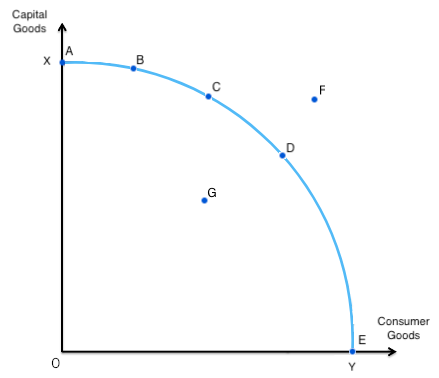 Diagram of Production Possibility Curve
A B C D E Capital Goods 10 9 8 5 0 Consumer Goods 0 25 50 75 100 - When moving from point A to point D, the number of capital goods produced reduces from 10 to 5, while the consumer goods produced increase from 0 to 75. Therefore, the opportunity cost is 5 Capital Goods.
- Point F, is a point outside the PPC, it is impossible to produce this much with current resources. To produce this much, new resources need to be found, or existing resources need to get more efficient.
- Point G, is a point inside the PPC, it shows inefficiency of allocation of resources. Resources are underemployed, hence, maximum possible production has not been reached.
Shifting the PPC
Outward Shift of the PPC:
|
Inward Shift of the PPC:
|
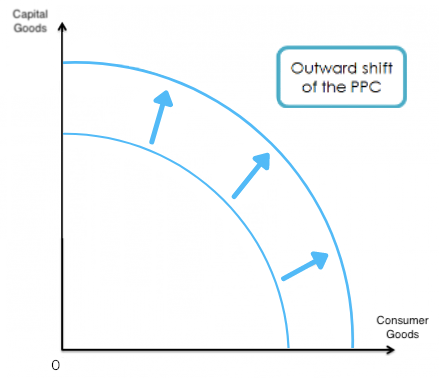
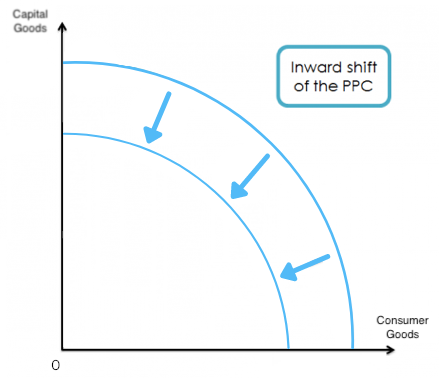
Outward Shift of the PPC:
|
|
|
Inward Shift of the PPC:
|
|
|
Common Mistakes That Lose Marks
The trap is in bold. Read the fix after it.
- “A point inside the PPC means a shortage of resources.” Wrong. It means resources are unemployed or used inefficiently, so output is below what the economy could produce (workers laid off in a recession). Examiners penalise this often. Say what it means for output.
- Movement vs shift. Moving along the curve means reallocating the resources you already have: more of one good, less of the other. Spending more on one good is a movement. The curve shifts only when the quantity or quality of resources, or technology, changes.
- Vague causes of a shift. Outward: more resources (new oil discovered, immigration), better quality (education, training), better technology, investment in capital. Inward: natural disasters, war, emigration of skilled workers, resources running out.
- “Outside the curve is impossible.” It is unattainable now. Economic growth can make it reachable later.
- Why the curve bows out. Resources are not equally good at producing both goods. As you move more into one good, you use less suitable resources, so the opportunity cost rises. A straight-line PPC means constant opportunity cost.
- Calculating opportunity cost without units. It is the units of one good given up for the units of the other gained, for example “10 tonnes of rice for 5 tractors”. Label both axes with the goods, label PPC and PPC1, and draw an arrow for any shift.
Exemplar Questions
- Using a production possibility curve, explain what happens to the economy after a major flood. (4 marks)
- Diagram: a PPC with both axes labelled (1) and an inward shift of the curve to a new PPC closer to the origin (1).
- The flood destroys land, capital and workers, so the economy has fewer resources (1).
- The economy can now produce less of every good, so its productive capacity, economic growth and living standards fall (1).
- Explain the difference between a point inside a PPC and a point outside a PPC. (4 marks)
- A point inside indicates unemployed resources (1) inefficient use of resources / wasted resources (1) output is below potential output (1) an attainable point (1).
- A point outside is unattainable (1) not enough resources / beyond productive potential / only achievable with more resources / only achievable with better quality resources / not achievable with current resources / will be possible with future economic growth (1).
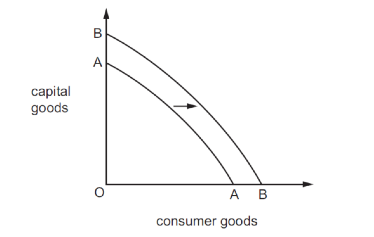
- Analyse, using a production possibility curve, the effect of advances in technology. (6 marks)
- Up to 3 marks for the diagram:
- Axes correctly labelled in terms of two different products or types of products (1)
- The curve or downward sloping line drawn to the axes (1)
- The curve shifting out to the right (1)
- Up to 3 marks for written comments:
- Advances in technology increase the quality of capital goods (1)
- Higher quality capital equipment increases productive capacity/the maximum quantity of products that can be produced (1)
- Increased productive capacity results in (potential) economic growth (1)
- May affect the output of the two products differently (1) slope may change (1).
- Up to 3 marks for the diagram:
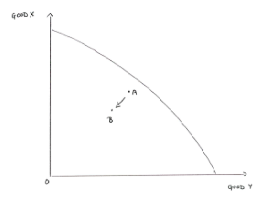
- Using a production possibility curve, analyse the effect of an increase in unemployment on a country's output. (6 marks)
- Up to 4 marks for the diagram:
- Axes correctly labelled (1)
- Original curve/downward sloping line to axes (1)
- Production point moved nearer to the origin (1)
- Direction of change in the production point indicated (1)
- Up to 2 marks for written explanation:
- Unemployment means resources are unused / the economy is not at full capacity (1)
- With unemployed resources, a country will be producing further inside/moving inside its production possibility curve (1)
- Up to 4 marks for the diagram:
- Breakdown of marks:
- Definition of opportunity cost: the (next) best (1) alternative foregone (1) as a result of making a decision
- Diagram of production possibility curve – axes correctly labelled (1) and curve correct shape (1)
- Explanation – idea of moving along one axis (1) has the effect of a reverse movement along the other axis (1)
- Note: maximum of 6 marks.
- Exemplar Answer:
- Opportunity cost is the next best alternative forgone while making a decision. (2)
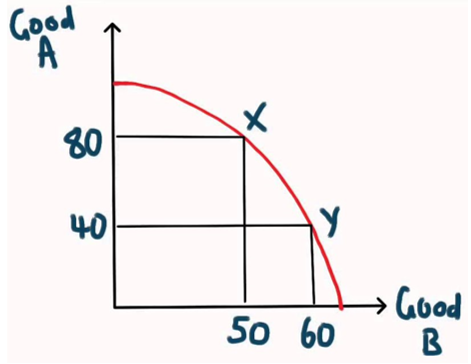
- If a company reallocates its resources from combination X to combination Y, it will gain 10 more units of good B but will have to forego 40 units of good A therefore the 40 units of Good A lost is the opportunity cost. (2)