Level: SL and HL. Sections marked HL only are for Higher Level students.
Governments often restrict trade to protect domestic producers. This topic analyses the main tools of protection, shows their effects on each stakeholder with diagrams and (HL) calculates those effects.
Trade protection is government intervention in international trade, through measures such as tariffs, quotas, subsidies and administrative barriers, that limits imports or gives domestic producers an advantage over foreign competitors.
A tariff is a tax on imported goods. It raises the price of imports in the domestic market.
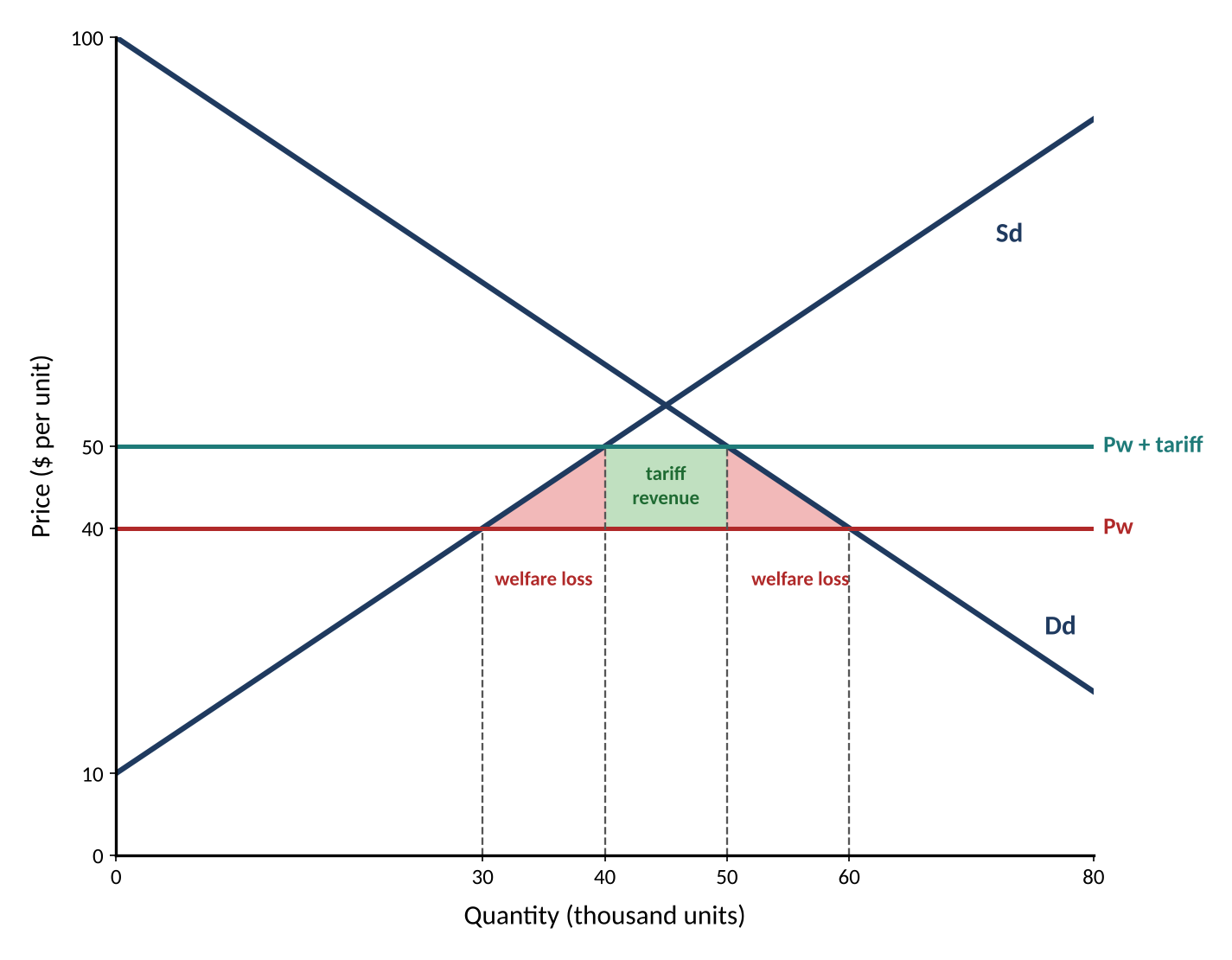
Before the tariff, the domestic price is Pw = $40: domestic producers supply 30 thousand units, consumers buy 60 thousand and 30 thousand are imported. A tariff of $10 per unit raises the price to $50. Domestic supply rises to 40 thousand, demand falls to 50 thousand and imports fall to 10 thousand.
| Stakeholder | Effect of the tariff |
|---|---|
| Domestic consumers | Pay a higher price and buy less; consumer surplus falls |
| Domestic producers | Sell more at a higher price; producer surplus and revenue rise; may employ more workers |
| Government | Gains tariff revenue (green rectangle) |
| Foreign producers | Sell fewer units; export revenue falls |
| Society (world) | Welfare loss (two red triangles): inefficient domestic producers replace cheaper imports, and consumers who valued the good above Pw no longer buy it |
Task HL only: Using Figure 1, calculate the effects of the $10 tariff.
Imports: fall from 60 − 30 = 30 thousand to 50 − 40 = 10 thousand.
Tariff revenue = tariff × imports = $10 × 10 000 = $100 000.
Domestic producer revenue: rises from $40 × 30 000 = $1.2 million to $50 × 40 000 = $2.0 million.
Consumer expenditure: changes from $40 × 60 000 = $2.4 million to $50 × 50 000 = $2.5 million.
Foreign producer revenue: falls from $40 × 30 000 = $1.2 million to $40 × 10 000 = $0.4 million (foreign firms still receive Pw).
Welfare loss = ½ × 10 000 × $10 + ½ × 10 000 × $10 = $50 000 + $50 000 = $100 000.
The USA raised tariffs on a wide range of Chinese goods from 2018, and in 2025 imposed higher tariffs on imports from most trading partners, including India. India uses tariffs too: it raised customs duties on many electronics and consumer goods from 2018 to encourage domestic manufacturing.
- 4.2.2 Import quotas
- 4.2.3 Production subsidies and export subsidies
- 4.2.4 Administrative barriers
- Exam practice: 5 questions with mark allocations
- 2 exemplar answers with full model answers and examiner commentary