HL only This topic is for Higher Level students.
A market can be efficient and still very unequal. Because markets reward people according to what they own and what they can sell, they tend to produce unequal incomes and wealth.
Income is a flow of money received over a period of time, such as wages, rent, interest and profit.
Wealth is a stock of assets owned at a point in time, such as property, shares, land and savings.
Equity in the distribution of income means fairness; it does not require complete equality (topic 1.2).
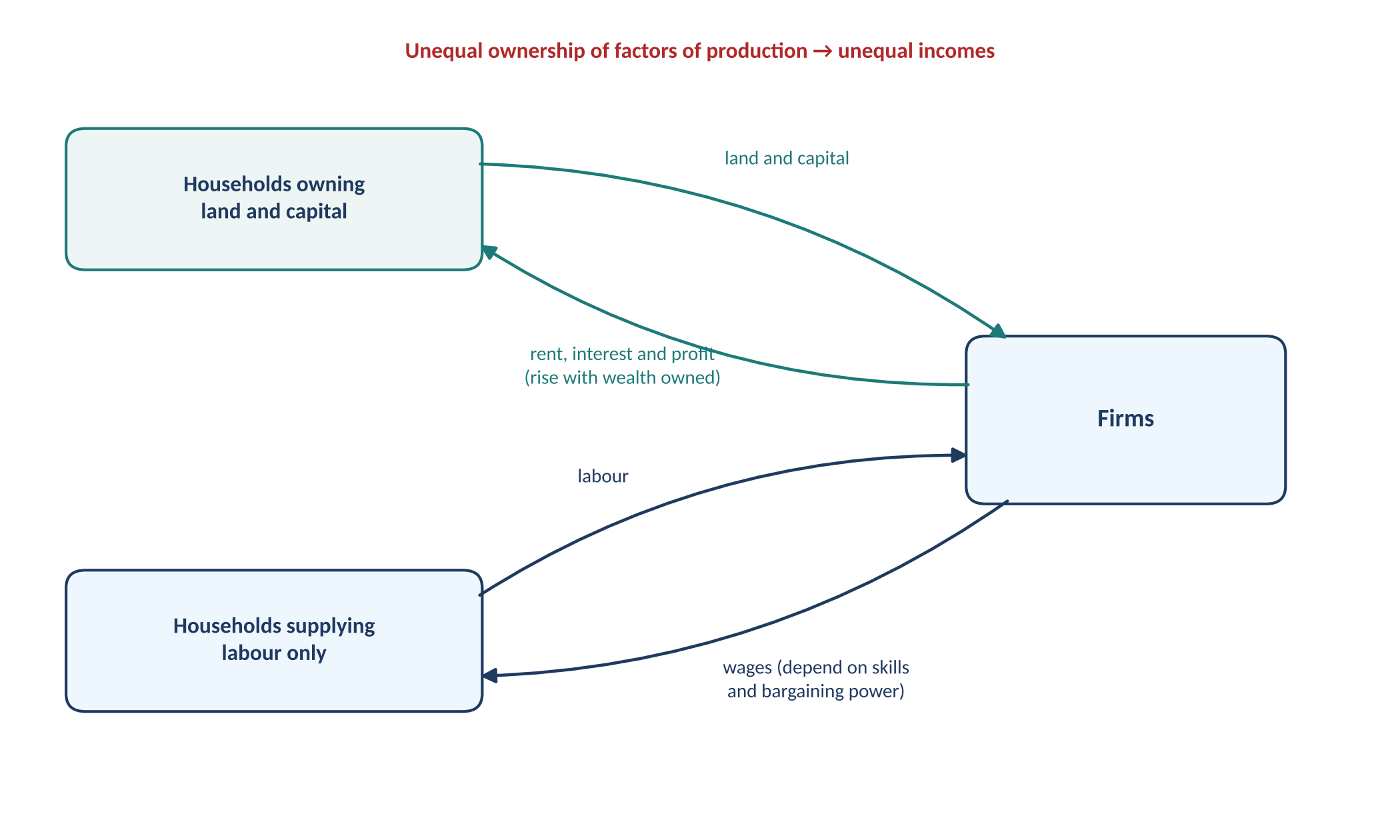
In a market economy, households earn income by selling the factors of production they own. Those who own more land and capital, or who have scarce and valued skills, earn more. The circular flow model shows why this creates inequality.
| Cause | How it creates inequality | Example |
|---|---|---|
| Unequal ownership of factors of production | Owners of land and capital receive rent, interest and profit; wealth | Families owning shares in large listed companies see their wealth |
| earns more income, which builds more wealth | grow with share prices | |
| Differences in human capital | Workers with more education, training and health earn higher wages | Software engineers earn many times the wage of agricultural labourers |
| Inheritance | Wealth passed between generations gives some people a head start | Inherited land and property in cities such as Mumbai |
| Market power | Firms and workers with bargaining power earn more; workers in weak positions earn less | Strong professional bodies can raise members' earnings; informal workers lack bargaining power |
| Discrimination | Some groups are paid less or excluded from jobs, education and credit | Gender pay gaps exist in most countries |
| Technological change and globalisation | Rewards rise for highly skilled workers and owners of technology, while routine jobs are automated or move abroad | Rising earnings in the IT sector compared with traditional manufacturing |
A household owns property and shares → it earns rent, dividends and capital gains → it saves and invests part of this income → its wealth grows further → its income rises again. A household with only its labour to sell, and low skills, earns a low wage and cannot save → its wealth does not grow. Over time, the gap between the two widens.
Inequality across countries. According to the World Inequality Database, the top 10% of earners in India receive more than half of national income. Inequality is also high in South Africa and Brazil, while Nordic countries such as Denmark and Norway have much lower inequality, largely because of progressive taxes and extensive public services rather than different market outcomes.
Is market inequality always a problem? It depends on:
- Incentives: some inequality rewards effort, skill and risk-taking, encouraging investment and innovation.
- Opportunity: inequality of outcomes is easier to accept when people have equal opportunity to improve their position, for example through access to education.
- Degree: very high inequality can reduce economic growth, weaken social cohesion and concentrate political influence.
- Policy responses: governments can reduce market inequality through progressive taxation, transfer payments and public provision of education and health care (Unit 3, topic 3.4).
- Exam practice: 3 questions with mark allocations
- 2 exemplar answers with full model answers and examiner commentary