Level: SL and HL. Sections marked HL only are for Higher Level students.
When the decisions of buyers and sellers affect people outside the market, the market produces the wrong quantity. Externalities and overused shared resources are among the most important causes of market failure.
Market failure occurs when the market fails to allocate resources efficiently, so that the quantity produced is not the one society values most.
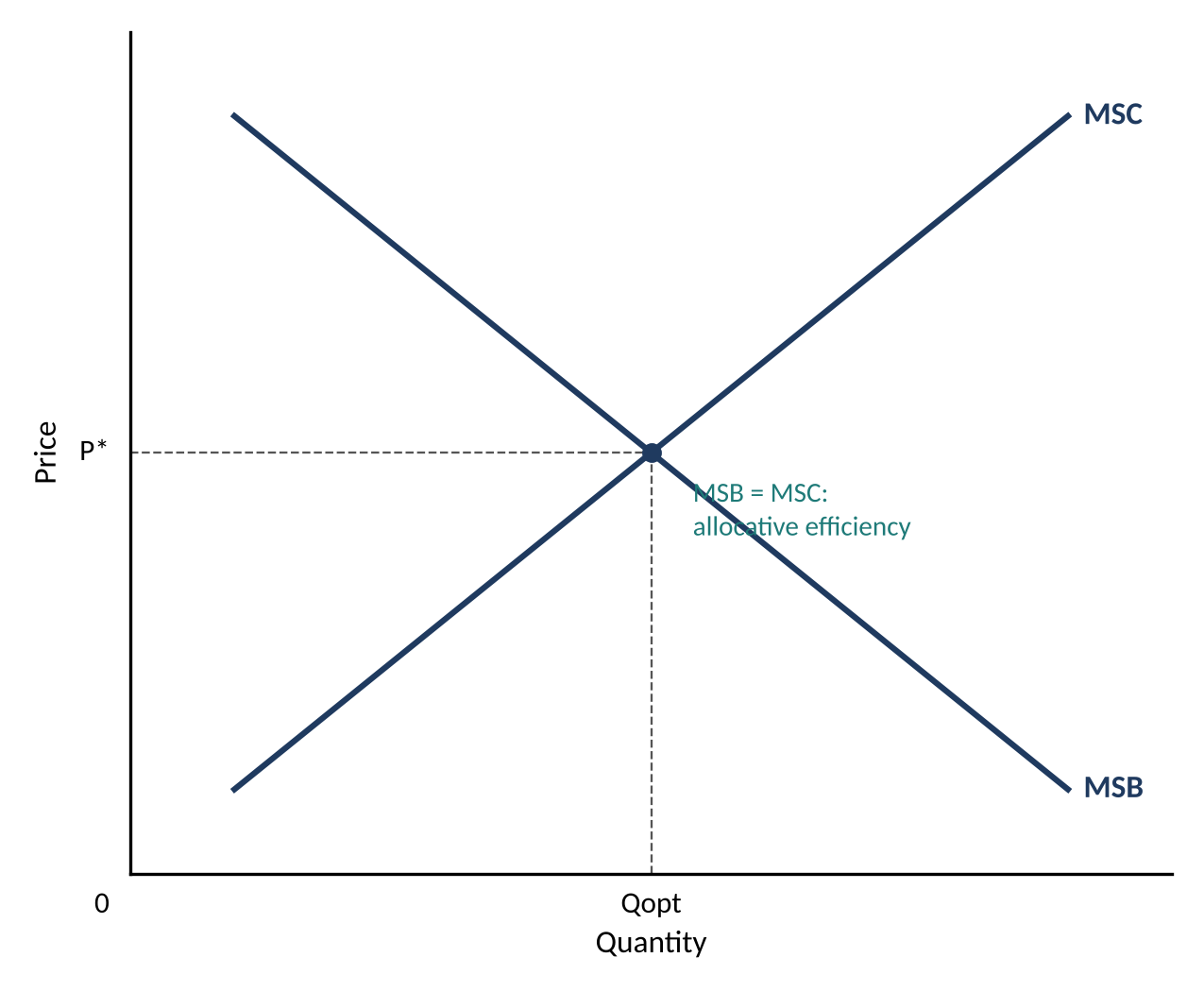
Marginal social benefit (MSB) is the extra benefit to society of one more unit: marginal private benefit (MPB) plus any external benefit.
Marginal social cost (MSC) is the extra cost to society of one more unit: marginal private cost (MPC) plus any external cost.
Society's welfare is maximised where MSB = MSC. At this socially optimum output, resources are allocatively efficient and social (community) surplus is maximised. If there are no externalities, MPB = MSB and MPC = MSC, so the free market reaches this point on its own.
An externality is a cost or benefit of producing or consuming a good that falls on a third party (someone not directly involved in the transaction) and is not reflected in the market price.
- 2.8.2 Negative externalities of production
- 2.8.3 Negative externalities of consumption and demerit goods
- 2.8.4 Positive externalities and merit goods
- 2.8.5 Common pool resources
- 2.8.6 Government responses to externalities and common pool resources
- 2.8.7 Strengths and limitations of policies to correct externalities
- 2.8.8 The importance of international cooperation
- Exam practice: 6 questions with mark allocations
- 3 exemplar answers with full model answers and examiner commentary