Level: SL and HL. Sections marked HL only are for Higher Level students.
When demand and supply meet, the market settles at a price where buyers and sellers agree. That price allocates resources, and in a competitive market it maximises the total benefit to society.
2.3.1 Market equilibrium
Definition
Market equilibrium occurs at the price where quantity demanded equals quantity supplied. At this price there is no tendency for the price to change.
Market equilibrium occurs at the price where quantity demanded equals quantity supplied. At this price there is no tendency for the price to change.
The equilibrium price (market-clearing price) and equilibrium quantity are found where the demand and supply curves intersect.
At any other price the market is in disequilibrium, and the price tends to move back towards equilibrium.
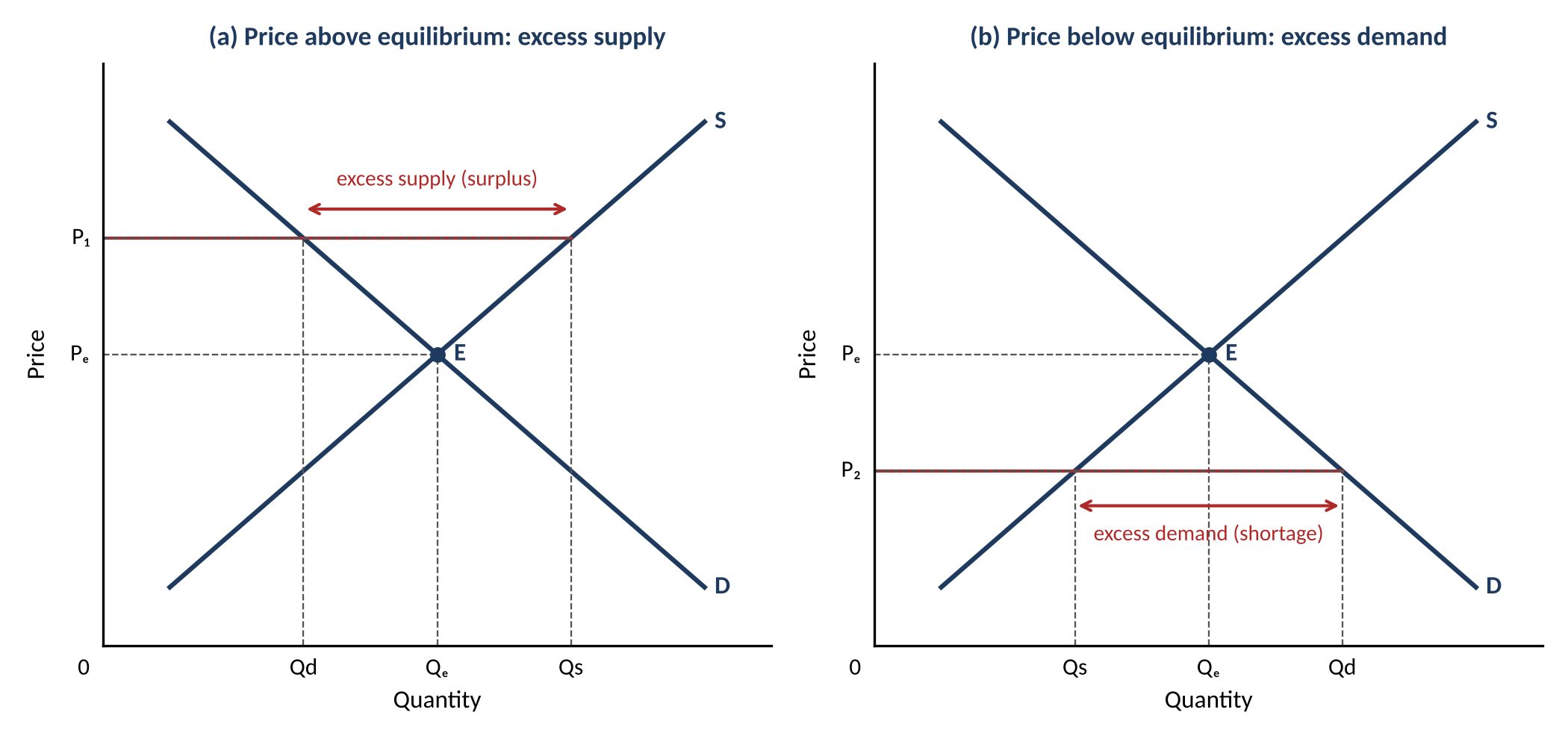
Figure 1: (a) excess supply above the equilibrium price and (b) excess demand below it
Definition
Excess supply (a surplus) exists when quantity supplied is greater than quantity demanded at the current price.
Excess supply (a surplus) exists when quantity supplied is greater than quantity demanded at the current price.
Excess demand (a shortage) exists when quantity demanded is greater than quantity supplied at the current price.
- Above equilibrium (P₁ in Figure 1a): firms cannot sell all they produce. Unsold stock builds up, so firms cut prices. As price falls, quantity demanded rises and quantity supplied falls until the surplus disappears at Pₑ.
- Below equilibrium (P₂ in Figure 1b): buyers want more than is available. Queues form and buyers compete, so price rises. As price rises, quantity supplied rises and quantity demanded falls until the shortage disappears at Pₑ.
🔒 Also in the full notes
- 2.3.2 Changes in market equilibrium
- 2.3.3 Functions of the price mechanism
- 2.3.4 Consumer surplus and producer surplus ((HL only): calculation)
- 2.3.5 Social surplus and allocative efficiency
- Exam practice: 5 questions with mark allocations
- 3 exemplar answers with full model answers and examiner commentary