The two papers
Paper 1: Multiple Choice
1 hour, 40 questions, 40 marks. Every question is compulsory. Read all four options: many wrong answers are “nearly right”.Paper 2: Structured Questions
2 hours, 80 marks.- Section A: one compulsory question based on source material about a real economy.
- Section B: answer three questions from a choice of four. Each question is built from short parts that rise in marks, ending with a longer “discuss” answer.
Timing:
on Paper 2 you have about 1.5 minutes per mark. Leave 10 minutes at the end to check your answers.
Always check the current syllabus and specimen papers on the Cambridge International website for the exact format of your exam series.
Command words: what each one asks
| Command word | What to do |
|---|---|
| Define | Give the precise meaning of the term, using its key words. |
| Identify / State / Give | Name or write down the answer briefly. No explanation is needed. |
| Calculate | Work out the answer from the figures given. Show the working and give the unit. |
| Describe | Say what something is like or what happens: its main features. |
| Explain | Give reasons: say what happens and why or how, and support each point. |
| Analyse | Show a chain of cause and effect, step by step, to the outcome the question asks about. |
| Discuss | Look at both sides in a structured way, then reach a supported conclusion. |
2-mark questions: define, identify, calculate
Define:
one precise sentence with the key words. For example: “Opportunity cost is the next best alternative given up when a choice is made.”Identify two…:
two separate, short answers. Do not explain.Calculate:
write the formula, put in the numbers and give the answer with its unit (₹, $ or %). If you make a slip, correct working can still earn credit.
4-mark questions: explain two…
Make two separate points. For each one, state the point, then explain why or how it happens.
Example: Explain two reasons why demand for petrol in India is price-inelastic.
- Petrol has few close substitutes for most car and scooter owners (point), so when its price rises people still need to buy it to travel to work (explanation).
- It is a necessity for transport and business (point), so spending on it cannot easily be cut when the price rises (explanation).
6-mark questions: analyse…
Build chains of reasoning: cause → effect → effect → final outcome. Use linking words such as “this leads to”, “as a result” and “therefore”. If a diagram is asked for, label both axes, every curve and the old and new equilibrium, then explain what the diagram shows.
Example chain: the Reserve Bank of India cuts the repo rate → loans become cheaper → households borrow to buy cars and homes, and firms invest in machines → total demand rises → firms produce more and hire workers → unemployment falls.
8-mark questions: discuss…
Side 1:
two developed (analysed) points that support the statement.Side 2:
two developed points against it.Conclusion:
answer the question directly and say what it depends on, for example the size of the change, how long it lasts or the state of the economy. A conclusion that only repeats earlier points earns little.
Example: Discuss whether a higher tax on sugary drinks will improve health.
- For: the tax raises the price, so quantity demanded falls, especially among price-sensitive young consumers; the tax revenue can fund health campaigns.
- Against: demand may be price-inelastic for habitual buyers, and people may switch to other unhealthy foods.
- Conclusion: the tax will help most if demand is fairly price-elastic and the revenue is spent on health, so it works best alongside education campaigns.
Diagrams that earn marks
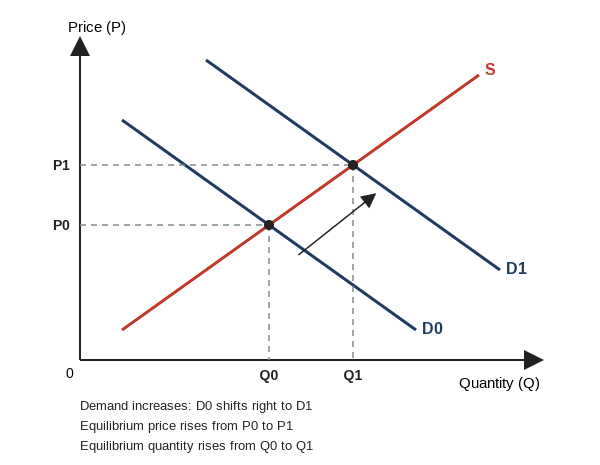
- Label the axes (Price, Quantity), every curve (D, S, D1, S1) and the equilibrium points (P0, Q0 → P1, Q1).
- Show the direction of a shift with an arrow.
- Refer to the diagram in your writing: “As shown, the supply curve shifts left from S to S1…”
Common mistakes
- Explaining when the question says “identify”, which wastes time.
- Giving a one-sided answer to a “discuss” question.
- Confusing a movement along a curve with a shift of the curve.
- Writing a list of points with no development in an “analyse” question.
- Leaving out the unit in a calculation.
Practise next
- Exemplar questions with model answers on every IGCSE Economics notes page.
- The Exam Calculations Toolkit quiz for calculation practice.
- The Definitions Bank and Diagrams Bank for 2-mark and diagram questions.
- Free Section 1 multiple-choice quizzes for Paper 1.
Independent resource by Sanjay Rajawat; not endorsed by Cambridge International Education.