4.6.1 Definition of inflation, deflation and disinflation
Definition: Inflation is a persistent (sustained) rise in the general price level of goods and services over time, causing a fall in the purchasing power of money. It is the rate of change of the price level, not the level itself.
Definition: Deflation is a persistent fall in the general price level (negative inflation rate).
Definition: Disinflation is a fall in the rate of inflation (e.g. from 6% to 4%); prices are still rising but more slowly.
| Degree | Inflation rate (approx.) | Meaning |
|---|---|---|
| Deflation | Below 0% | General prices falling (Japan 1990s– 2000s) |
| Creeping | 0–3% | Mild, gradual |
| Walking | 3–10% | Noticeable and steady |
| Galloping | 10–100% | Rapid, destabilising (Turkey) |
| Hyperinflation | 100%+ | Money rapidly loses value (Argentina, Zimbabwe) |
Good deflation: caused by higher productivity or lower costs (SRAS shifts right); the price level falls while output and employment rise (consumer electronics). Bad deflation: caused by falling AD (consumption, investment or confidence); output and employment fall, and consumers delay spending expecting lower prices (a deflationary spiral; Japan's "lost decade").
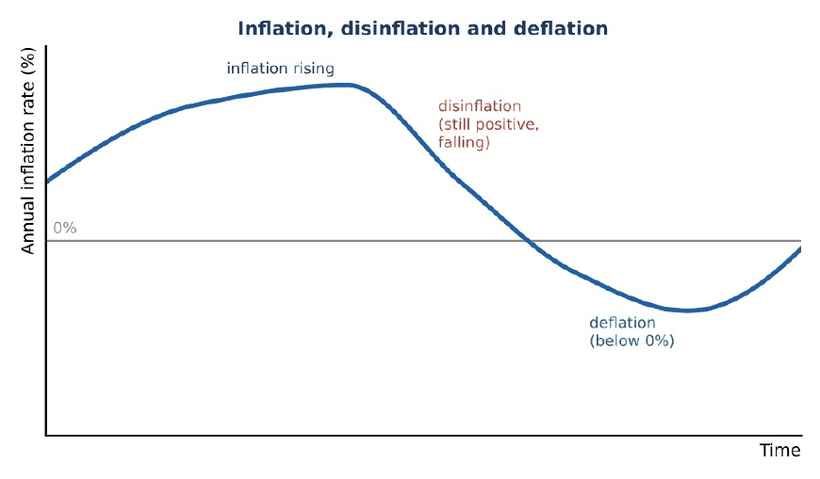
Figure: Inflation, disinflation and deflation
Analysis chain (AO2): Inflation → purchasing power of money falls → real incomes fall if wages do not keep up; disinflation → prices still rise but more slowly; deflation → general price level falls.
🔒 Also in the full notes
- 4.6.2 Measurement of changes in the price level: the CPI
- 4.6.3 Money values (nominal) and real data
- 4.6.4 Causes of inflation: demand-pull and cost-push
- 4.6.5 Consequences of inflation
- Exam practice: 7 practice questions
- 3 exemplar answers with full model answers and mark breakdowns