4.2.1 Circular flow in a closed economy and an open economy
The circular flow shows how income, spending and output move around an economy. Households supply factors of production to firms and receive income (wages, rent, interest, profit); they spend income on firms' output. Output generates income, income is spent on output.
| Closed economy | Open economy | |
|---|---|---|
| Sectors | Households, firms (and government) | Households, firms, government and the rest of the world (international economy) |
| Trade | No exports or imports | Exports (injection) and imports (leakage) |
| Cross-border finance | None | FDI, remittances, foreign investment |
| Realism | A teaching simplification, used to isolate one effect (e.g. "assume a closed economy") | Describes real economies such as India: IT and pharma exports; imports of crude oil, electronics and gold; remittances; FDI |
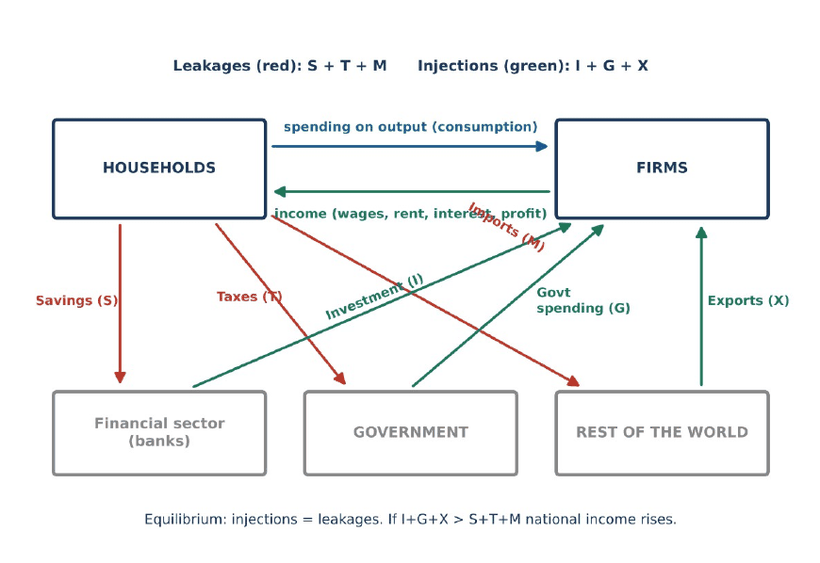
Figure: Circular flow of income
Analysis chain (AO2): Households spend → firms receive revenue → firms pay factor incomes → households receive income → spending again; injections (I, G, X) add to the flow, leakages (S, T, M) remove income from it.
Evaluation (AO3):
- Exam tip (official mark scheme): a closed economy circular flow must include government (G and T), not just households and firms.
🔒 Also in the full notes
- 4.2.2 Injections and leakages (multiplier not required)
- 4.2.3 Equilibrium and disequilibrium
- Exam practice: 5 practice questions
- 2 exemplar answers with full model answers and mark breakdowns