6.1.1 Absolute and comparative advantage
Why countries trade: differences in factor endowments (oil in the Gulf, abundant labour in India); climate and geography (tropical coffee and cocoa, temperate wheat); technology and skills; economies of scale from producing for a global market; greater choice and variety for consumers; increased competition and efficiency.
Definition: Absolute advantage: a country can produce a good using fewer resources (higher output per unit of input) than another country.
Definition: Comparative advantage: a country can produce a good at a lower opportunity cost than another country, even if it has no absolute advantage. Gains from trade arise from comparative advantage, not absolute advantage.
| Output per worker per day | Cloth (m) | Coffee (kg) |
|---|---|---|
| India | 10 | 6 |
| Brazil | 6 | 5 |
- Absolute advantage: India produces more of both goods.
- Opportunity cost of 1 m cloth: India = 6 ÷ 10 = 0.6 kg coffee; Brazil = 5 ÷ 6 = 0.83 kg coffee. India has the comparative advantage in cloth.
- Opportunity cost of 1 kg coffee: India = 10 ÷ 6 = 1.67 m cloth; Brazil = 6 ÷ 5 = 1.2 m cloth. Brazil has the comparative advantage in coffee.
- Conclusion: India specialises in cloth, Brazil in coffee, and both gain by trading.
Example: Country A makes 6 units of food or 3 of clothing; Country B makes 1 food or 2 clothing. A has an absolute advantage in both. Opportunity cost of 1 clothing: A = 2 food, B = 0.5 food. B has the comparative advantage in clothing and A in food. They specialise and trade; each gains.
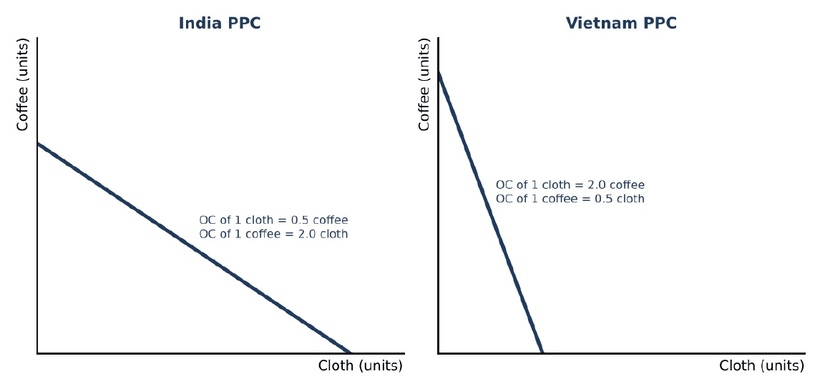
Figure: Comparative advantage: opportunity costs of two countries
Analysis chain (AO2): Each country specialises in the good with the lower opportunity cost → total world output rises → trade at a rate between the two opportunity costs → both countries can consume beyond their PPC.
Evaluation (AO3):
- The theory assumes constant costs, no transport costs and perfect factor mobility, which do not hold in reality.
- Specialisation can leave a country dependent on a narrow range of exports.
🔒 Also in the full notes
- 6.1.2 Benefits of specialisation and free trade (trade liberalisation); the trading possibility curve
- 6.1.3 Exports, imports and the terms of trade
- 6.1.4 Limitations of the theories of absolute and comparative advantage
- Exam practice: 7 practice questions
- 3 exemplar answers with full model answers and mark breakdowns