7.5.1 Short-run production function
- Short run: at least one factor (usually capital) is fixed; output changes by changing variable factors (labour, raw materials).
- Total product (TP): total output. Average product (AP) = TP ÷ L. Marginal product (MP) = ΔTP ÷ ΔL.
- Law of diminishing returns (law of variable proportions): as more units of a variable factor are added to a fixed factor, the marginal product of the variable factor eventually falls.
| Workers | TP | AP | MP |
|---|---|---|---|
| 1 | 10 | 10 | 10 |
| 2 | 24 | 12 | 14 |
| 3 | 42 | 14 | 18 |
| 4 | 56 | 14 | 14 |
| 5 | 65 | 13 | 9 |
| 6 | 70 | 11.7 | 5 |
| 7 | 70 | 10 | 0 |
MP rises at first (specialisation, better use of the fixed capital) and then falls as each extra worker has less capital to work with (diminishing returns set in after the 3rd worker). MP cuts AP at the maximum of AP: when MP > AP, AP rises; when MP < AP, AP falls.
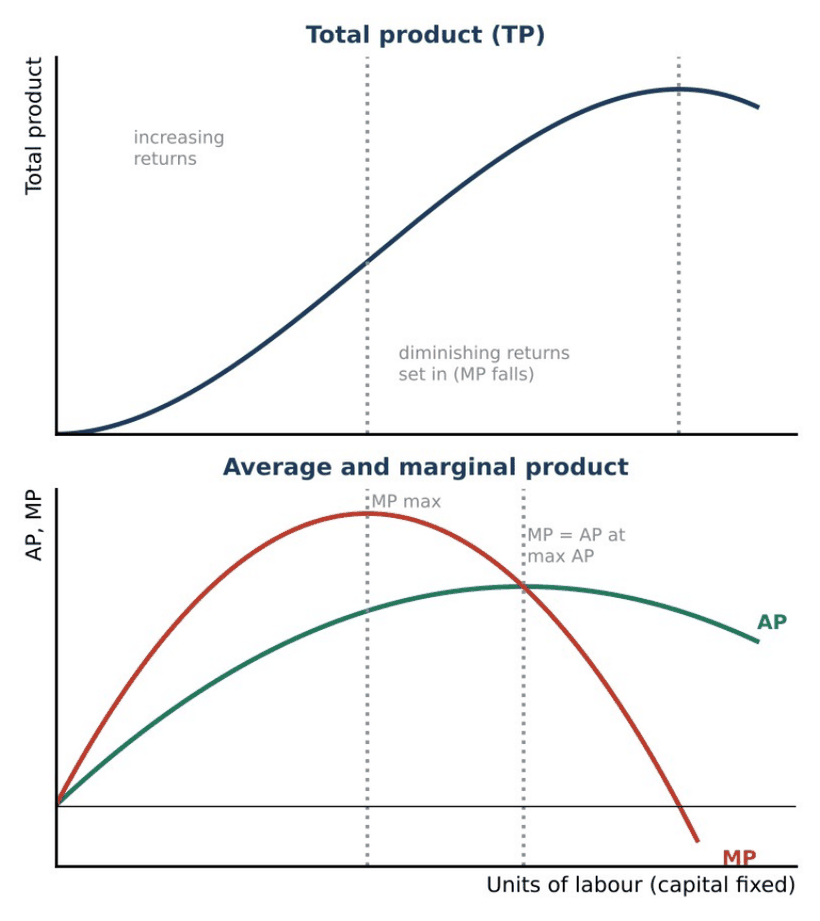
Figure: Total, average and marginal product
🔒 Also in the full notes
- 7.5.2 Short-run cost function
- 7.5.3 Long-run production function
- 7.5.4 Long-run cost function
- 7.5.5 Relationship between economies of scale and decreasing average costs
- 7.5.6 Internal and external economies of scale
- 7.5.7 Internal and external diseconomies of scale
- 7.5.8 Definition and calculation of revenue: TR, AR and MR
- 7.5.9 Definition of normal, subnormal and supernormal profit
- 7.5.10 Calculation of supernormal and subnormal profit
- Exam practice: 3 practice questions
- 4 exemplar 20-mark essays with full model answers, mark breakdowns and common mistakes