Governments intervene to move output towards the socially optimal level where MSB = MSC. Each tool works in a different way, and each has strengths and weaknesses. A strong answer always links the tool to the specific market failure (externality, public good, merit/demerit good, information failure, market power) and judges its effectiveness.
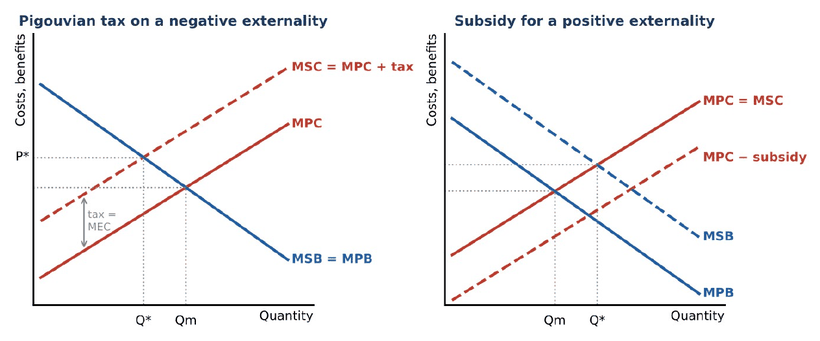
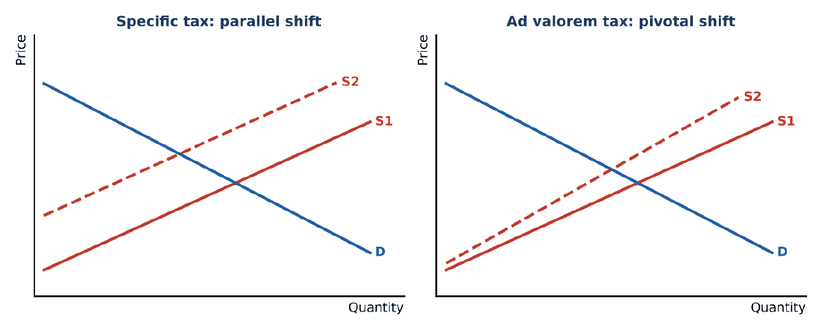
1. Specific and ad valorem indirect taxes. A tax equal to the marginal external cost (a Pigouvian tax) shifts the supply curve up from MPC to MPC + tax = MSC, so the market produces at Q* where MSB = MSC: the externality is internalised ("the polluter pays"). A specific tax is a fixed amount per unit (parallel shift); an ad valorem tax is a percentage of price (pivotal shift: the tax per unit rises with price).
| Strengths of taxes | Weaknesses of taxes |
|---|---|
| Use the price mechanism; consumers and firms still choose | Hard to measure MEC in money, so the "right" tax is uncertain |
| Raise revenue (double dividend: can fund clean-up or cut other taxes) | If demand is inelastic (cigarettes, fuel), quantity falls little |
| Incentive to cut pollution permanently (cleaner technology) | Regressive: take a larger share of poor households' income |
| Flexible: rate can be adjusted | Encourage smuggling, black markets and tax evasion; firms may relocate (carbon leakage) |
2. Subsidies. A subsidy equal to the marginal external benefit lowers producers' costs (supply shifts right) or consumers' prices, raising output from Qm to Q*. Used for merit goods and positive externalities: public transport, renewable energy (rooftop solar subsidies), vaccination, fertiliser, electric vehicles (FAME scheme).
| Strengths of subsidies | Weaknesses of subsidies |
|---|---|
| Increase consumption of merit goods; help poorer consumers | Opportunity cost for government budgets |
| Encourage positive externalities and new technology | Hard to measure MEB; may be captured by producers as higher profit |
| Can lower prices of essentials | Firms may become inefficient and dependent; difficult to remove politically (fertiliser and fuel subsidies) |
3. Price controls. Maximum prices keep essentials affordable (e.g. caps on essential medicines under India's Drug Price Control Order, rent controls) but create shortages, queues and black markets. Minimum prices support producers (MSP) or discourage demerit goods (minimum unit pricing of alcohol in Scotland), but create surpluses that someone must buy or store. Effectiveness depends on setting the price at the right level and on enforcement.
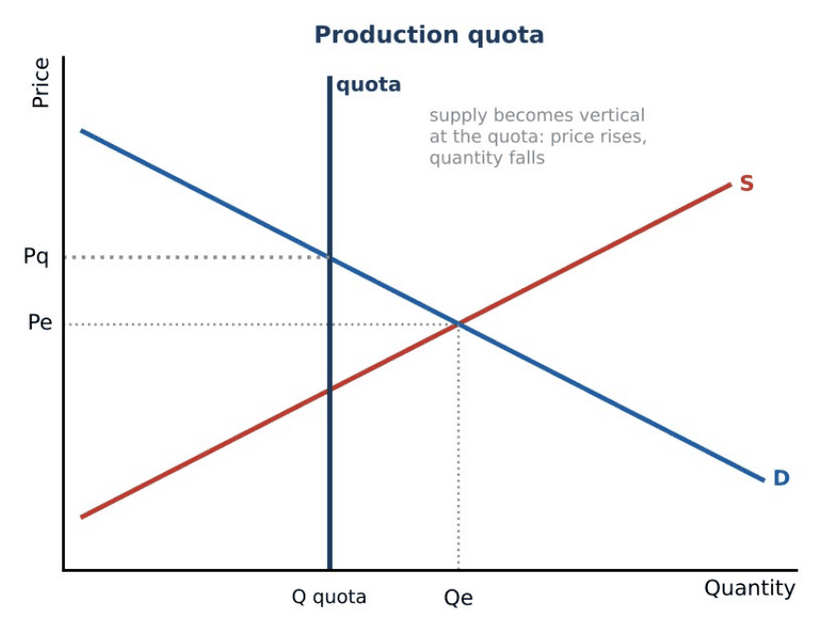
4. Production quotas. A legal limit on the quantity that can be produced (fishing quotas, crude oil output quotas, sugar production limits). Quotas directly cap output, e.g. to protect fish stocks (a common access resource). Supply becomes vertical at the quota, so the price rises. Weaknesses: hard to set the right level and to enforce (illegal fishing); producers receive a higher price (windfall); inefficient firms may keep quotas.
5. Prohibitions and licences. Prohibition bans a good or activity outright (single-use plastics, hard drugs, burning crop stubble, sale of gutka in some states). Useful when harm is very large and MSB is below MSC at every output. Licences limit who can supply (liquor licences, taxi permits, mining licences) and allow conditions to be imposed. Weaknesses: bans create black markets, enforcement costs, loss of tax revenue and loss of consumer freedom; licences can create artificial scarcity and corruption.
6. Regulation and deregulation. Regulation sets legally enforceable rules: emission standards for vehicles (Bharat Stage VI), safety standards, minimum quality rules, compulsory education to age 14 (Right to Education Act), rules on food labelling (FSSAI), and regulation of monopolies (price caps by sector regulators such as TRAI). Deregulation removes rules that restrict competition (opening telecoms and airlines to private firms), reducing barriers to entry and making markets more contestable.
| Regulation: strengths | Regulation: weaknesses |
|---|---|
| Simple, clear and enforceable; certain outcome | Costly to monitor and enforce; fines may be too low |
| Suitable when harm is severe or must be stopped quickly | No incentive to do better than the standard |
| Does not rely on estimating MEC in money | Same rule for all firms, even if costs of reduction differ (inefficient); regulatory capture |
7. Direct provision. The government supplies public goods (defence, street lighting, flood defences) and merit goods (state schools, government hospitals, Ayushman Bharat health cover) free or at low price, funded by taxation. Strengths: solves the free-rider problem; ensures equitable access. Weaknesses: high cost and opportunity cost; may be X-inefficient without a profit motive; excess demand and waiting lists at a zero price; quality may suffer.
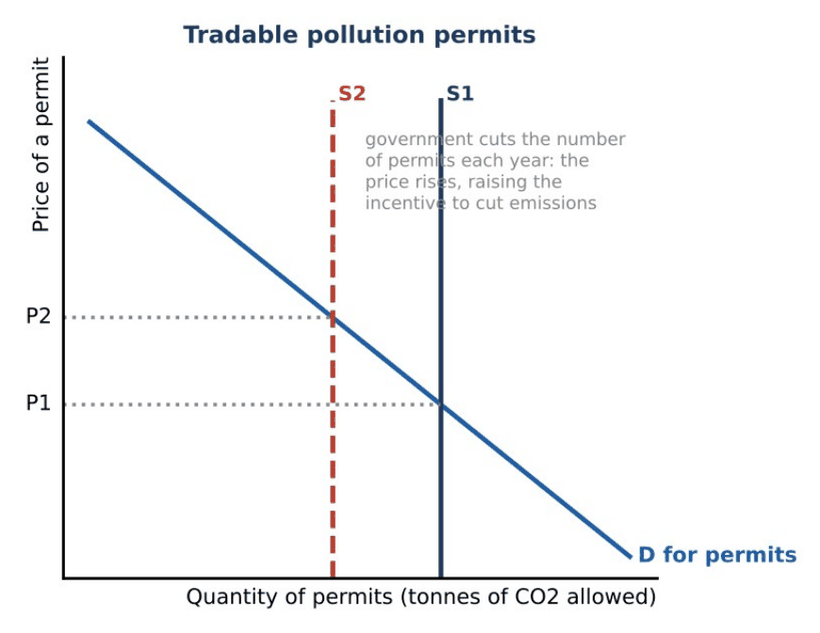
8. Pollution permits (tradable permits / cap and trade). The government sets a cap on total emissions and issues permits; firms must hold a permit for each tonne emitted and can buy and sell them. Firms that can cut pollution cheaply do so and sell their spare permits; firms with high abatement costs buy them. The pollution target is reached at the lowest total cost. Cutting the number of permits each year raises the permit price and the incentive to invest in cleaner technology. Examples: EU Emissions Trading System; India's Perform, Achieve and Trade scheme and the Surat particulate-emissions trading market.
| Strengths of permits | Weaknesses of permits |
|---|---|
| Certain level of total pollution (cap) | Price of permits is uncertain and volatile |
| Pollution cut where it is cheapest: efficient | Hard to set the right cap; too many permits issued → price collapses (early EU ETS) |
| Revenue if permits are auctioned; incentive to innovate | Monitoring and enforcement costs; "local hotspots" where buyers keep polluting; firms may relocate |
9. Property rights. Many externalities arise because nobody owns the resource (air, rivers, fish stocks). The Coase theorem argues that if property rights are clearly assigned and bargaining costs are low, the parties can negotiate to the efficient outcome without government (e.g. a factory compensates residents or residents pay the factory to cut pollution). Giving communities rights over forests or fisheries can encourage conservation. Weaknesses: transaction costs are high when many people are affected; hard to assign rights over air; unequal bargaining power; legal costs.
10. Nationalisation and privatisation. Nationalisation transfers private firms into state ownership (e.g. bank nationalisation in India in 1969); it can tackle natural monopoly, secure strategic industries, protect jobs and allow social objectives (cross-subsidising rural services). Privatisation transfers state-owned firms to the private sector (e.g. Air India sold to the Tata group in 2022); it aims to raise efficiency through the profit motive and competition, raise revenue and reduce political interference. Weaknesses: nationalised firms may be X-inefficient and loss-making; privatised firms may become private monopolies that need regulation and may cut unprofitable but socially valuable services.
11. Provision of information. Tackles information failure: health warnings, food labelling, energy-efficiency star ratings (BEE star labels), information on investment products, school performance tables. Cheap and keeps consumer choice, but slow, may be ignored and does not fix externalities alone.
12. Behavioural insights and nudge theory. Nudges change the way choices are presented ("choice architecture") to make better choices easier, without banning options or changing financial incentives significantly. Examples: default options (automatic enrolment in pension schemes, opt-out organ donation), social norms messages ("most people in your area pay tax on time"), placing healthy food at eye level, simplifying forms, reminders by SMS, and making the desired choice the easiest one (Swachh Bharat messaging on toilet use). Strengths: low cost; preserve freedom of choice; based on how people
actually behave (bounded rationality, inertia, present bias). Weaknesses: effects can be small or short-lived; can be seen as manipulative; do not work for strongly held habits or addiction; hard to scale and evaluate.
Analysis chain (AO2): Choose a policy → show how it changes the private costs or benefits, or the information, faced by decision-makers → show the effect on output/consumption (shift of MPC or MPB) → output moves from Qm towards Q* → welfare loss falls → allocative efficiency improves.
- Information problem: most tools need an estimate of MEC/MEB; if it is wrong, the policy over- or under-corrects (government failure).
- Elasticity: price-based tools (taxes, subsidies) work poorly when demand is inelastic.
- Combination: real policy uses a mix (e.g. tobacco: taxes + bans on advertising + warnings + age limits).
- Time: regulation works quickly; taxes and information change behaviour gradually.
- Cost and enforcement: cheap policies (nudges, information) may be less effective; strong policies (bans) need costly enforcement.
- 8.1.2 Government failure in microeconomic intervention
- Exam practice: 5 practice questions
- 5 exemplar 20-mark essays with full model answers, mark breakdowns and common mistakes