10.3.1 Effectiveness of fiscal policy
Fiscal policy uses government spending and taxation to influence AD and the supply side. Expansionary fiscal policy (higher G, lower taxes) raises AD to reduce unemployment and increase growth; contractionary fiscal policy reduces AD to control inflation and the current account deficit. Fiscal policy can also redistribute income (progressive taxes, transfers) and promote supply-side improvements (capital spending, tax incentives).
| Strengths of fiscal policy | Limitations of fiscal policy |
|---|---|
| Directly affects AD; powerful in a deep recession, when interest rates are already very low | Time lags: recognition, decision (budget timetable) and implementation (projects take years) |
| Multiplier effect can magnify the impact | Size of the multiplier uncertain; may be small in open economies |
| Can be targeted at regions, sectors or income groups | Crowding out: government borrowing may raise interest rates and reduce private investment |
| Automatic stabilisers work without decisions | Budget deficits raise national debt; future taxes higher; may lose credibility with investors (higher bond yields) |
| Capital spending raises long-run potential output | Political pressures: easy to raise spending, hard to cut; election cycles |
| Redistributes income | Disincentive effects of high taxes; Ricardian equivalence (households save tax cuts expecting future tax rises) |
Definition: The Laffer curve shows the relationship between tax rates and tax revenue. At a 0% rate revenue is zero; at 100% nobody has an incentive to earn taxable income, so revenue is also (near) zero. Revenue is maximised at some intermediate rate (t*). Above t*, cutting tax rates increases revenue because of stronger incentives to work, invest and declare income (less avoidance and evasion).
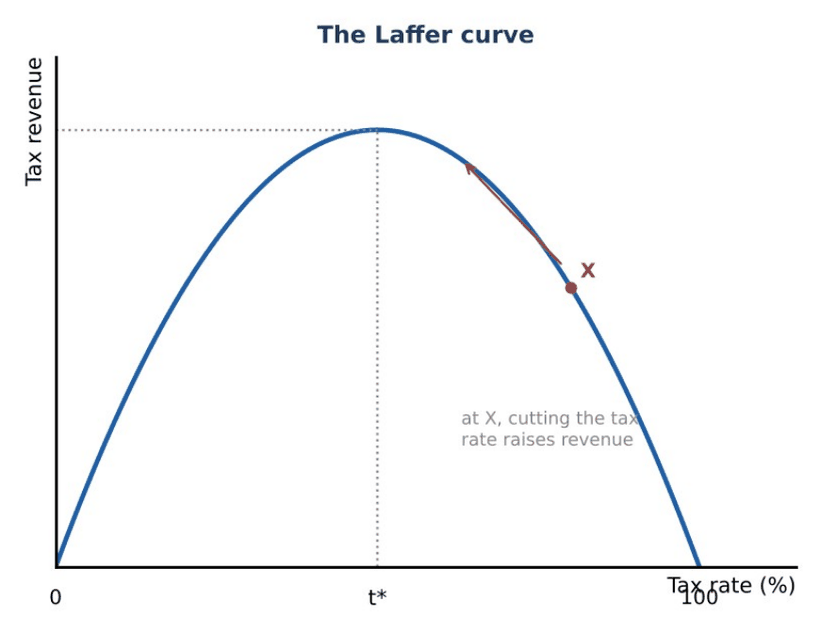
Figure: The Laffer curve
Evaluation (AO3):
- The Laffer curve is used to justify supply-side tax cuts, but nobody knows where t* is; most evidence suggests that, for most taxes, economies are to the left of the peak, so tax cuts reduce revenue.
- The curve may apply more to very high marginal rates, or to taxes that are easy to avoid (e.g. corporate tax and profit shifting); India's 2019 corporate tax cut aimed partly to improve compliance and attract investment.
🔒 Also in the full notes
- 10.3.2 Effectiveness of monetary policy
- 10.3.3 Effectiveness of supply-side policy
- 10.3.4 Effectiveness of other policies: exchange rate policy and trade policy
- 10.3.5 Conflicts between policy objectives
- 10.3.6 Government failure in macroeconomic policy
- Exam practice: 6 practice questions
- 5 exemplar 20-mark essays with full model answers, mark breakdowns and common mistakes