Perspectives explain why people looking at the same environmental issue reach different decisions. This sub-topic underpins every other topic: in Paper 1 and Paper 2 you will often be asked how different perspectives or value systems lead to different responses. It is assessed at both SL and HL; HL students later develop it through the environmental ethics lens (HL.c).
Two people can look at the same forest and see different things: a timber company may see a store of valuable wood, a local community may see firewood, food and a sacred grove, and a conservation biologist may see a habitat for endangered species. None of them is simply "right" or "wrong": each perspective highlights some features of the situation and hides others.
- Assumptions are ideas accepted as true without proof, for example that technology will always find a solution.
- Values are what a person thinks is important (see 1.1.3).
- Beliefs are convictions about how the world is or should be, which may be religious, political or scientific.
Perspectives are informed by many influences, including culture, science, law, religion, economics, major events and personal experience.
| Influence | How it shapes a perspective on the environment |
|---|---|
| Culture | Traditions such as sacred groves in Meghalaya or Māori kaitiakitanga (guardianship) encourage protection of nature. |
| Science | Evidence such as the Keeling curve of rising carbon dioxide changes how people view fossil fuels. |
| Law | Laws such as India's Wildlife (Protection) Act 1972 set out what society considers acceptable. |
| Religion | Many faiths teach stewardship, care for creation or reverence for living things. |
| Economics | A household that depends on coal mining may value jobs above emissions cuts. |
| Events and experience | Living through a flood or a severe air-pollution episode can change priorities quickly. |
Perspectives are shaped by sociocultural norms (shared expectations in a community), scientific understanding, laws, religion, economic conditions and people's lived experience. A farmer who has lived through repeated droughts may see water very differently from a city resident whose tap never runs dry.
A perspective is a viewpoint; an argument is a reasoned case supported by evidence. Two people can share a perspective (for example, that forests have intrinsic value) but make different arguments about what should be done. In essays, you should identify the perspective behind an argument and then evaluate the argument itself.
Values are held by individuals but are shaped by the communities they belong to: family, faith group, school, nation and online communities. They include, for example, valuing economic security, freedom, justice, tradition, health or the natural world.
Values set priorities: they guide the judgements and choices people make when goals conflict, such as whether to protect a forest or clear it for jobs.
Values can be seen in what people and organisations say (communication), do (actions) and publish (advertising, mission statements and policy). Values that differ create tensions between individuals, communities, businesses and governments.
- A company's advertising may emphasise "sustainable" packaging, showing that it believes customers value the environment.
- A government policy that subsidises electric vehicles shows that it values lower emissions and new industries.
- Protests, petitions and boycotts are actions that express values.
Mining company values profit and jobs → plans an open-pit mine in a forest → Indigenous community values ancestral land and the forest → conflict over land use, legal challenges and protests
A values survey is a questionnaire that measures the attitudes of a sample of people. It can show how different social groups (for example, by age, income, region or education) view environmental issues.
- Surveys often use Likert scales (strongly agree to strongly disagree) so that responses can be counted and compared.
- Results can be presented as bar charts or percentages for each group.
- Limitations: people may give answers they think are acceptable (social desirability bias); question wording can lead respondents; small or unrepresentative samples cannot be generalised.
Worked example: comparing groups in a survey
Students agreeing = 36 out of 200; parents agreeing = 82 out of 200
Students: 36 ÷ 200 × 100 = 18%; parents: 82 ÷ 200 × 100 = 41%
Difference = 41 − 18 = 23 percentage points
A good values survey needs a clear aim, a defined sample (who and how many), neutral questions and a consistent scale such as a Likert scale (strongly agree to strongly disagree). The results can be summarised statistically (for example the percentage agreeing, or the median score) to compare the perspectives of different groups.
People holding the same worldview tend to make similar judgements about environmental issues. Worldviews were once shaped mainly by local communities; today social media exposes people to a much wider range of influences, so worldviews can spread and change faster.
Environmentalists group worldviews into categories (see 1.1.8). These classification models are imperfect: real people often hold a mix of views, and the labels can oversimplify.
An EVS can be modelled as a system (see 1.2): it has inputs, which are processed according to the person's values, and outputs.
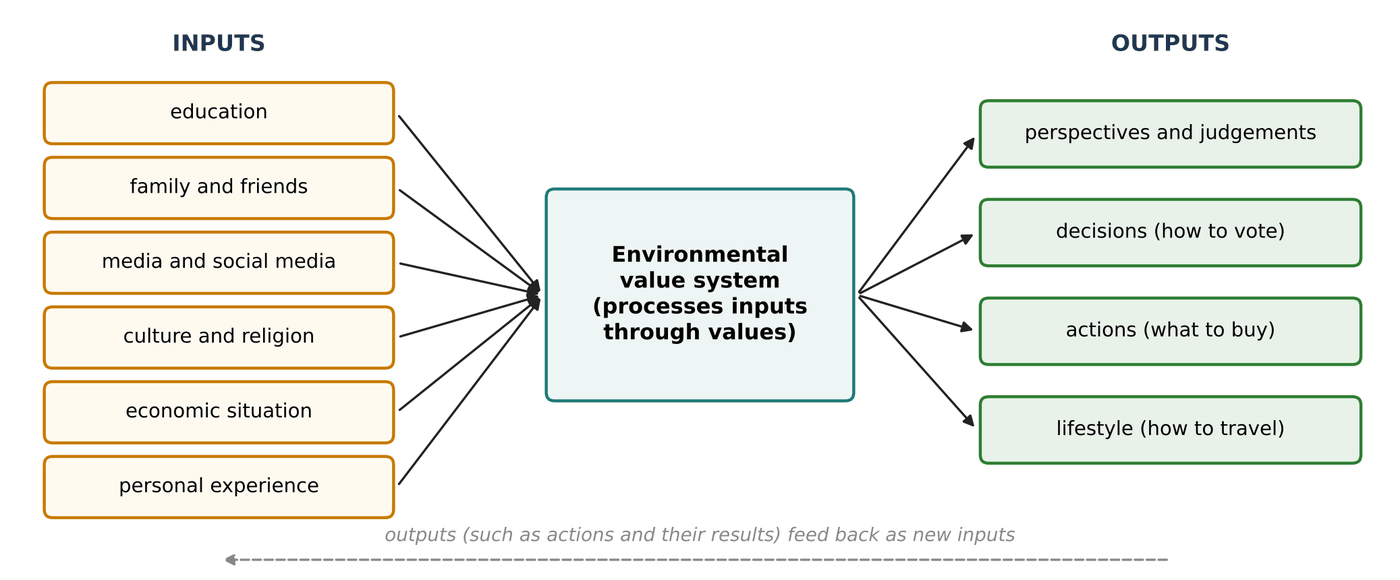
- Inputs: education, family, media, culture, religion, economic situation, political views, personal experience.
- Outputs: perspectives, judgements, decisions and actions, for example how a person votes, what they buy, how they travel.
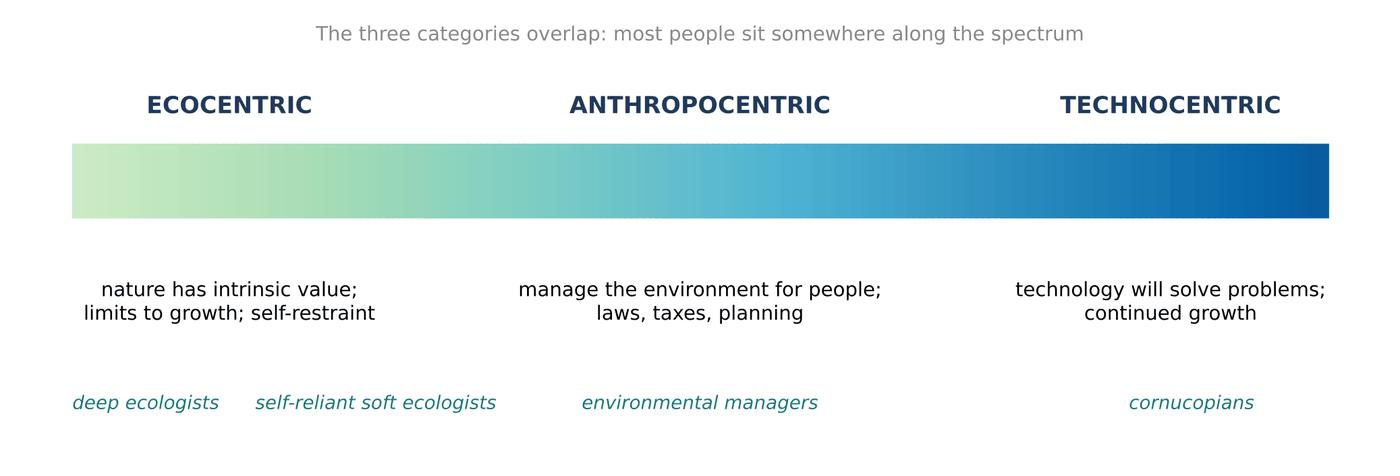
Environmental perspectives are often placed on a spectrum. The three broad categories overlap, and most people sit somewhere between them.
| Perspective | Key ideas | Typical responses to an issue |
|---|---|---|
| Ecocentric (nature-centred) | Nature has value in itself; humans are part of nature; limits to growth; self-restraint; respect for traditional knowledge | Reduce consumption; protect wilderness; local, small-scale solutions; strong regulation |
| Anthropocentric (people-centred) | Humans must manage the environment sustainably for human benefit; stewardship; regulation and planning | Taxes, quotas, laws, international agreements, sustainable management of resources |
| Technocentric (technology-centred) | Human ingenuity and technology can solve environmental problems; continued growth is possible | Geoengineering, genetic modification, carbon capture, desalination, new energy technologies |
Within these categories, finer labels are sometimes used: deep ecologists and self-reliant soft ecologists (ecocentric), environmental managers (anthropocentric) and cornucopians (technocentric).
Issue: falling groundwater in Punjab → ecocentric: switch to less water-hungry crops and restore traditional water harvesting → anthropocentric: meter and price electricity for pumping, set extraction limits → technocentric: drip irrigation, sensors and new drought-tolerant rice varieties
- Labels are useful for analysing debates and predicting how groups will respond.
- They are limited because individuals mix perspectives (a person may support solar technology and also value wilderness), and the categories reflect a mainly Western classification.
The classification is a model: it simplifies a continuous spectrum into categories, so few people fit one category exactly. Ecocentrics attribute intrinsic value to nature (value in itself), whereas anthropocentric and technocentric views mainly value nature for its usefulness to people.
Perspectives and worldviews change over time, both for individuals and for whole societies. Changes can be driven by:
- Campaigns by NGOs and activists that raise awareness, for example campaigns against single-use plastics.
- Social change, such as rising incomes, education and access to information.
- Demographic change, as younger generations, who will live with the consequences of climate change, become a larger share of voters and consumers.
Perspectives also change through government and NGO campaigns, new scientific evidence, disasters, social change and demographic change as younger generations replace older ones. Change over time can be shown with a behaviour-over-time graph, which plots a variable (such as the percentage of people who see climate change as a serious threat) against time and shows the overall pattern rather than exact values.
The modern environmental movement has been shaped by people, events and inventions. You should be able to give one example from each category below and explain its influence.
| Category | Example | Influence |
|---|---|---|
| Activists | Chipko movement, Uttarakhand (1973 onwards), led by village women including Gaura Devi | Hugging trees to stop logging; led to a 15-year ban on green felling in the Himalayan forests of Uttar Pradesh in 1980 and inspired community forest movements worldwide |
| Authors | Rachel Carson, Silent Spring (1962) | Showed how DDT harmed birds and food chains; led to the US ban on DDT for agriculture in 1972 and to the creation of the US Environmental Protection Agency |
| Media | Earthrise photograph from Apollo 8 (1968) | Showed Earth as a small, fragile system; helped launch the first Earth Day (1970) |
| Environmental disasters | Bhopal gas leak, India (1984) | Thousands killed by methyl isocyanate; led to India's Environment (Protection) Act 1986 |
| International agreements | Montreal Protocol (1987) | Phased out ozone-depleting substances; often called the most successful environmental agreement |
| Technological developments | Satellite remote sensing | Made it possible to measure deforestation, ice loss and sea-level rise across the whole planet |
| Scientific discoveries | Discovery of the Antarctic ozone hole (1985) | Gave clear evidence of human impact on the atmosphere and speeded up the Montreal Protocol |
- Aim: compare the environmental value systems of two groups (for example students and adults).
- Method: write 6–10 neutral statements; use a 5-point Likert scale; pilot the survey on 5 people and remove unclear questions; choose a sample of at least 30 per group; record anonymous responses.
- Data processing: calculate the median score for each statement and group; present as a divergent bar chart; a Mann–Whitney U test (or simple comparison of medians) shows whether the groups differ.
- Evaluation: leading questions, social desirability bias (people give the "acceptable" answer) and unrepresentative samples reduce validity.
- Ethics: informed consent, anonymity and the right to withdraw.
- Plot time on the x-axis and the variable on the y-axis; label key events (for example a disaster or campaign) to suggest possible causes, but remember that correlation in time does not prove causation.
Question: Define the term environmental value system. [2]
Question: Outline how the media can influence the environmental value system of an individual. [3]
Question: Distinguish between an ecocentric and a technocentric perspective. [2]
Question: Identify two possible inputs and two possible outputs of an environmental value system. [4]
Question: Explain how one named environmental disaster has influenced the environmental movement. [4]
Question: Outline two limitations of using a values survey to compare the perspectives of different age groups. [4]
Question: Evaluate the usefulness of classifying environmental perspectives as ecocentric, anthropocentric or technocentric. [7]
Question: Suggest two ways in which the design of a values survey could reduce bias. [2]
Question: HL lens (ethics): Using an example, explain how ecocentric and anthropocentric perspectives draw on different ethical frameworks. [4]
Question: To what extent do environmental value systems determine how societies respond to an environmental issue? [9]
An environmental value system acts like a filter: the same information is processed differently, so societies with different EVSs produce different outputs. For example, in response to declining groundwater in Punjab, an anthropocentric response is to limit free electricity for pumping, a technocentric response is to promote drip irrigation and new rice varieties, and an ecocentric response is to return to traditional crops such as millets that need less water.
The Chipko movement shows a society's response being driven by an ecocentric EVS: villagers placed the value of forests for water, fodder and soil above income from logging, and their actions led to a 15-year ban on green felling. Similarly, India's Environment (Protection) Act 1986 followed the Bhopal disaster, showing how an event can shift a whole society's EVS towards stronger regulation.
However, EVSs are not the only factor. Economic constraints may prevent a society from acting on its values: a low-income country may value forests but still allow logging because it needs export income. Political systems also matter, because lobbying by powerful industries can block laws even when most people support them. Responses can also be imposed by international agreements, such as the Montreal Protocol, regardless of national EVSs.
In conclusion, EVSs strongly influence how societies respond, because they determine which problems are seen as important and which solutions are acceptable. However, the response actually adopted also depends on economic resources, political power and international pressure, so EVSs shape responses to a large extent but do not fully determine them.
- Explains what an EVS is and how it filters inputs into outputs (AO1).
- Applies the idea to named, specific examples: Punjab groundwater, Chipko and Bhopal (AO2).
- Considers counter-arguments, namely economic constraints, political power and international agreements (AO3).
- Reaches a balanced, justified conclusion that answers "to what extent" directly (AO3).
- Efficiency: about 251 words, which can be written in about 18 minutes (roughly 2 minutes per mark). Each paragraph makes one developed point, and the conclusion answers the command term directly.
- Defining an EVS as "what someone thinks about the environment". Fix: it is a worldview or paradigm that shapes how issues are perceived and evaluated, with inputs and outputs.
- Treating ecocentric, anthropocentric and technocentric as fixed boxes. Fix: say they form a spectrum and that individuals often hold mixed views.
- Confusing anthropocentric with technocentric. Fix: anthropocentric relies on management, laws and regulation; technocentric relies on technology and growth.
- Naming an example without explaining its influence. Fix: for each example, state what changed as a result, such as a law, a ban or a shift in public opinion.
- Using "perspective" and "argument" as the same thing. Fix: a perspective is a viewpoint; an argument is a reasoned case with evidence.
Data types are shown in brackets: measured data, estimates (modelled or calculated from measurements) and projections (future scenarios) should be interpreted differently. Accessed November 2026.
- UN Environment Programme Ozone Secretariat (1987). The Montreal Protocol on Substances that Deplete the Ozone Layer. https://ozone.unep.org/treaties/montreal-protocol [treaty text]
- Government of India (1972, 1986). Environment (Protection) Act 1986 and Wildlife (Protection) Act 1972 (India Code). https://www.indiacode.nic.in [legislation]
- Carson, R. (1962). Silent Spring. Boston: Houghton Mifflin. [book]
- International Baccalaureate Organization (2024). Diploma Programme Environmental systems and societies guide (first assessment 2026). https://www.ibo.org/programmes/diploma-programme/curriculum/sciences/environmental-systems-and-societies/ [official curriculum]
Independent revision notes by Sanjay Rajawat for the IB Diploma Programme ESS guide (first assessment 2026). Not official IB material and not endorsed by the International Baccalaureate.