This sub-topic introduces the atmosphere as a system: its composition, how unequal heating drives circulation, and how greenhouse gases keep Earth warm. HL students study how the atmosphere changes with altitude, Milankovitch cycles, glacial–interglacial cycles and how life has shaped the atmosphere. Understandings 6.1.5 to 6.1.9 are HL only.
The atmosphere is the layer of gases surrounding Earth, held by gravity. It forms the boundary between Earth and space and supports life by supplying gases for photosynthesis and respiration, absorbing harmful ultraviolet radiation, keeping temperatures suitable through the greenhouse effect, and transporting heat and water around the globe.
| Gas | Approximate share of dry air by volume |
|---|---|
| Nitrogen (N₂) | 78% |
| Oxygen (O₂) | 21% |
| Argon (Ar) | 0.93% |
| Carbon dioxide (CO₂) | 0.04% (about 427 ppm, Mauna Loa annual mean, 2025) |
| Others (neon, helium, methane, ozone, nitrous oxide) | Traces |
Water vapour varies from almost 0% to about 4%.
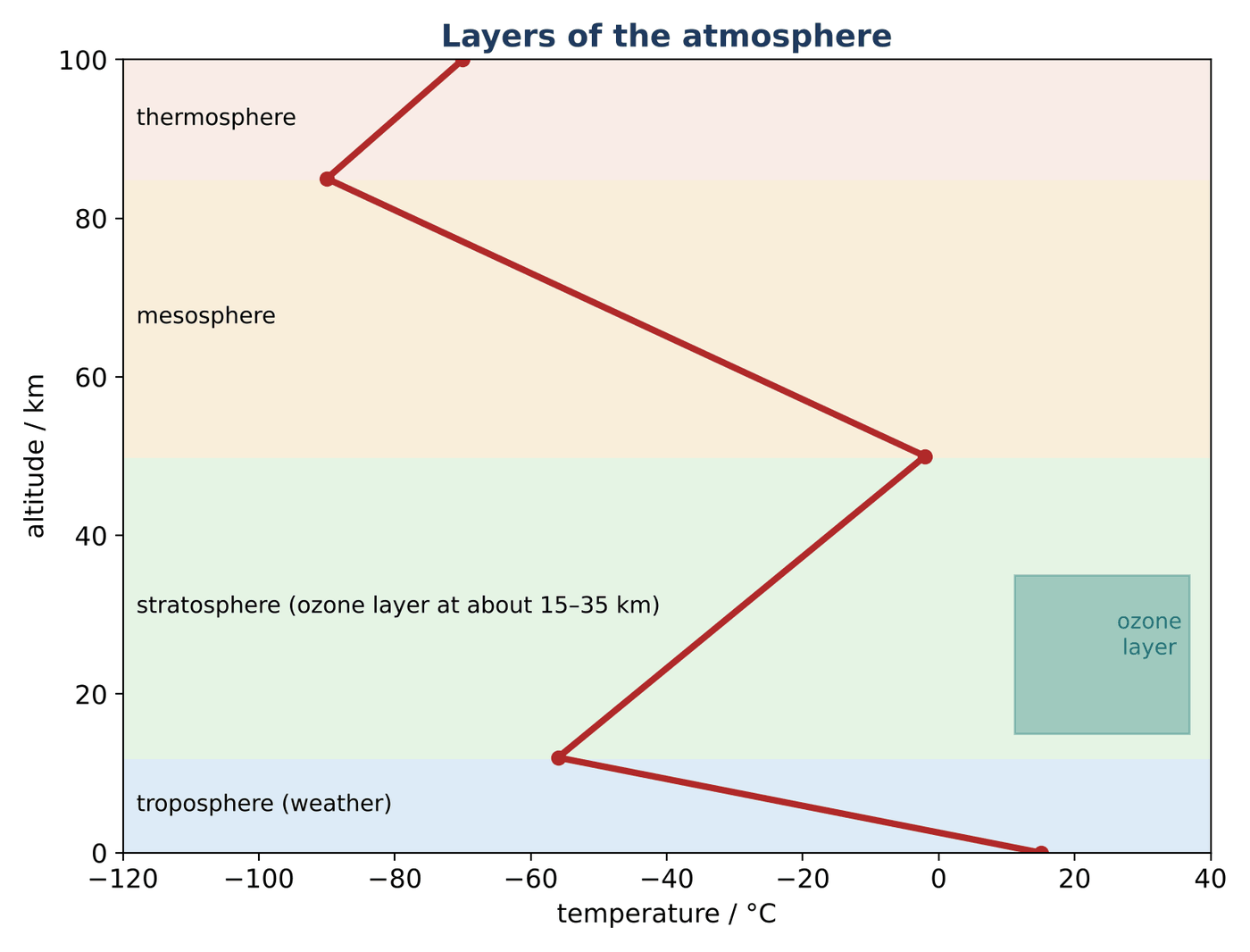
The atmosphere is a mixture of gases that marks the outer limit of the biosphere; winds redistribute heat and moisture through physical processes such as convection.
- 3 more understandings (6.1.2 to 6.1.4) for SL and HL
- 5 HL-only understandings (6.1.5 to 6.1.9)
- Skills and investigations
- Exam practice: 8 practice questions
- 1 exemplar answer with a full model answer and mark breakdown
- Where students commonly lose marks
Independent revision notes by Sanjay Rajawat for the IB Diploma Programme ESS guide (first assessment 2026). Not official IB material and not endorsed by the International Baccalaureate.